

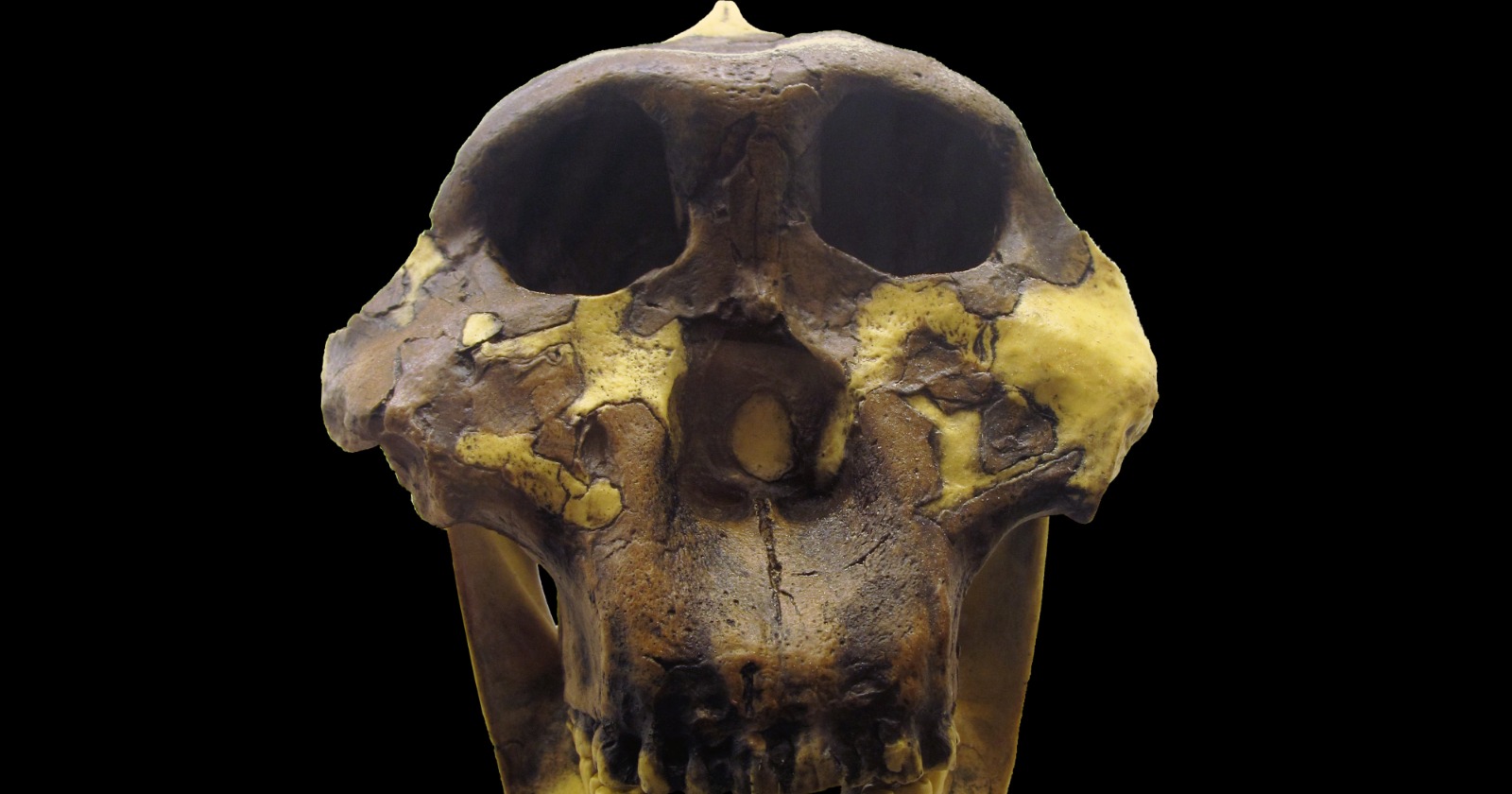
Three genus names do nearly all the work in the human fossil record. Homo covers a stretch generally estimated at about two to three million years, Australopithecus most of what came before, Paranthropus the heavy-jawed lineage that lived alongside both. A paper published on 18 August in the American Journal of Biological Anthropology takes the three in turn and argues that the first is too young to behave like a genus, the second is not a clade at all, and the third, which he calls possibly the strongest of them, is under more challenge than it looks.
Ian Towle, of the Biomedicine Discovery Institute and the Department of Anatomy and Developmental Biology at Monash University in Melbourne, is the paper’s only author. The journal files it as a synthesis. No new fossil is described in it, and its data availability statement records that no datasets were generated or analysed. The paraphyly of Australopithecus is also not his discovery; he writes that it has long been recognised, citing work back to 1993. The remedy is what he is arguing for, and he says up front that similar proposals have been advanced before: stop treating Australopithecus and Paranthropus as separate genera and fold both, along with Kenyanthropus, into Homo.
A group that leaves out some of its own descendants
Most of biology now organises its groups as clades. A clade is an ancestor plus every one of its descendants, with nobody left out. Leave a descendant lineage outside the group and the group becomes paraphyletic, which in clade-based practice is grounds for revising it.
Towle writes that Australopithecus is widely considered non-monophyletic, and that while the specific relationships differ between analyses, the overall pattern does not. One or more Australopithecus species keeps turning up more closely related to Homo or to Paranthropus than to the other Australopithecus species. All recently published phylogenies containing multiple Australopithecus taxa, he writes, recover a paraphyletic configuration, and he cites four of them.
That leaves the field running a grade-based classification while claiming a clade-based one. Australopithecus, in his description, continues to function largely as a non-monophyletic wastebasket grade rather than a well-defined evolutionary clade. Wastebasket is the paper’s own word, and he notes the view was promoted openly before clade-based taxonomies were widely adopted.
Brain size stopped drawing the line
Even without being clades, the three genera might earn their keep by marking real differences in anatomy, diet or behaviour. Towle’s case is that the fossils have eroded those too. Brain size was long the working line between Australopithecus and Homo, and the description of Homo habilis in 1964 already stretched it. Since then, he notes, several samples with brain sizes overlapping those of Australopithecus, or only minimally larger, have been assigned to Homo: Homo floresiensis, some of the Dmanisi specimens, and Homo naledi.
He takes Homo naledi as the sharpest case. The paleoanthropologist David Strait set out four traits in 2013 as the behaviourally important adaptations of Homo: an enlarged brain, the manufacture and use of stone tools, fully committed terrestrial bipedality, and reduced reliance on processing highly resistant foods in the mouth. H. naledi had a small brain and key adaptations for climbing, and Towle writes that it fails to conform in all respects except potentially tool use, which is now recognised in other genera on the human side of the tree and in a growing list of living primates.
The line blurs in the other direction as well. Australopithecus garhi has teeth larger than those of the most megadont Paranthropus species, P. boisei, and is still assigned to Australopithecus on other grounds. The scope of that comparison matters: it is against the most megadont Paranthropus taxon, not against every Paranthropus specimen ever measured.
Paranthropus itself, Towle allows, may be both the most controversial and the strongest of the currently recognised genera on this part of the tree. Many paleoanthropologists, likely most, treat its three species as a clade, though he calls that likely far from settled, with debate continuing over whether the southern and eastern African forms descend independently from different Australopithecus lineages. Growing evidence, some of it from his own earlier work, suggests the two had substantially different diets, neither relying heavily on hard foods. That weakens the functional justification for a separate genus without undermining the possibility that Paranthropus is a clade, a distinction he draws himself.
Among the baboons and mangabeys
The comparative section is where the argument is built. Homo as currently used, Towle contends, is simply too young to behave like a genus: its depth is generally estimated at about two to three million years, while primate genera, measured a different way, as the divergence time of their common ancestor, most often span approximately five to ten million years.
Young genera are unstable for a reason that shows up wherever the genetics have been done properly. Naturally occurring hybridisation has now been documented in all well studied primate groups. Among the African papionins, the baboons and their relatives, Towle traces a tangle: molecular work showed the two mangabey genera to be polyphyletic, one newly discovered mangabey proved closer to baboons and needed a genus of its own, and geladas, baboons and mangabeys have all been recorded hybridising across genus lines. The estimated common ancestor of that group broadly overlaps the window in which Australopithecus, Paranthropus and Homo diversified, on the same continent.
Other cases sit closer to home. The colobine genera Nasalis and Simias share a common ancestor likely within the last 2.5 million years, with gene flow continuing after the split, and the deepest split among living orangutans, nearly 3.5 million years ago, was again followed by substantial gene flow. A recent study found strong evidence for an extinct ghost lineage that diverged from the ancestor of living gorillas around 3.5 million years ago and later interbred with the eastern gorilla lineage.
A genus originating around two to three million years ago, Towle writes, would have had little or no period in which hybridisation was rare.
Four to five million years of Homo
The proposal is to broaden Homo to take in the specimens currently assigned to Australopithecus and Paranthropus, along with Kenyanthropus, the additional genus in most common use today. That would place Homo in a four to five million-year range.
Two of the paper’s own benchmarks pull against each other here. Towle writes that a grouping extending back approximately four to five million years still matches the temporal duration of genera observed in other primates, even if still on the recent side. That sits below the five to ten million years he cites earlier as the usual span. The benchmark it does fit is the set of standardised temporal frameworks proposed for primate taxonomy, which run from around four to eleven million years, with the lower bands at four to six.
Where to start the genus is the part he treats as unusually secure. Australopithecus anamensis is almost always regarded as the sister taxon to all other Australopithecus, plus Paranthropus and Homo and Kenyanthropus, and that grouping, anamensis and everything descended from the same ancestor, is what the expanded genus would name. Describing the analyses themselves he puts it more softly, as what many recent ones recover, but the relative consensus around that node is rare in paleoanthropology, and it is why he anchors there.
He does not go further back. Sahelanthropus, Orrorin and Ardipithecus stay outside, their placement contentious and with little evidence that any of them fall inside this clade, though he flags one recent paper arguing otherwise. Above the genus, he would define the tribe Hominini as the Pan-Homo clade, containing chimpanzees, bonobos and modern humans, and keep the subtribe Hominina for the human side of that split. On that scheme, the animals everyone now calls hominins would be called homininans.
Towle never names Lucy. The consequence follows from the proposal’s scope: Lucy is a specimen of Australopithecus afarensis, and every Australopithecus would take a Homo name.
The cost, in Towle’s own accounting
The main objection is one he raises himself. Expanding the genus loses information. Taxonomy is not only a labelling system, and most researchers would likely agree that Homo and Paranthropus, whatever their imperfections, currently convey something real about two lineages that lived alongside each other and went in markedly different directions. Many, he writes, will see the proposal as chucking the baby out with the bath water, and he grades that criticism as having considerable merit and as making his proposal unlikely to gain momentum.
His answer is a partial one, and he marks it as partial: subgenera or species groups could preserve the distinctions inside a broader Homo, giving forms such as Homo (Paranthropus), the way Macaca and Trachypithecus are handled among living primates. He judges that less satisfactory than distinct genera. To the charge that the scheme merely displaces the problem backwards in time, he answers that genera originating deeper down get a stretch in which reproductive isolation can build, which very young genera never had.
None of this is a finding. It is a taxonomic argument, published open access, whose own author writes that it will likely not prove widely acceptable. His conclusion is narrower than his title: the central argument, he writes, is not that this particular solution is necessarily the best one, but that the current treatment of these genera is increasingly difficult to justify.
The argument now runs in both directions
The idea has a history the paper sets out. Ernst Mayr argued for a more inclusive Homo in 1950. Morris Goodman’s genetic work in 1999 went further and placed Pan inside Homo. John Robinson, in the mid-1960s, proposed collapsing Australopithecus into Homo while keeping Paranthropus separate, an arrangement Towle calls hard to reconcile with modern phylogenies, which almost invariably nest Paranthropus inside the broader Australopithecus-Homo clade.
Live proposals also push the other way. Towle names work by Bernard Wood and Mark Collard that would tighten the definition of Homo and exclude some earlier forms, and work by Ian Tattersall that would recognise more genera, with Tattersall’s most recent suggestion extending the splitting to taxa already inside Homo. Brian Villmoare, cited alongside them, argues the reverse of Tattersall on one point: that grouping humans with material such as the Ledi-Geraru mandible is defensible under strict cladistics.
The minimum Towle asks for is smaller than the reclassification and separable from it: consistency. If the field keeps using groups that are not clades, it should say so explicitly and say why. That request survives whether or not anyone adopts the expanded genus, and both will be settled where the argument has run since the 1960s, which is print.