

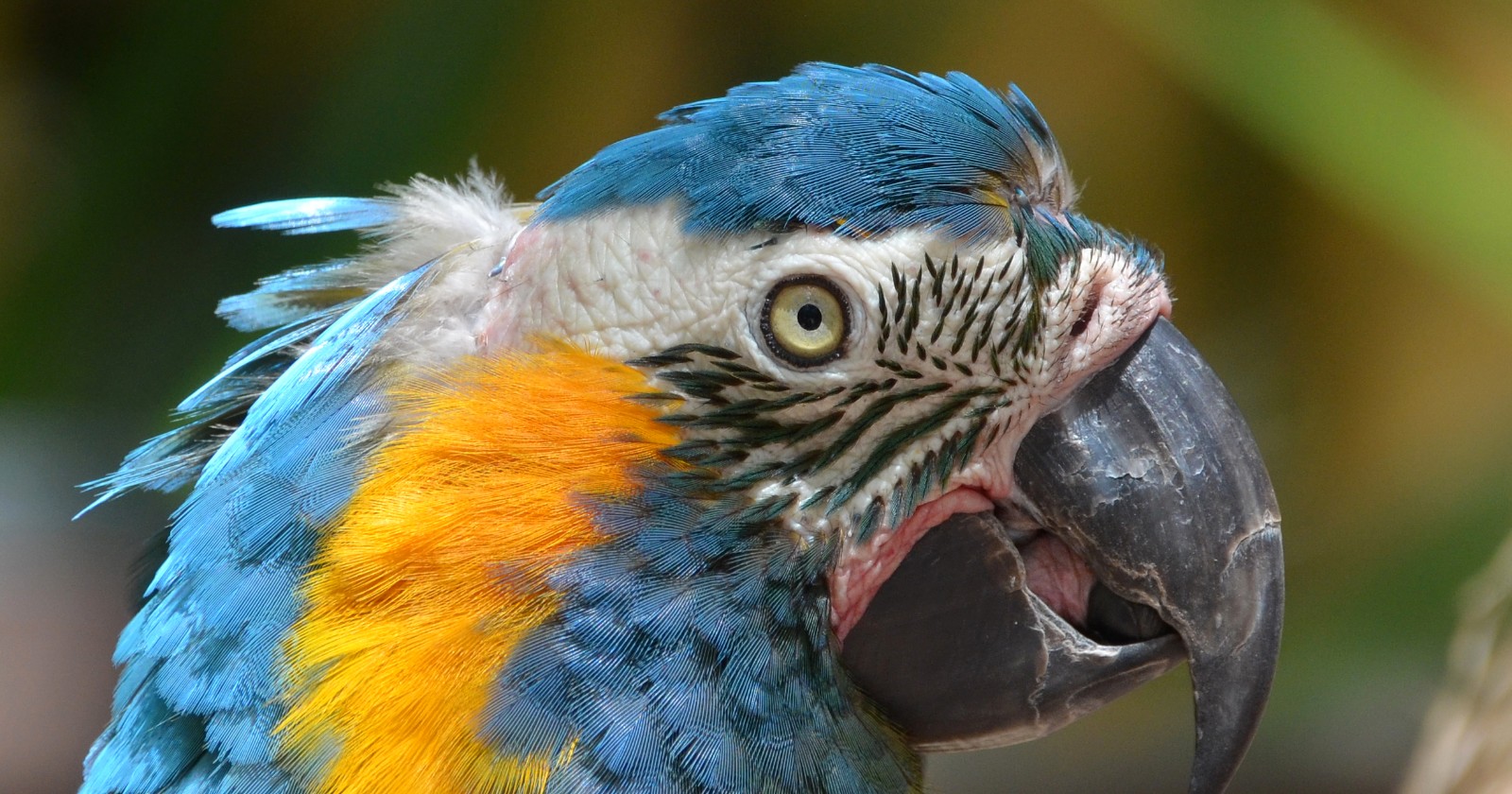
Five blue-throated macaws were put in front of a sliding feeder door with no demonstration of any kind, and all five opened it downward. Averaged across the group, their success rate solving it downward was 0.73, with a standard error of 0.11. Their success rate solving it upward was 0.00. None of them got the door open by sliding the panel up in any of their baseline trials.
That unanimity is the point of the apparatus. A bidirectional control task is deliberately built to be solvable in two opposite directions, so that whichever way an animal goes, it gets fed. The interesting measurement is which of the two equally good solutions a bird picks, and because the same object can be worked either way, the design forecloses the cheap explanations that dog most social-learning experiments: a bird drawn to the right place, or to the right object, would still have to choose a direction.
Ten more macaws then watched a trained conspecific work that door the other way. Eight of them went on to slide it upward themselves, in the result reported on 2 September in Royal Society Open Science. On a second device, built to the same logic, the effect did not reach significance.
Devices built to open either way
The door was adapted from a chimpanzee experiment by Watson and colleagues. A sliding panel of 17 by 8 centimetres sat in a window cut into a vertical frame, with a three-centimetre gap above and below so a bird could get a grip either way, an eight-centimetre knob at its centre, and a transparent box of walnut pieces three centimetres behind.
The panel was opaque on purpose, because a bird that can see the reward, the authors reasoned, “might pay less attention to the relevant actions required to obtain it”. The door was built, in their words, “to make upward and downward pushing of the panel equally challenging”. On our reading that symmetry is load-bearing: if one direction were easier, the experiment would be measuring strength, not influence.
The second device descends from an earlier budgerigar test by Heyes and Saggerson: a cork in a five-centimetre hole in a plexiglass slab, removable by grasping its knob and pulling, or by pressing its face with the beak and pushing it through. The five untutored birds were as consistent on it as they were on the door, with a mean success rate of 0.72 pulling it out, standard error 0.04, and 0.00 pushing it in. All five preferred to pull the plug free, a tendency the authors say “could be linked to the strong tendency in parrot species to ‘pull’ or detach the cork and hold it with their beak or foot”.
All fifteen birds were captive-bred by Loro Parque Fundación and hand-raised, then socialised into groups of five or six in semi-outdoor aviaries at the Max Planck comparative cognition station at Loro Parque on Tenerife. Blue-throated macaws are critically endangered, with BirdLife International’s 2021 Red List assessment putting the wild population at 208 to 303 mature individuals. The paper gives no population figure itself, and that scarcity shapes what the study could and could not test.
Then the direction flipped
Two of the five untutored birds, Lady and Sherlock, were retrained to do the opposite of what they had preferred, and became the demonstrators. Ten macaws, five adults and five subadults, watched one of them work each device the non-preferred way, twice before each of their own attempts.
Eight of the ten went on to open the door upward. Against a control group in which no bird ever did, that is a two-sided Fisher’s exact test at p = 0.007. The test group’s mean success rate upward was 0.71, standard error 0.12, and downward 0.16, standard error 0.11, the near-inverse of the untutored birds, though not a clean one: the test group still solved it downward on about a sixth of their trials.
They also matched something the task did not require. Where the controls used the gap above the panel to move it down, the test birds grasped the knob with their beaks as the demonstrator had, which the paper describes as “matching the directionality of the movement as well as the use of relevant stimulus on the device”. They stop short of reading it as evidence for imitation.
In the paper’s per-bird table, two individuals stand out. Iron-man, a one-year-old male, and Pickle, a male of six months and the youngest bird in the study, each solved all 24 of their door trials, and each did it upward every time. Two test birds went the other way: Marvel, aged three, and Thor, aged thirteen, went down on every door trial they solved, like the controls.
One number here should be handled at arm’s length. The generalised mixed model fitted to the door data returned a coefficient of 133.97 with a standard error of 7.47, which the paper reports as confirming a strong group effect. Read as an effect size it is not usable, because a coefficient that large against a cell whose count is zero is the signature of statistical separation rather than a measurement. The same pathology sits in two further coefficients the paper reports as ordinary nulls, and its own figure captions concede that the “model-based confidence intervals were extremely wide owing to limited sample size and high variability”. The Fisher test on eight against zero carries the result without the artefact.
On the second device, the line blurred
On the cork, the group difference disappeared into the noise. Three of the ten test birds pushed it inward in more than 60 per cent of their trials. Five pulled it out consistently, like the untutored controls. Two split their behaviour between the two actions and were scored as mixed. The test group’s mean success rate pushing was 0.38, standard error 0.10, and pulling 0.52, standard error 0.11, so the behaviour was there and pointing the right way, but the comparison did not reach significance, at p = 0.201.
The authors offer two readings of the birds that pulled, and hedge both. The birds that pulled “could have” learned from the demonstrator that the cork detaches at all, which the paper calls social affordance learning; or they “could have” learned that alone, driven by the natural tendency to pull that the whole control group displayed. The control data do lean one way: with all five untutored birds pulling unprompted, the simpler account needs no demonstrator at all. They point to budgerigars studied by Galef and colleagues, which used a demonstrated pushing technique two or three times before reverting to pulling a cover off a feeding cup. Two of the macaws split their trials between the two actions, which is at least consistent with that pattern.
The paper’s discussion then stretches the plural. Its conclusion, it says, is implied by “the significant effects of conspecific observation on matching the directionality in the bidirectional tasks (‘door’ and ‘plug’ device)”, naming both devices, where the results give p = 0.201 for the second one. The sentence after it does concede the split, separating “the majority (in the ‘door’ device)” from “half of the subjects (in the ‘plug’ device)”. The word left standing across both is significant.
The abstract also explains this failure by saying it happened “because the subadults were less likely to copy the demonstrated action than the adults”. That age effect was measured, in a model restricted to the test group, and it is real at p = 0.045. It is also the reverse of what the authors expected, their stated prior being that “young individuals may be more prone to social learning of demonstrated actions than adults”. What was never modelled is the “because”: the group-by-age model that would test whether the subadults’ reluctance explains the null collapsed into “partial to complete separation and numerical instability”, and “we, therefore, dropped the age and interaction variables”.
A second abstract claim runs the same way. It says the test birds and subadults “approached and solved the tasks significantly faster”, which holds in three of the eight group-and-age latency comparisons the paper reports, by our own count from its results section. Every significant group effect is on the cork, at p = 0.004 and below p = 0.001, while on the door those differences come back at p = 0.077 and p = 0.590. The subadults were genuinely quicker to touch the door, at p = 0.047, but the same effect on solving it reaches only p = 0.057, which the paper’s own text calls “although statistically non-significant”.
The control group that was never run
The study’s central limitation is a conservation problem before it is a statistical one. To separate imitation, copying the demonstrator’s bodily action, from emulation, copying the change the demonstrator produced in the object, an experiment needs a ghost control: the door seen moving upward with no bird moving it. That group was never run. “Blue-throated macaws are a critically endangered species whose numbers are limited even in captivity, so it was not possible to test an additional ghost control group.”
So the paper declines to commit to the stronger word, repeatedly and explicitly. A bidirectional task, it says, “can only provide evidence for copying without distinguishing between imitation and emulation skills in the tested animals”. Object movement re-enactment, in which a bird learns the direction the object travelled and not the action that moved it, “is an alternative explanation, which we cannot exclude”. The conclusion the authors sign is that the macaws copied their conspecifics “through either object movement re-enactment or imitation of object-directed, transitive actions in the problem-solving task”.
The spin and the buzzer nobody needed
Both devices carried a pointless extra step. Before opening the door the demonstrator spun once on its perch, and before working the cork it pressed a blue buzzer with its foot. Neither action does anything to the food.
Three of the ten test birds performed one of these in their first three trials. Wanda and Gargamel, both adults, spun. Carrot, a four-year-old, pressed the buzzer with her foot in three trials in the demonstrated order, then pulled the cork out instead of pushing it in, copying the useless half of the sequence and skipping the useful half. No control bird ever spun or foot-pressed the buzzer, which is the authors’ reason for thinking the demonstrations caused it, though the paper records that every bird, controls included, probed the buzzer with its beak early on as ordinary exploration.
They are careful about how much this is worth. The study “provides only a weak indication that overimitation may have occurred”, and they suspect their chosen irrelevant actions were badly picked, since the spin was cued by a hand signal the observing birds were never given. Their claim is narrow and hedged: “to our knowledge, this is the first indication of overimitation in an avian species, a behaviour so far tested only in mammals.”
A bidirectional task is a strong design and a bounded one. It can establish that a bird’s choice of direction came from another bird, and it cannot establish whether what crossed between them was a body’s movement or an object’s, because both leave the same trace in the data. Closing that gap takes a condition in which the door rises with nobody touching it, and the captive population that would supply the birds for it is small enough that the authors say the condition was not possible. What the study puts on the record is a measured case of copying, one condition short of the word its authors would rather use.