

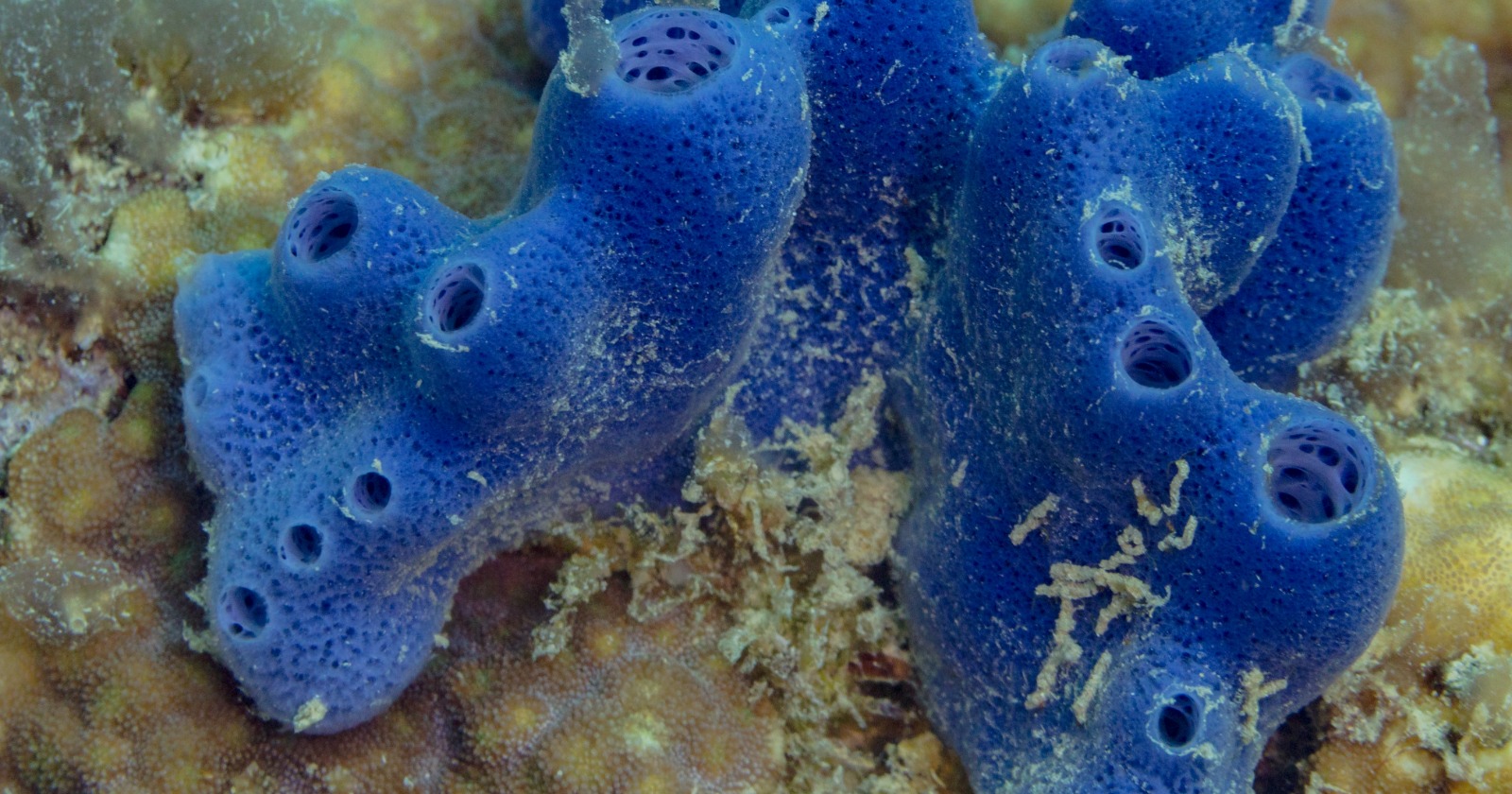
A sponge larva has no brain, no nerves and no neurons, and it still does not wait to be told. Before it meets the alga that will trigger its metamorphosis, while it is still swimming in open water, its genome has already been rearranged into a state that makes the transformation possible. Take away the signal that triggers the rearrangement, a normal sunset, and the larva swims on and will not settle for as long as the light stays on.
Huifang Yuan and colleagues at the University of Queensland report this in a study of the Great Barrier Reef sponge Amphimedon queenslandica, posted as a reviewed preprint in eLife. They profiled gene activity and chromatin accessibility in the same individual larvae across the hours around settlement, and a wave of chromatin reorganisation turns out to come before the cue, ahead of the burst of gene activity that follows it.
The standard description of environmentally induced metamorphosis is a response: the larva encounters its cue, and the machinery starts. These data describe a runner already crouched in the blocks. The starting pistol still matters, and almost everything that makes the start fast happened earlier.
There is a version of that which overshoots, and it is worth heading off before the numbers arrive. Nothing in this study shows a sponge representing a future event or planning ahead. What it shows is a reliable daily signal, the darkening of the water, wired into the physical state of the genome, so that when a second and less predictable signal arrives the response is already loaded. Anticipation is the authors’ own word and a fair one at the level of chromatin. It says nothing about a mind.
The alga only works after the light goes
Amphimedon queenslandica larvae are released from adult sponges in the early afternoon. They become competent to settle on the coralline alga Amphiroa fragilissima five to six hours later, shortly after sunset. Earlier work from the same laboratory showed that under normal conditions, fading light at sunset is necessary for the larvae to respond to the algal cue.
So there are two cues and they have to arrive in that order. Sunset makes the larva capable of settling. The alga then tells it where. The order matters, which is why keeping the lights on is such a clean way to break the system.
The researchers collected adults from the intertidal reef flat of Shark Bay on Heron Island Reef, in the southern Great Barrier Reef, and worked with naturally released larvae at the research station there. Six individuals were sampled at each of six stages: pre-competent larvae, competent larvae, and postlarvae at one, three to four, six to seven, and eleven to twelve hours after settlement. Each animal was processed on its own rather than pooled, and at four of those stages the same six individuals supplied both the gene-expression and the chromatin data.
Chromatin moves before the genes do
Across that time course more than 8,000 genes changed expression. The largest single shift came in the first hour after settlement, where 4,881 genes were differentially expressed and 63 percent of them were turned down rather than up. The repressed set was enriched for larval metabolism.
The chromatin runs on a different clock. Using an assay that maps which stretches of the genome are physically accessible, the team identified 60,716 open regions. Roughly 80 percent of them sit inside protein-coding genes, or within a kilobase of where a gene starts or ends. Of the 3,482 regions whose accessibility changed anywhere across development, nearly a third, 1,146 of them, changed between the pre-competent and the competent larva. That is the window in which comparatively little was happening transcriptionally.
One detail gets lost in summary. At competence, 71.4 percent of those shifting regions became less accessible, not more. The genome is not simply flinging doors open in advance. It is being reorganised, and the reorganisation is mostly subtraction.
What the reorganisation buys is speed later. By the time the larva settles, 62 percent of the genes that change expression in the first hour, 3,032 of them, already sit next to a region that was accessible back when the larva was still swimming. Those regions were open before the alga arrived. Chromatin still moved after settlement, with 1,555 regions changing accessibility in the first hour and most of them opening, but for most of the genes that changed expression in that hour a nearby region was already accessible.
The transcription factors are extreme in their own way. Of 127 that change across the period, 52 are expressed at levels higher than at least 95 percent of all expressed genes. That is a concentration the authors say they cannot find a precedent for in an animal developmental transition.
Among the transcription factors that rise at competence, the circadian regulator CLOCK shows the most pronounced increase. It is also enriched in the larval epithelial cell types that express light-detecting cryptochromes, which the authors read as consistent with a role in responding to the fading light.
That last step is where the evidence thins, and the paper concedes as much. Functional dissection of individual regulators, it says, is currently unfeasible in this system. CLOCK’s role therefore rests on the ordering of events, on motif enrichment, and on what happens when the light is left on, rather than on switching CLOCK off and watching the priming fail. The motif work is deliberately coarse for a related reason. Sponges and bilaterians diverged 700 million years ago, so the team matched binding motifs to transcription factor classes and families instead of to individual proteins. Reading bilaterian annotations onto a sponge genome would have manufactured precision the data cannot carry.
The larvae that never got a sunset
The test of all this was to withhold the sunset. More than 50 freshly released larvae were split between two beakers, one under natural light and one under constant light, and eight from each were sampled at sunset.
The constant-light larvae moved into a state the researchers had not seen before, rather than holding in the pre-competent condition they started from. Relative to normal larvae, 779 genes were up and 879 were down, and metabolic pathways were running that swimming larvae do not normally use.
Transcription factors were flattened almost across the board: 45 significantly down, exactly one up. CLOCK was among the casualties, along with HIF, TbxB, FoxN2/3, ATF4/5 and Glass. And 88 percent of the chromatin regions that are open under natural light were closed in the constant-light animals. Of those closed regions, 24 percent carried the binding motifs associated with CLOCK’s family, which is the thread the authors use to tie the light signal to the priming.
Stress is the obvious alternative explanation, and the data argue against it. The same laboratory has previously shown that larvae held under constant light swim normally and settle promptly once moved into darkness. No stress pathways were enriched in the constant-light animals here either. Whatever the light is doing, it is switching a program.
The paper carrying all of this is an eLife reviewed preprint, version one, posted in May 2026. The authors have since posted revised versions of the manuscript on bioRxiv, most recently on 5 September 2026, which eLife has not yet assessed; every figure here comes from the version eLife reviewed. eLife’s own assessment calls the evidence compelling and the advance fundamental, which in that journal’s vocabulary is high praise, and the three public reviewers are broadly enthusiastic. Two of the three fault the presentation. One says the findings are compressed into four multi-panel figures with succinct legends, so that it is not always straightforward to connect the conclusions in the text to the figures, and a second says the paper often reports its data in a difficult-to-follow way. The remaining reviewer asks the sharper question: not every pre-emptively opened region can be tied to a gene that later changes, and whether that association is statistically significant at all is left open.
Which is a fair place to leave the mechanism. The chromatin changes, it changes at sunset, and it changes before the transcription does. That much is counted. That CLOCK is the thing doing the priming is a model, and a well-supported one, and still a model.
What the sponge suggests is that the trick of getting ready in advance does not need nerves. The daily rhythm of light on a reef flat is one of the few things an animal drifting in open water can count on. This one has folded that rhythm into the physical state of its own genome, so that a body plan can be taken apart and rebuilt in the hours after it finally touches down on the right piece of algae.