

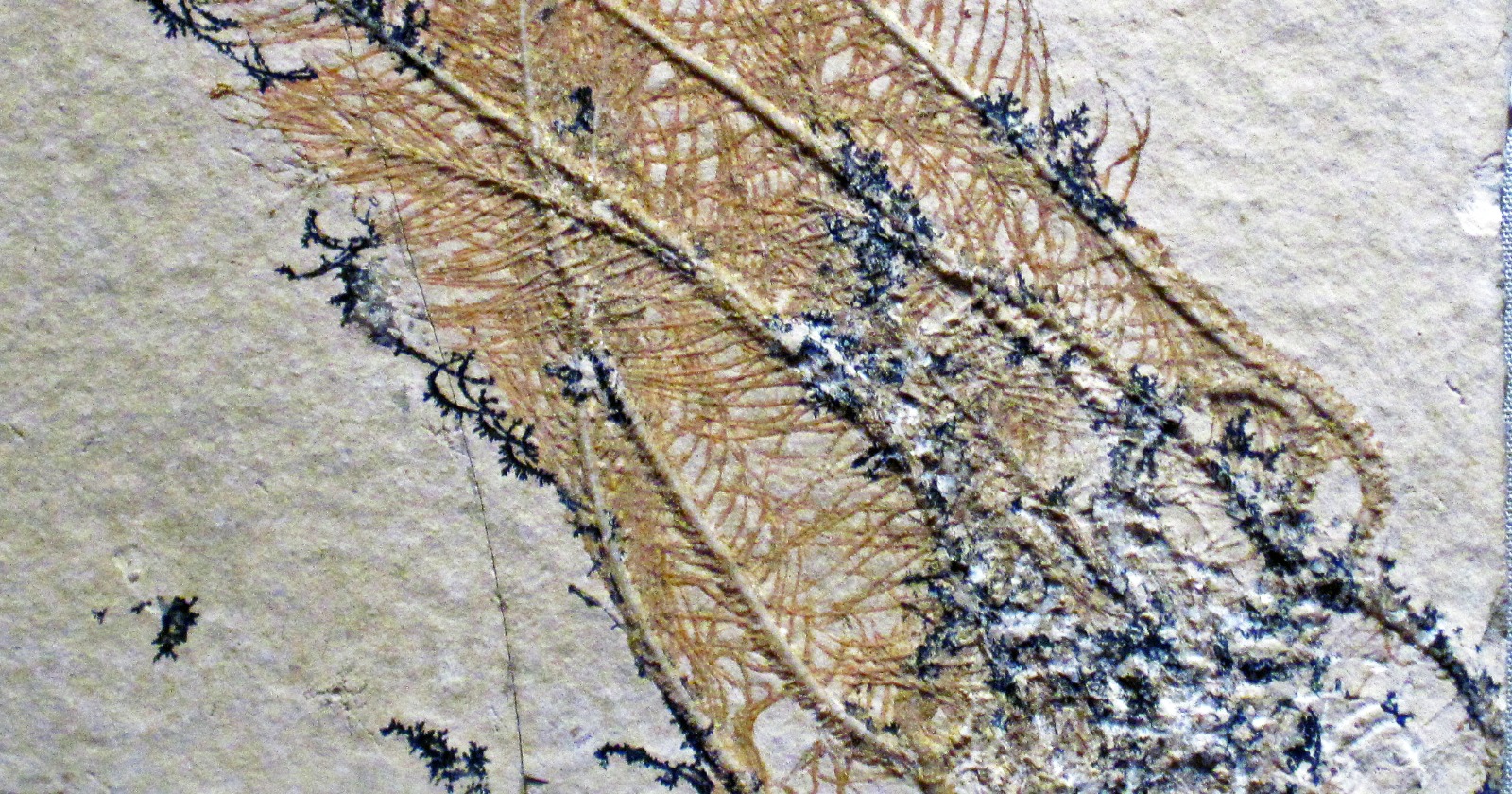
Only one crinoid fossil had ever been found with a tube foot on it. Across a record that runs 485 million years, exactly one specimen had been described as keeping any trace of the small hydraulic structures the animals use to catch their food, and it came from the Lower Devonian of Germany. Two small fossils from a quarry northeast of Quebec City have now supplied the second, and at roughly 452 million years old they are the oldest tube feet known from any crinoid.
The specimens are two individuals of Dendrocrinus simcoensis, both small and both crushed, sitting next to each other on a single slab alongside three partial solute echinoderms. Selina Cole, David Wright, William Ausich and Mario Cournoyer describe them in Royal Society Open Science, where they report the oldest evidence for tube feet in the crinoid fossil record. The slab came from the Saint-Joachim Quarry, about three kilometres northeast of Beaupre, which exposes the upper Grondines Member of the Neuville Formation. The two crinoids were picked out during a survey of the crinoid holdings at the Musee de paleontologie et de l’evolution in Montreal, where the specimens are housed after being collected, prepared and donated by J. Iellamo.
Tube feet do the catching
A tube foot is an extension of the water vascular system, the hydraulic plumbing that every echinoderm runs on. In a sea lily the tube feet line the food grooves along the arms and do the actual work of feeding. The animal holds its arms out into the current and waits, and particles that drift past are intercepted by the tube feet rather than by the arm itself.
In living crinoids the tube feet occur in groups of three, in an arrangement called podial triplets, described by Byrne and Fontaine. The primary tube foot is the longest of the three and catches the particle. The other two are shorter: one transfers the particle down the food groove, the other compacts it into a bolus. Only the primary tube foot is large enough to expect in a fossil, since the secondary and tertiary ones are usually invisible in a living animal without a microscope.
Because the shape of a tube foot follows the job it does, the dimensions carry ecological information that skeletons do not. For a group with a fossil record this long and this rich, almost nothing was known about the part of the animal that fed it.
The outlines only show under alcohol
The Neuville Formation was laid down on a deep carbonate ramp with little storm disturbance, and the deep-water setting there promoted the preservation of fully articulated echinoderms, with many specimens keeping complete columns, holdfasts and feeding structures. Most are preserved as their original calcite, but many carry partial pyritization, and pyrite is scattered through the surrounding rock as well.
That is what saved the tube feet. The soft tissue was replaced by a thin film of pyrite while the skeleton stayed calcite, and the two materials look different enough under a microscope that the authors judged scanning electron microscopy and X-ray fluorescence unnecessary to tell them apart.
Seeing the tube feet at all takes some doing. Photographed dry under direct light they are essentially indistinguishable from the rock. Under strongly angled light they show up as faintly raised, reflective structures similar in colour and texture to the matrix. Immersed in alcohol, the pyrite gains enough contrast for most of the outlines to resolve, though heavy pyritization blurs some of them anyway, which is why the published images combine dry shots, angled light, alcohol immersion and camera lucida tracings.
The same slab supplied a useful control. Other structures near the arms superficially resemble tube feet, but under alcohol they turn out to be calcite plates rather than pyrite films, and they are larger and squarer, averaging 0.39 millimetres wide and 0.41 long. In one specimen they fall roughly into two columns. Those are ambulacral cover plates, the biserial roof over the food groove, and the fact that the paper can point to both tissue types on one surface is a large part of why the tube foot identification holds.
The measurements against living crinoids
Tube feet average 0.41 millimetres long and 0.15 wide in one specimen and 0.48 by 0.16 in the other, for an overall mean of 0.45 by 0.15. Spacing runs about four per millimetre in both, with each arm plate carrying two pairs. One calyx measures 3.7 millimetres high and 3.3 wide; the other is crushed but of a similar size. The longest complete arm on the slab measures 17.9 millimetres. This is an animal that would sit comfortably on a fingernail.
Taken one at a time, those numbers all have living matches. Feather star tube feet run about 0.45 to 0.9 millimetres, and a deep-sea stalked hyocrinid reaches about two. Spacing in feather stars falls between 4.59 and 9.49 per millimetre by the means the authors calculated from Meyer’s reported values; one non-reef species, Florometra serratissima, sits at four per millimetre on a measurement the authors took themselves from a published photograph, exactly where the fossil sits. The fossil’s length, 0.45 millimetres, matches Himerometra robustipinna, which has the shortest tube feet among the extant species sampled.
What no living crinoid has is both at once. Among reef feather stars, short tube feet come with close spacing and longer ones with wider spacing, and the one widely spaced non-reef species the authors include is intermediate in length rather than short. D. simcoensis is short and widely spaced together, a combination the authors state is not documented in any living crinoid. Their comparison dataset holds 17 extant species, 16 of them with spacing data, assembled from published measurements plus that one photograph.
The other fossil with preserved tube feet sits at the far opposite corner. Codiacrinus schultzei, from the Lower Devonian Hunsruck Slate, preserves three partial tube feet at least seven millimetres long and about 1.4 wide. Their bases are obscured, but spacing works out to roughly 0.3 per millimetre. Two fossils, and between them a range of lengths far wider than the living animals span.
The posture the spacing implies
The fossil is short and widely spaced, and that combination is exactly what stops the ecological analogy resolving cleanly.
Meyer’s 1979 work on reef-dwelling feather stars found that tube foot geometry tracks habitat and posture. Short, closely spaced tube feet go with exposed, high-flow perches and arms held out as a flat filtration fan. Longer, more widely spaced ones go with sheltered, slow, multidirectional water and arms held out in all directions. D. simcoensis reads as one thing on length and the other on spacing, so the model cannot simply be applied.
The authors follow the spacing rather than the length. They note that wide spacing is associated with low-current water in living species, and that the Neuville Formation is interpreted as having been deposited in exactly such a deep-water, low-energy setting. From that they suggest D. simcoensis may have fed with its arms in a multidirectional or conical posture rather than the fan that most modern stalked crinoids use.
Their own hedge is explicit: few studies have linked tube foot form to posture and habitat, the data for both fossil and living species are thin, and further work is needed before the relationship can be relied on. There is a second complication they raise themselves. D. simcoensis is apinnulate, meaning its arms lack the fine side branches that every living crinoid has, so the geometry of its filtration surface is not the geometry the modern comparisons were measured on. Its very small size may also be part of why the tube feet are short.
So the pyrite films, their dimensions and their spacing are things the paper measured. The posture is a reading taken off them through a model built on other animals, and the paper says as much.
A statistical check on the identification
One result does work independent of all that. Using a model John Brower published in 2006, which infers tube foot spacing in fossil crinoids from the arrangement of their ambulacral cover plates, the authors generated expected spacing distributions for the major subclades. Those distributions were built from 16 extant species and 16 fossil ones, 15 of them Brower’s inferred values spanning 2.24 to 13.70 tube feet per millimetre and the sixteenth the directly measured Codiacrinus schultzei. D. simcoensis itself is held out of the distributions and tested against them.
The fossil falls inside the distribution predicted for the Eucladida, the clade it belongs to on skeletal grounds, and, in the paper’s words, significantly outside the distributions for all other crinoid subclades, a comparison its supplementary table runs against the Camerata, the Disparida, the Porocrinoidea and living crinoids. The paper presents that as a relationship between spacing, phylogeny and ecology. It doubles, though the paper does not put it this way, as a check on whether these pyrite films are tube feet at all, since a spurious set of measurements landing inside the right clade and outside the others would be a strange coincidence.
It is a check the fossil passes on figures taken from two crushed animals smaller than a fingernail. Every living crinoid they were measured against has pinnules; these two had none. How much can a filtration-geometry comparison carry when the filters are built differently?