

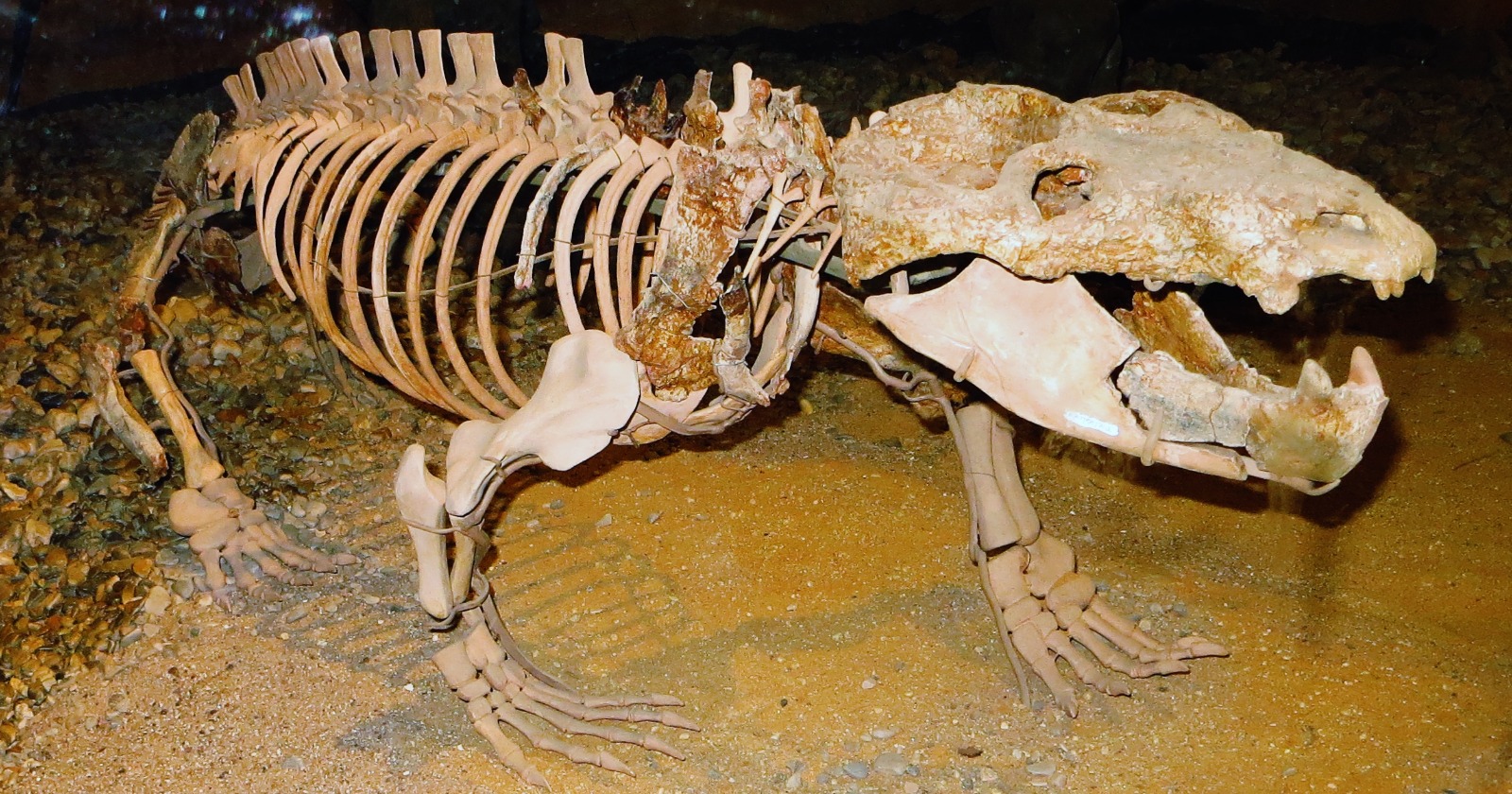
How did the animals that led to mammals reproduce? For as long as the question has been asked there has been no way to test it. No fossil egg has ever been assigned to a non-mammalian synapsid, and the working assumption was that these animals laid soft-shelled eggs that simply did not fossilise, and that live birth arrived much later, near the origin of the therian mammals in the Late Jurassic or Early Cretaceous. That view was still being restated in the specialist literature into the late 2010s.
A paper published on 13 August 2026 in Frontiers in Mammal Science argues that one of those animals gave birth to live young roughly 236 million years ago, and it gets there by measuring a single ring of bone. Leandro Gaetano, María de los Ángeles Miceli Baro, Ignacio Cerda and Adriana Mancuso, working at institutes in Buenos Aires, Río Negro and Mendoza, report a neonatal line in the femur and the ulna of one Chiniquodon theotonicus specimen. From the circumference of the femoral ring, 17.3 millimetres, and of the bone’s outer surface, 35.81 millimetres, they estimate the animal weighed about 1.68 kilograms at birth and about 11.99 kilograms at death, which makes its birth weight 14.04 percent of the maximum weight it ever reached. In the living comparison set assembled for the study, that proportion belongs to placental mammals.
The evidence is one individual of one species. Everything after that is comparison.
A bone that kept its own beginning
The specimen is catalogued as CRILAR-PV109 and came out of the Chañares Formation in north-western Argentina, a Carnian unit near the start of the Late Triassic. It is a partially articulated skeleton with a skull and a good deal of the postcranium. More than fifty Chiniquodon theotonicus specimens are known from that formation, with skulls running from about 50 to about 160 millimetres, and at a basal skull length of 160 millimetres this one sits at the top of the range. Its skull sutures are closed, its teeth are fully erupted and even its wrist and ankle bones are ossified, which is why the team treat it as an adult and probably a fully grown animal.
That matters because of what was found inside it. The team cut thin sections through the midshaft of the right ulna and the left femur. In both, the medullary cavity is unusually narrow and there has been very little secondary remodelling, so the tissue laid down before the animal was born survived reabsorption. Running through that innermost tissue is an abrupt change: the vascular canals are smaller and mostly longitudinal on one side of it and larger and mostly radial on the other, and the fibres in the bone matrix reorganise across the boundary. In living placentals a transition of this kind marks birth. Its exact form differs from species to species and even between two bones of the same species, but in every case it is read as an abrupt acceleration in growth.
Embryonic tissue had not previously been recovered from any of the twenty-five species of non-mammalian cynodont that have been studied histologically. “In cynodonts, embryonic tissues were never observed before, let alone a neonatal line,” Miceli Baro said in the journal’s announcement of the work. Gaetano, in the same announcement, calls the question of how mammalian ancestors reproduced an “inscrutable mystery”.
The equations behind 1.68 kilograms
The ring is a measurement of circumference, and circumference is a standard route to body mass. The team measured the femur at the neonatal line, 17.3 millimetres around, and at the outer surface, 35.81 millimetres, and pushed both through three regression equations published by Anyonge in 1993, built on modern carnivorans in general and on felids and canids specifically. The carnivoran and felid equations agreed closely. The canid equation returned almost double for the newborn, which the authors read as a sign that it does not behave well at very small sizes and should be treated with care.
Averaging the three gives the 1.68 and 11.99 kilogram figures. As a check, the team ran the animal’s skull length through a separate equation linking skull length to body mass in living carnivorans, and got a congruent answer. That second equation, run backwards, predicts a newborn skull of 40 to 50 millimetres, which happens to be the size of the two smallest Chiniquodon theotonicus skulls in collections, specimens MCZ 4296 and PVL 4675. The team now propose those two are perinates.
This is where the estimate is softest. The regression equations were built on modern carnivorans, which are not obvious analogues for a Triassic cynodont, and the authors say no published equation they know of links femoral circumference to body mass in four-legged mammals in a way that accounts for growth stage. Applied to a very small individual, these equations appear to overpredict: the paper notes that the birth weight it calculates, and the birth-to-maximum-weight proportion that follows from it, come out larger than in birds and than in most placentals of similar adult size. The defence offered is that any bias should push the birth and death estimates in the same direction, leaving the ratio between them usable even if the absolute numbers drift.
How 14 percent compares
A birth and a hatching look the same in the tissue. The paper states that whether the mark is a neonatal line or a hatching line cannot be seen in it. The argument for live birth is made by comparison, and the comparison carries most of the work.
The team assembled neonate and adult body masses for 1,869 mammals, 2,619 non-avian reptiles and 782 birds and plotted Chiniquodon against them. Monotremes and marsupials fall out immediately: most are born at less than 0.15 percent of adult body mass. Lepidosaurs and crocodiles heavier than 10 kilograms as adults produce hatchlings that do not exceed 0.62 percent of the female’s weight. Placental mammals with adults above 10 kilograms can deliver young amounting to more than 22 percent of adult body mass. Chiniquodon theotonicus, which the paper puts between 10 and 20 percent, sits in the placental range, and above every other group in the comparison at that adult size. One caution about that ranking: the Chiniquodon figure is the newborn’s mass against the animal’s own maximum-reached weight, while the comparisons above it are against adult or maternal mass.
The paper’s bird percentage is printed in a form that cannot be right. One sentence says birds with adults above 10 kilograms produce hatchlings heavier than those of lepidosaurs and crocodiles and comparable to some placentals; the next puts those same hatchlings at 0.002 to 0.024 percent of adult mass, against the 0.62 percent the paper gives lepidosaurs and crocodiles. Both cannot hold. The journal’s newsroom item puts the bird comparison at roughly 1.3 to 4.5 percent, working from hatchlings of 110 to 357 grams against an 8-kilogram adult; restoring a factor of 100 to the paper’s own range gives 0.2 to 2.4 percent, so the two versions cannot be reconciled by a single misplaced decimal. Every reading places Chiniquodon above birds, and the abstract states the comparison without a number: its birth mass is “notably higher than the one registered for monotremes, marsupials, lepidosaurs, crocodiles, and birds.”
Two statistical tests were run on the same data, a discriminant analysis and a K-nearest-neighbours classification with the parameter varied from 1 to 1400. In every run the fossil grouped with placentals, and with high probability.
Three other extinct animals were put through the same machinery, and in none of them does the paper reach a conclusion about reproductive mode. Ophiacodon retroversus, an early synapsid whose growth mark was originally read as a hatching line, lands between 2.62 and 7.76 percent and gets classified alternately as a reptile, a bird or a placental. That estimate needed two substitutions: the humerus in place of the femur, and two different specimens for the two ends of the ratio. Lystrosaurus, which a 2026 paper showed laid eggs, an embryo preserved in the egg position, falls between 0.2 and 1.3 percent depending on which of three adult mass estimates is used, and in the discriminant analysis lands in the intersection of the reptile, bird and placental fields. The authors suggest it may have retained its eggs internally for an extended period. The tritylodontid Kayentatherium wellesi, whose perinates weighed an estimated 4.7 grams, comes out at 0.01 percent and is classified as a non-avian reptile in every run of the nearest-neighbours test, though the authors say the clutch-mass evidence leaves its reproductive mode undetermined.
The claim that live birth was widespread among cynodonts is not made in the paper. Gaetano’s framing is that this specimen may not be an isolated case but that more evidence is needed to test that. The abstract puts it as a change in the record: the finding pushes back the recognition of viviparity in the clade by roughly 90 to 95 million years, which is a statement about the fossil record rather than about when the trait first appeared. The journal’s own announcement of the work puts it more strongly, saying the finding pushes the adaptation itself back by up to 95 million years and quoting Gaetano that viviparity in the mammalian lineage originated at least 90 to 95 million years earlier than previously thought. The paper claims the record, not the origin.
The tree splits two ways
The family tree is the part the paper does not resolve. Map viviparity and oviparity onto the cynodont phylogeny and two scenarios come out exactly equally parsimonious. In the first, oviparity is ancestral for mammals and Chiniquodon evolved live birth independently, one more instance in a group where viviparity has arisen more than 150 times across vertebrates. In the second, live birth appeared once in the early probainognathians and the egg-laying of today’s platypus and echidnas is a reversal. The paper does not pick between them; on the tree as it currently stands neither costs fewer steps than the other.
The egg nobody has found is still not found. In its place there is a ring 17.3 millimetres around, deep inside a thigh bone that spent 236 million years in Argentine siltstone, marking the point at which one animal’s growth rate jumped. The birth weight four authors have now read off that ring is what the rest of the argument rests on.