

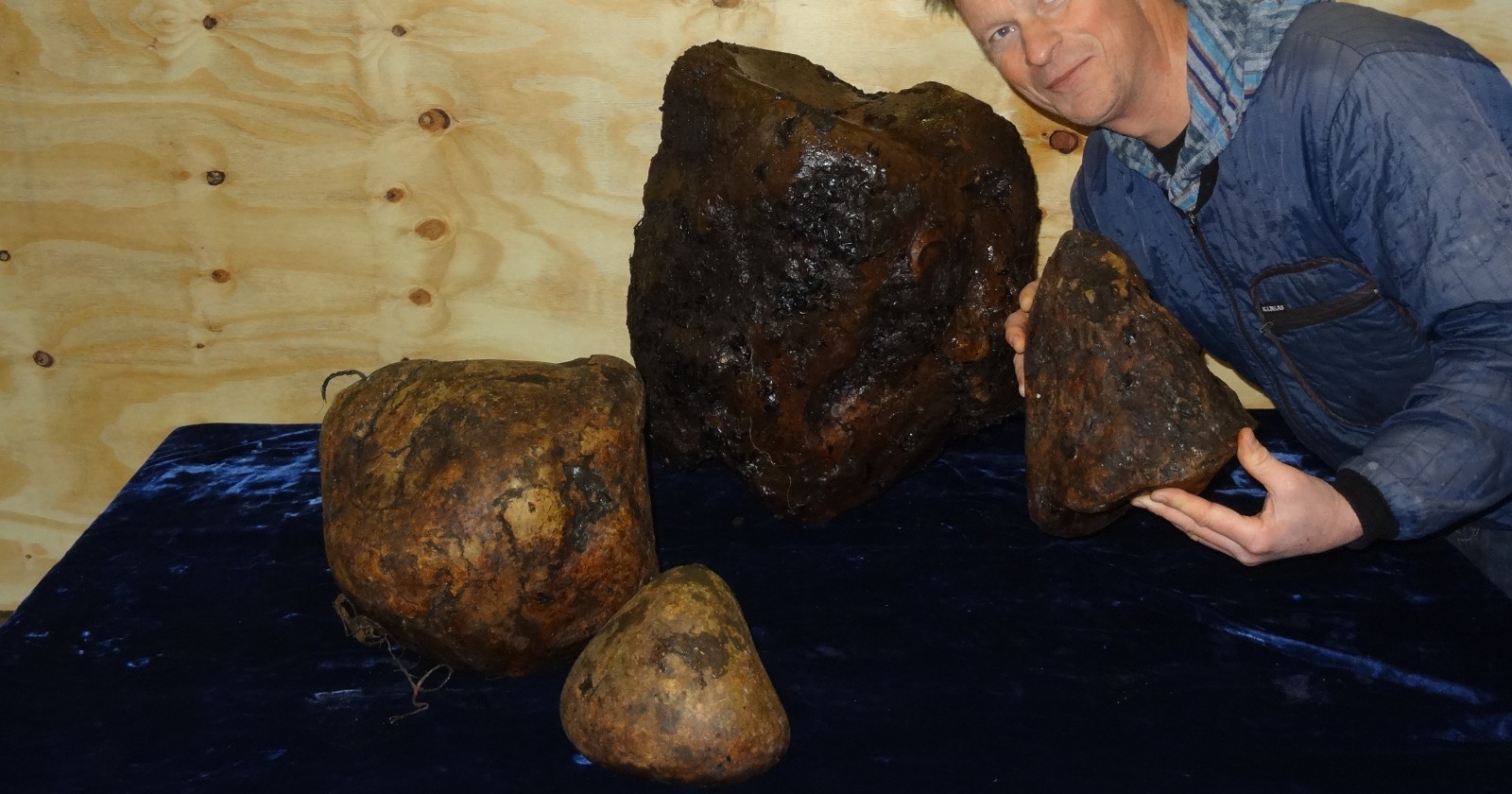
Two of nine specimens catalogued as ambergris did not yield the marker compound the chemical tests look for, and one of the two held the highest DNA concentration in the study while returning no detectable sperm whale DNA on either genetic marker.
The finding comes from a verification study in Royal Society Open Science, dated 2 September 2026, by Matthew Campbell, Lewis Haines, Alan Scarlett, Kenny Travouillon, Kliti Grice, Morten Allentoft and Zoe Richards. Eleven samples were run through two checks the authors call complementary: chemical profiling for the marker compounds of ambergris, and DNA metabarcoding for the species that made it. Nine cleared the chemistry. Seven yielded sperm whale DNA. The overlap between those two groups is where the interesting part sits.
Ambergris forms in the digestive tract of sperm whales, by the paper’s account through the gradual accumulation and compaction of indigestible material such as squid beaks. Only about one per cent of them produce it, on a figure the paper mentions in passing. Lumps wash up on beaches, where they are collected as jetsam and sold into the perfume trade. Because the substance is rare, valuable and highly variable in appearance, it is also faked.
The needle, the nose and the spectrometer
The traditional screen is physical. The paper’s own account of appearance is a gradient rather than a checklist: fresher material typically darker and more faecal, weathered material paler, harder and waxier, and appearance alone, it warns, cannot reliably indicate chronological age. Nine of the eleven samples in this study are held in the collections of the Western Australian Museum, and all nine had been assigned as jetsam ambergris on the strength of a hot needle test. The paper does not describe that test, citing a perfumery reference work for it.
Smell is the second screen. The paper says only that aged ambergris carries a complex fragrance distinct from the faecal odour of fresh material, and treats odour as offering additional clues rather than confirmation.
The third screen is chemical, and it is the one the study treats as most definitive. Gas chromatography with mass spectrometry and Fourier transform infrared spectroscopy both look for ambrein, a triterpene alcohol regarded as a key diagnostic biomarker of ambergris. They look for the cholesterol derivatives that accompany it too. What none of these three can do is say which animal a lump came from, which is why the group added DNA.
The chemistry put two samples outside the group
Ambrein turned up in nine of the eleven samples. That is a different nine from the nine museum specimens, since it excludes two of them and includes both of the reference samples. The two exceptions were the specimens catalogued as WAM63191 and WAM65250, and they failed in different ways.
WAM63191 dissolved only 51 per cent into dichloromethane; every other sample in the set cleared 80 per cent, and most reached 97 per cent or better. Its infrared spectrum did not match authenticated material, and the compounds its chromatogram did show were the same ones present in the blank control, which the authors read as potential contamination.
WAM65250 dissolved at 88 per cent but showed no ambrein either, and instead carried elevated hexadecanoic acid, better known as palmitic acid, together with decanedioic acid. Neither is a common constituent of ambergris. Palm oil is a known source of that fatty acid, on the survey of Thai commercial palm oils the paper cites, and the authors float it as a possible origin. They also state plainly that the sample’s biological origin remains unresolved.
A third specimen cleared the ambrein test but sat oddly. WAM1151 carried roughly four times more of one cholestanol than ambrein, a profile the authors say fits body ambergris, freshly expelled material or even sperm whale faeces better than most highly weathered jetsam with its high proportion of faecal steroids.
Both lumps had previously passed the needle. The paper’s main text does not say when.
That is the finding underneath the finding: the physical screen these specimens were sorted by passed two lumps in which a spectrometer could find no ambrein.
The DNA turned up in fewer samples than the chemistry did
DNA was the newer half of the workflow, and it registered in fewer specimens. Four of the extracts held too little DNA for the fluorometer to quantify at all, though three of those four still returned sperm whale sequence by amplification, which the authors read as a point in the method’s favour. Among the seven extracts that could be quantified, concentrations ran from 0.083 to 19.1 nanograms per microlitre.
The gap is in the totals. Sperm whale DNA was recovered from five of the nine museum jetsam samples, and from both reference specimens. Those two came from sperm whale carcasses via the Albany Whaling Museum and had been confirmed chemically in earlier work. Seven of eleven, against nine of eleven for the chemistry. The two markers did not always agree with each other either. The group ran both a 12S and a 16S ribosomal assay, and reports that when one failed the other often worked, an approach they call particularly useful for degraded or low template samples.
Then there is WAM63191 again. It held 19.1 nanograms per microlitre, by a wide margin the highest DNA concentration in the study. No sperm whale DNA was detectable in it. The plant marker returned 330 reads, all of them assigned to Tetragonia, a genus of coastal and dune plants widespread in the southern hemisphere. The same extract’s 18S assay returned 3,239 reads spread across several taxa, so the lump was not short of DNA, only of sperm whale DNA. The authors read that either as contamination or as evidence that the lump was botanical to begin with, and do not choose between the two.
Two more samples cleared the chemistry and still gave no sperm whale signal. WAM65060 dissolved 97 per cent into dichloromethane with ambrein present on both instruments, and WAM2668 did the same, and neither yielded detectable sperm whale DNA on either marker. In WAM65060’s case there was measurable DNA to work with: 1.25 nanograms per microlitre, third highest of the seven extracts the fluorometer could read. The authors attribute their non detections to degradation or, they allow, possible misidentification.
Nobody handed the workflow a known fake
The honest limit here is what was not in the sample set. This was a retrospective study of curated museum material, and the group states that commercial counterfeit substances were not available to them, and neither were paired environmental controls such as sand from the beaches where the lumps were picked up. The workflow’s ability to tell genuine ambergris from specific counterfeit materials was therefore, in the authors’ own words, not directly tested.
The sample size limits the second question the study asked. It looked for DNA from the pygmy and dwarf sperm whales, Kogia breviceps and Kogia sima, which the authors note have been proposed as possible ambergris producers. None was found. With seven verified samples the authors say firm conclusions are impossible, and that the involvement of those species cannot be ruled out.
The short mitochondrial fragments used here are, by the group’s own account, complementary evidence rather than definitive forensic species authentication, because closely related species can be hard to separate on a barcode of that length. Nor can the specimens supply their own history: accession dates record when the museum acquired each lump, not when it formed or beached, so the exposure history of most of the set is unknown.
The paper’s headline summary is that DNA metabarcoding supplied complementary biological origin evidence in 70 per cent of chemically verified cases, and that genetic data alone, in the authors’ words, cannot reliably authenticate all ambergris specimens. That percentage has no stated denominator in the text. Read against the seven museum jetsam samples the chemistry accepted, five of which gave sperm whale DNA, it comes out at 71 per cent; read against all nine chemically verified samples including the two references, 78 per cent. Neither reproduces 70 exactly, and the sentence is better read with the counts substituted for the percentage, because the counts are the part the table supports.
What a second round of this would need
The authors recommend using both methods, and where they have to rank them they rank the chemistry first. Chemical profiling, they conclude, is the most consistent way to confirm ambergris, through markers such as ambrein and the faecal steroids around it. Separately, they note that chemical methods are more resilient than DNA to environmental degradation and contamination. For routine screening where counterfeiting is not suspected, they judge chemical analysis probably sufficient on its own. Where a sample’s origin is uncertain or biological verification is required, DNA adds a layer of evidence, at more expense, more time and more specialised equipment.
What the study does not do is test the case that matters commercially. Nine curated museum accessions are not a representative draw of the lumps that reach a dealer, and the paper derives no accuracy figure for the needle from them. Two of the nine did not yield the chemistry the authors treat as diagnostic, but the paper stops short of calling either one a misidentification: one specimen’s origin it records as unresolved, the other’s anomalous profile it attributes to potential contamination. The gap the authors name themselves is the one to close: broader sample sets, deliberate counterfeit controls, paired sand from the recovery beaches, and assays able to separate a sperm whale from its smaller relatives. Until a workflow has been shown a fake and caught it, what has been demonstrated is that the chemistry can sort a museum drawer, which is a smaller and more useful claim than authentication.