

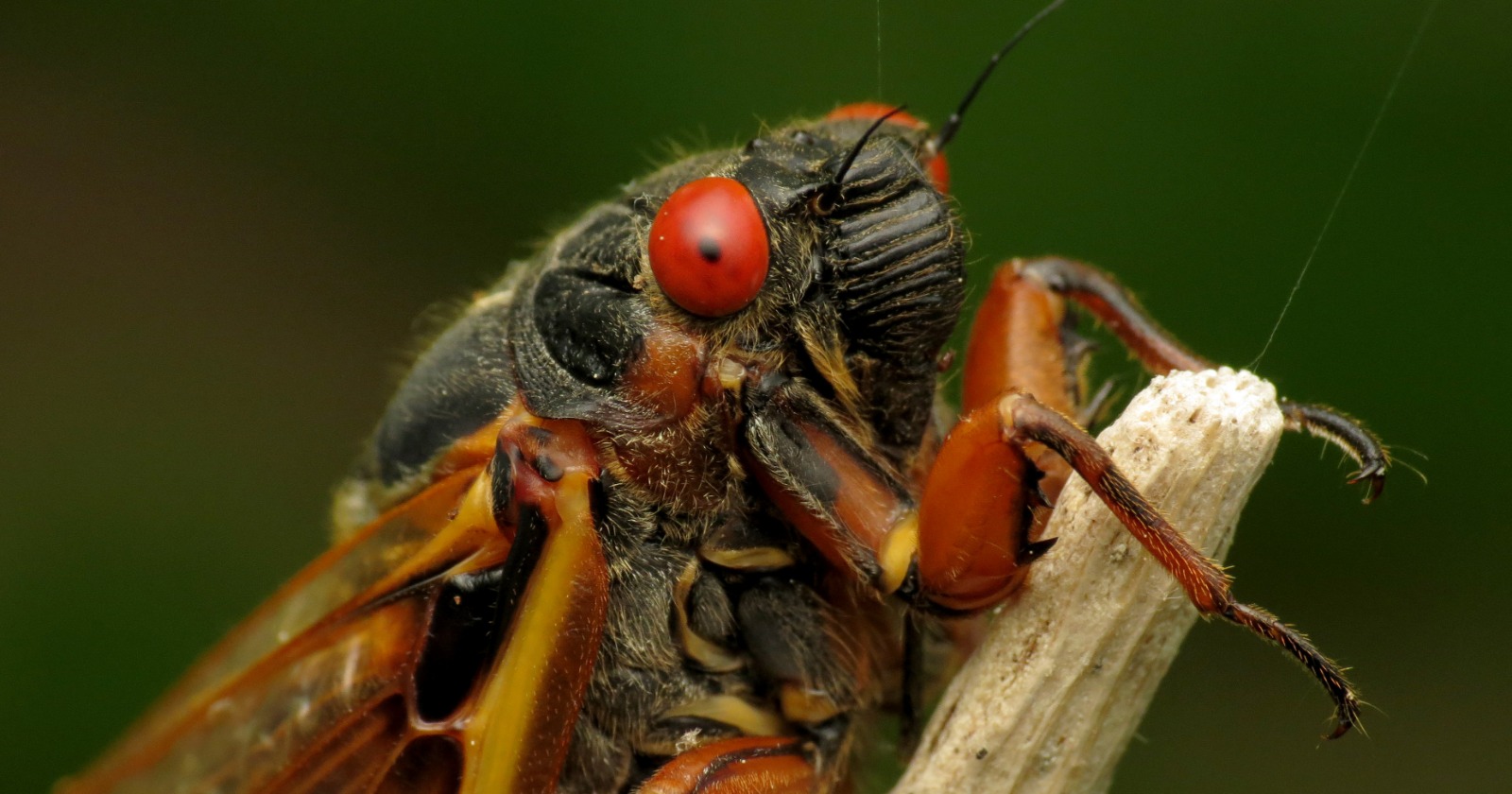
“I was really sad,” Andrew Forbes told the University of Iowa’s news office. “I wanted to find out why that is.” Forbes had gone looking for an expected periodical cicada emergence around Iowa City, and found little of it.
The study he and thirteen colleagues published on 4 September 2026 in the journal Ecology, on the legacy effects of century-old forest removal, is the answer he went after, and it is an unwelcome one. Where cicadas were singing in Johnson County, Iowa, during the 2024 emergence turns out to be predicted better by a map of the county’s trees from 1930 than by a map of its trees from 2023. Tree cover there has risen since 1930. The cicadas have not risen with it.
Periodical cicadas spend 13 or 17 years underground feeding on the root fluids of a tree, then surface together in numbers large enough that predators cannot eat them all. Johnson County sits inside the ancestral range of Brood XIII, one of the 17-year groups, which last came up in 2024.
Two maps of the same county
Across the peak chorusing weeks of 27 May to 20 June the team visited 301 sites with tree cover and heard male chorusing at 116 of them. Chorusing is the study’s evidence of an established, reproducing population, because males need at least five days above ground before they start and predator pressure through those days is extremely high. At 16 sites checked earlier for the tunnels nymphs dig a month before surfacing, only five carried mean densities significantly above 0.5 tunnels per square metre, and only those five went on to produce a mass emergence, sustained chorusing and the withered branch tips that follow heavy egg laying.
Those tunnel counts were taken around trees chosen because they were old, which biased the sampling away from the forest edges where cicadas often lay the most eggs and may therefore have understated densities. Some of the counted holes could also have been dug by ground-nesting bees or other animals, though nymphs were visible in many of them. The authors state both limitations themselves.
Tree cover measured in 1859, 1930 and 2023 all predicted chorusing to a statistically significant degree. The single best fit was 1930, which explained 52.5 percent of the variation at a radius of two kilometres, and a combination of three measures raised that to 64.1 percent. Present-day cover did win at the tightest radii, which the authors say likely reflects only that trees had to be physically standing at a site for cicadas to be in it, but from 1.5 kilometres outward the 1930 map was the better predictor at every radius tested.
Only 3.9 percent of the county held tree cover continuously from 1930 to 2023. Using those persistent patches to set a bar, the study calculates that a site has a 90 percent chance of holding cicadas when at least 17.4 percent of the landscape within 1.5 kilometres has stayed wooded throughout. Apply that bar to the county as it stood in 2023 and 247 of the 301 sites clear it, including 110 of the 116 where cicadas were actually singing. The other 137 sites clear the bar and had none in 2024. They are, in general, places where the trees came down before 1930 and have since grown back.
The dispersal number the argument rests on
Everything downstream of that result turns on how far a cicada can travel, and that figure comes from one piece of fieldwork: Richard Karban’s 1981 measurements of periodical cicada flight and dispersal. Most cicadas in that study rarely flew more than 50 metres, which the new paper reads as under 50 metres per generation, and the furthest a mated female was recorded travelling was 149 metres. The authors of the new work state that there are no direct observational studies of cicada dispersal other than Karban’s, and add that the tail of the distribution is probably long and probably includes rare long flights nobody has caught.
A nymph that spends 17 years attached to the roots of one tree will often die with that tree, especially if it is still early in its development, and a population gets only five to seven opportunities a century to be anywhere else. At the distances Karban measured, the paper puts the advance of a cicada front at 50 to 150 metres every 17 years.
Those two figures are worth holding on to, because the University of Iowa announcement that carried the study replaces them with a third. It says periodical cicadas spread “about 50 yards, on average, during each emergence”, attributing the figure to previous research rather than to Karban by name. Under 50 metres is where most of Karban’s cicadas stopped, and the new paper gives no average at all. On the bigger question the announcement’s headline keeps the paper’s hedge and says the insects may be doomed. The flat version, that their interesting biology “also has doomed them”, is Forbes speaking in his own voice rather than the paper speaking in its.
Most of the 1930 forest has since been replaced somewhere else
A landscape can gain trees and lose cicadas at the same time, because the replacement happens somewhere other than where the clearing did. Of the tree cover standing in Johnson County in 1930, only 35 percent was still tree cover in 2023, even though the county’s total rose from 11.2 percent to 12.8 percent of its area.
The paper labels its turnover figures, a 14.5 percent gain and an 11.9 percent loss for a net 2.6 percent, as rates per year, then uses the 11.9 percent a paragraph later as a rate per 17-year generation. Per year they cannot be right: 2.6 percent a year compounded from 1930 would put trees over the whole county by 2023. Read as shares of the 1930 tree area per 17-year generation, averaged across the 93 years, all three figures reproduce both the 12.8 percent endpoint and the 35 percent survival figure, so the label is the defect and not the accounting. This piece reads them as per-generation rates, which is how the paper’s own model uses them.
From its measured rates of loss and gain the team built a model of a 1,500 square kilometre landscape. Total tree cover in it peaks after 12 cicada generations, or 204 years. Cicada-occupied cover falls by more than half within seven generations, 119 years, at the under-50-metre distance most cicadas fly, and is still halved within 14 generations even at the maximum 149 metres. Ranges hold flat only if large numbers of cicadas disperse 300 metres, and grow only at 500 metres and above, which is well past anything the one dispersal study on record measured.
The numbers a model produces are projections. This one is built on one dispersal study, one county’s turnover rates and one brood in one emergence year. The study’s central result, for its part, is a statistical association between historical tree cover and present cicada song rather than a demonstration that the clearance before 1930 caused the 2024 silence.
The release at Pappy Dickens Preserve
To find out whether dispersal could simply be given a push, the researchers moved 20,126 adult cicadas over ten days into Pappy Dickens Preserve in Iowa City, a managed forest that had been reduced to pasture at some point between 1859 and 1930 and by 2024 carried 40.8 percent tree cover within 1.5 kilometres, comfortably above the threshold. It sits 3.8 kilometres from the nearest chorusing population, and the study calculates that cicadas from there would not reach the preserve naturally until somewhere between the years 2466 and 3316, and that is assuming an unbroken forested corridor with no tree turnover in it at all.
The released insects climbed into the trees and undergrowth. Bird and small mammal activity at the release site was heavy, and predators were seen eating cicadas during and after every release. No adults were observed after the final release day, and no chorusing followed.
The authors read this outcome as predator aggregation, the flip side of the strategy that makes an emergence work. Safety comes from being one insect among millions, and twenty thousand released into an otherwise empty wood are a meal for every bird within reach, of which more than 80 species are known to take cicadas. The paper says this failure echoes earlier translocation attempts, citing reports by Marlatt, by Alexander and Moore, and by Lloyd. It does not say when those were carried out or what became of them.
What would have to change
The study offers two routes, presented alongside each other rather than in sequence. Tree turnover could be held under roughly 4 percent per 17-year generation. Or more than 95 percent of all cicada-occupied woodland could be preserved indefinitely without turnover, including any new patches the insects reach. Even in those most favourable scenarios, the paper says, expanding a range by just one or two kilometres would take centuries.
The paper’s closing line keeps a hedge on the rest. The large-scale removal of North American forest more than a century ago, it says, may have set the insects on the same decline towards inevitable extinction that befell other North American animals of extreme abundance. Earlier in the same paper those animals are named: the passenger pigeon, the Carolina parakeet, the Rocky Mountain locust.
One hundred and thirty-seven wooded places in a single Iowa county meet this study’s own bar for holding periodical cicadas and held none of them in 2024. On the numbers in this paper, how many of them hear a chorus again this century?