
Archaeothanatology reads a burial from the position of the body: which joints are still articulated, what the body is touching, where it lies in the sediment. It is the method for recovering the order in which a crowded deposit was made, and Jared Carballo-Pérez and Miguel Ángel Molinero Polo have applied it to one small room on the Luxor west bank.
The room is Side Chamber 3 of Theban Tomb 209, roughly 5.10 by 3.15 metres. Into it went 16 mummified people, a mummified canid, and a burnt secondary deposit holding at least four more individuals. The bodies span the Twenty-Fifth Dynasty to the Ptolemaic period, and the authors argue the earliest may have gone on conditioning where later ones could be put down over at least three centuries.
The analysis is published in Frontiers in Environmental Archaeology and is open access. Carballo-Pérez works at Leiden and at the Universidad de La Laguna, Molinero Polo at La Laguna, and fieldwork on this chamber ran from 2018 to 2026.
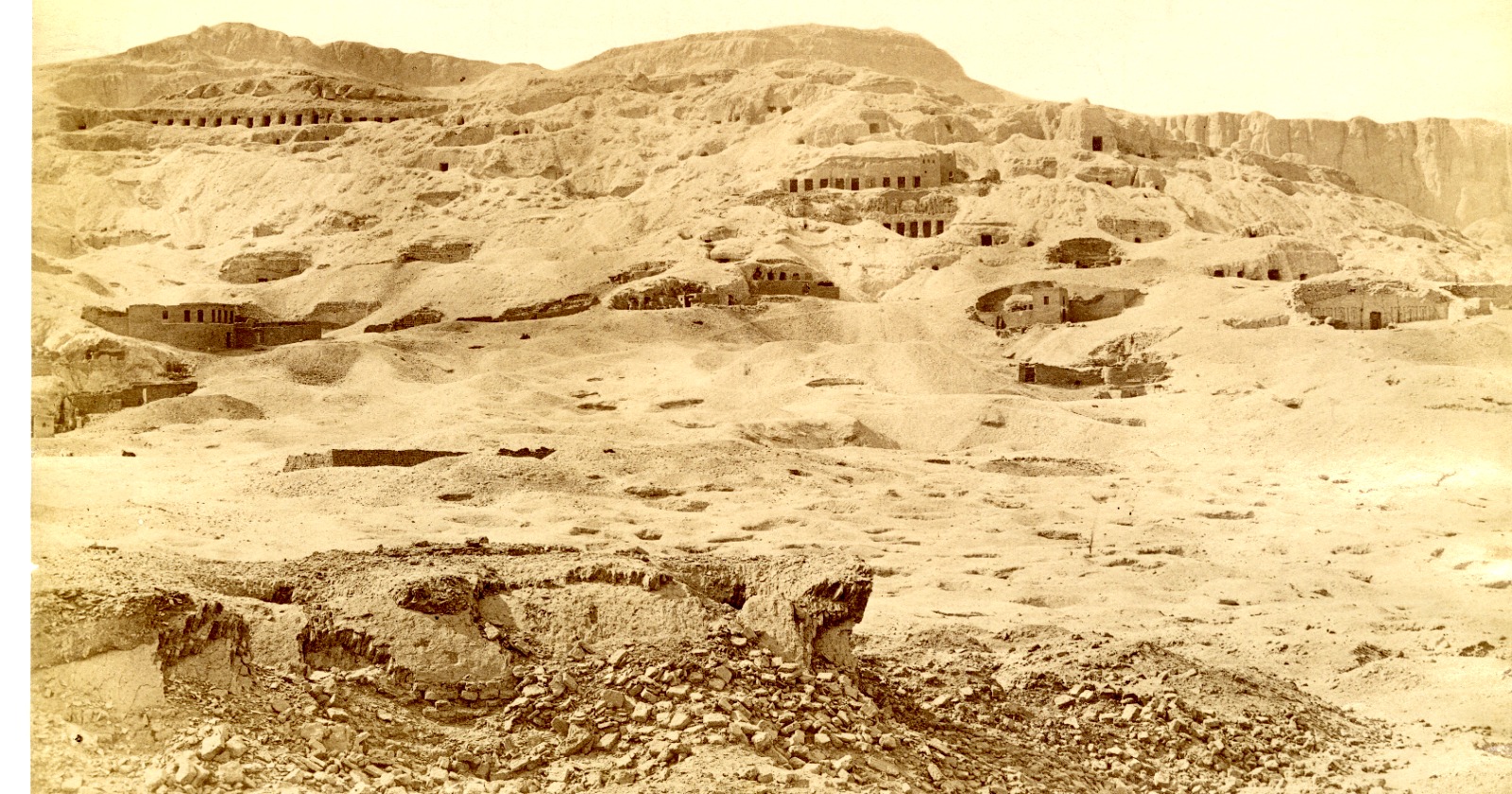
Wadi Hatasun runs through TT 209
TT 209 belongs to the South Asasif sector of the western Theban necropolis, on the northern slope of the Wadi Hatasun. Prosopographic and archaeological evidence assigns it to a high official of Nubian origin named Nisemro, active at Thebes in what was probably the early Twenty-Fifth Dynasty. Its mudbrick superstructure was stepped into the slope on three terraces, and the façade would have carried pylons nearly 17 metres long.
The tomb was also cut directly into an active drainage channel of the wadi. Flash floods have repeatedly pushed water and sediment through it, in antiquity and again in the twentieth century, so what survives inside is a product of burial and flooding together.
Early twentieth-century diggers missed Side Chamber 3, and no later modern intrusion reached it either, so its sequence survived unexcavated. It yielded 1,444 bones from the 16 humans found in primary or partially primary position, plus the canid, plus 1,775 burnt fragments.
First the coffins were kept apart
The two oldest deposits lay on the chamber’s first floor surface and stayed out of each other’s way. Two men aged roughly 20 to 30 lay in separate coffins in the eastern sector, one with a small clay ushebti, the other with a Twenty-Fifth Dynasty cup. Two women lay in two more coffins in the southwestern sector, with scarabs, Sons of Horus amulets and faience beads. Between the groups the excavators recorded what apparently remained an empty circulation space.
Both men in one corner and both women in another is a neat pattern. The small sample, the authors write, means the pattern should be read cautiously rather than as a formal sex-based organisation of the chamber, and from the fourth deposit onward the pattern becomes less clearly defined anyway.
The early material is emphatically funerary: ceramics dominate, including Phoenician amphorae, incense cups and large vessels placed in direct contact with bodies and coffins, alongside amulets and faience beads.
The southeastern corner filled from the bottom up
From the fourth deposit onward, new bodies started going on top of old ones, almost all of it in the same corner. A woman of 17 to 20 was laid directly over a man past 60. Another man’s coffin was set on the coffin already holding one of the two men from the earliest phase, stacking containers where the room had once held a row.
A Persian-period group of three lies more closely packed than the earlier deposits. A woman of 25 to 35 and a man of 35 to 45 are closely superimposed, both with arms crossed, both with feet to the east. The mummified canid was placed over the lower limbs of both, its own limbs flexed and its feet pointing west.
The paper calls the animal a canid five times and never names a species, so the widely reported “mummified dog” is an identification the authors did not publish. The table and the figure caption place it over the lower limbs of the two humans, and the paper makes no claim about a relationship between them. The psychopomp suggestion comes from the senior author speaking to Frontiers’ own newsroom, hedged there as something the placement “could” reflect, and appears nowhere in the paper.
The stacking continued upward through the Ptolemaic phases. Across the whole chamber, at least six of the nine funerary deposits show clear vertical superposition, which the authors put at about 66.7 per cent. That figure counts deposits, not individuals; the accompanying Frontiers newsroom item converted it into two thirds of the burials.
As the stack grew, the coffin stopped doing its job. At least seven of the nine deposits show direct or indirect evidence of coffins, though the use is systematic only in the earliest three. By the last three there is none, and the later bodies were conditioned by whatever was already in the room: one man’s skull rests on a large ceramic fragment, one woman is wedged between limestone blocks. The authors’ argument is that the coffin loses its role of defining a burial as a discrete unit, and the chamber’s own topography takes that role over.
Some coffins now exist only as paint.
Between the Persian and Ptolemaic levels the wooden structures had decayed and the painted stucco stayed behind in the sediment. Two floor boards were recovered that way, one carrying a goddess and one an Osirian djed pillar.
The reuse has travelled under an appealing description. Carballo-Pérez said in a statement that the sequence indicates “a kind of funerary memory in the processes of reuse”. The paper does use the word memory, defining it in a material and analytical sense: the persistence of earlier bodies, objects, sediments and architectural constraints inside the chamber. It does not claim a demonstrable conscious engagement with the past by later users, and reads the repeated vertical contacts as practical continuity in the use of one funerary sector.
The vertical positions visible today should also not be read as a direct reflection of where the bodies were placed. Coffins collapsed, wrappings and soft tissue decayed, sediment filled the gaps, and the authors think some bodies were probably lowered gradually within the stack. Earlier bodies and coffins may therefore have remained more visible to later burial parties than their present position suggests.
Burnt bone from somewhere else
One deposit is unlike the rest. Stratigraphically it sits between the Persian and Ptolemaic levels, though the paper’s table assigns its phase earlier, to the late Twenty-Fifth Dynasty or Persian. It holds 1,775 bone fragments with no recoverable body arrangement, from a minimum of four individuals, three adults and one subadult, and it is the only deposit in the chamber whose original arrangement cannot be reconstructed.
The bone had been burnt, and thoroughly. Some 88.6 per cent of fragments show thermal alteration, the commonest damage category is grade 4 on the standard macroscopic scale, and roughly 36 per cent approach calcination, which the authors read as temperatures approaching 550 degrees Celsius under largely oxygen-poor conditions. Skulls and lower limbs took more than spines and arms.
Where the burnt bone was originally buried is unknown. It may come from an earlier deposit inside this chamber or from a displaced deposit elsewhere in the tomb. Its stratigraphic position, above one sedimentary unit and below another, makes it an intermediate disturbance in the sequence.
Somebody also came back in. An intrusive cut by the neighbouring chamber’s entrance runs through one of the earliest men and alters the lower half of his body, long after he was laid there. At least three of the nine deposits were altered by intrusive or redepositional processes.
The later burials cross their arms
Arm position changes across the sequence. Crossed arms over the chest are the commonest position, concentrated in the later deposits, and hands on the pelvis cluster in the earlier ones. The paper’s own tally here, eight of fourteen crossed against four of fourteen on the pelvis, does not match its Table 1, which lists ten of the sixteen people with arms crossed and three with hands on the pelvis. Everything else holds steady: the supine position clearly predominates among individuals in anatomical connection, and eastward orientation predominates, with westward persisting throughout and no clear directional evolution. The paper’s global figures of about 61.5 and 38.5 per cent imply a base of thirteen, where its Table 1 records eleven bodies with feet east and six with feet west.
Crossed arms are a recurrent attribute of Osirian iconography, and the authors say the shift may reflect an increasing Osirian bodily display. They then say it should not be interpreted as direct evidence for a single process of Osirianization, and treat arm position as one variable among changes in wrapping, embalming and deposition.
The conclusions name three things as provisional: the mechanisms of reuse, the intentionality behind the spatial recurrences, and the original position of the burnt deposit. Floods, fire and re-entry make the boundary between an original relationship and a later alteration hard to draw.
The room itself is not provisional. Nine deposits: eight hold seventeen mummified bodies, one of them the canid, and the ninth holds 1,775 burnt fragments from at least four more people, in about sixteen square metres of bedrock cut into a channel that flooded repeatedly. The chamber has been settling since the last body went in, and the paper describes the positions it recorded, leaving the original heights open.