

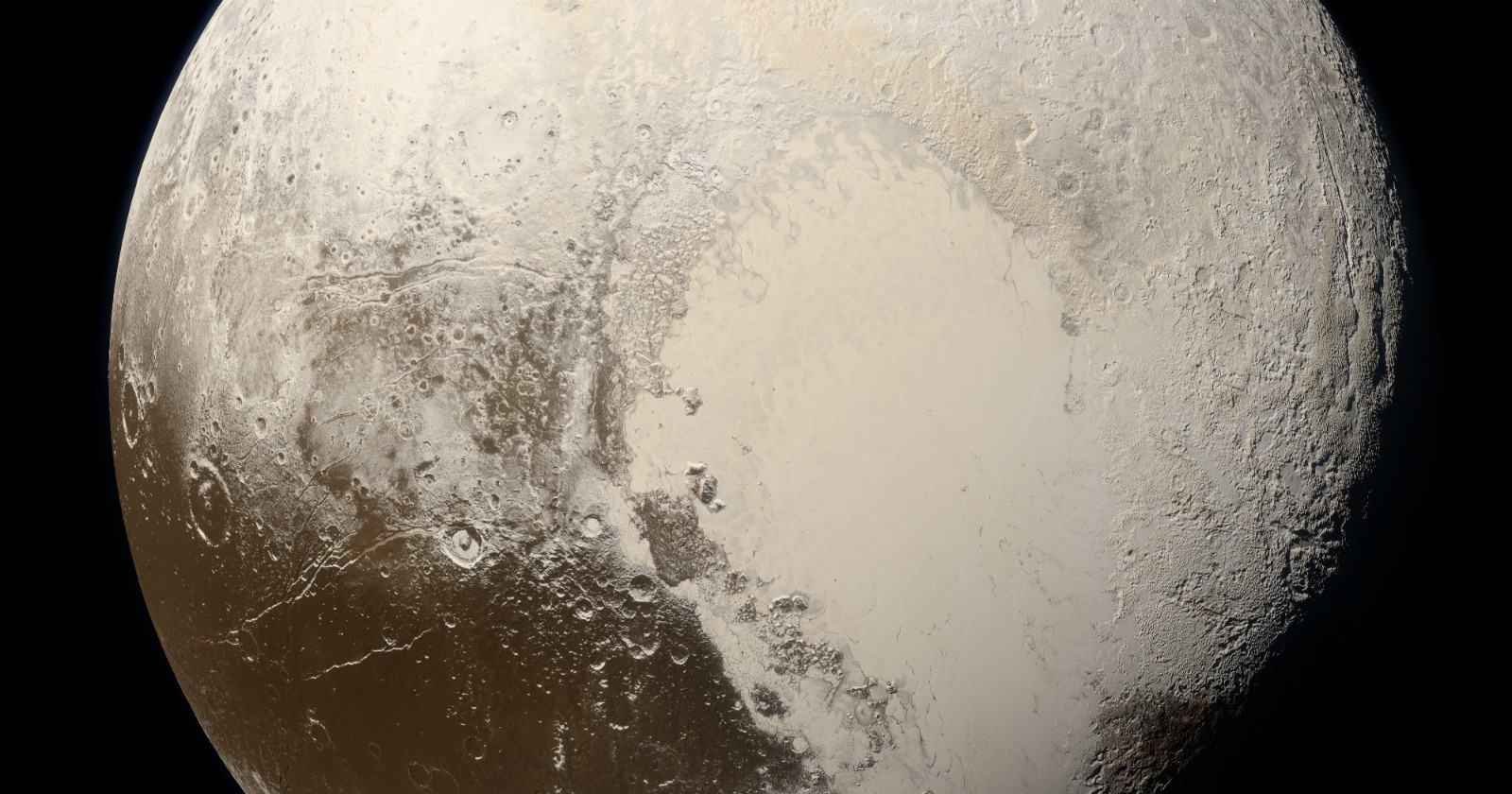
The New Horizons spacecraft passed Pluto once, in 2015, and then sent its pictures home slowly. Among them was a panchromatic frame of the northern part of Sputnik Planitia, the bright plain that forms the left lobe of Pluto’s heart, at a characteristic resolution of about 300 metres per pixel.
The frame showed a loose network of dark lines threaded through the polygonal cells of the ice, tens of kilometres long, running roughly along the seams between cells. Most of them are surrounded by a softer dark halo that spreads several times, and in places twenty times, further than the narrow line it encloses.
Eleven years later a team led by Alan Stern, the principal investigator of the New Horizons mission, has published an explanation in The Planetary Science Journal. They think the dark lines are where liquid nitrogen pooled after reaching the surface.
The lines in the 2015 frame
Sputnik Planitia is a sheet of nitrogen-rich ice, with minor amounts of carbon monoxide and methane. It measures roughly 850 kilometres east to west and 1,500 kilometres north to south, and it fills an ancient impact basin of similar extent. Its surface sits 2.5 to 3.5 kilometres below the mountains around it, and its cellular plains are broken into polygons typically 20 to 35 kilometres across, generally read as the tops of slow convection cells.
The paper states that New Horizons found no impact crater of any size across the plain in images down to about eighty metres per pixel, citing the mission’s own crater surveys, and the authors read that as evidence that its convective resurfacing is still running.
The team calls the dark lines Discrete Dark, Narrow Features and the halos around them Diffuse Dark Aprons. Measured against the albedo map built from the flyby data, the aprons are about 0.10 darker than the surrounding ice sheet and the narrow cores about 0.15 darker. The sheet’s own mean broadband albedo is roughly 0.8, close to the albedo of Earth’s polar ice.
Their colour matters too. The dark material in the mountains around Sputnik Planitia is reddish, the signature of atmospheric haze settling out. The aprons are relatively neutral in colour, unlike those reddish deposits, a contrast the paper notes without settling what the darkening agent is. A rising liquid could darken them in either of two ways in the paper’s account: by carrying dark material up from below, or by changing the porosity of the surface ice so that it scatters less light.
There are also ways to darken an ice sheet that need no liquid at all. Larger nitrogen ice grains reflect less light, and haze raining out of Pluto’s atmosphere is an additional source of dark impurities on the surface. The authors accept that either could reproduce the observed brightness. They argue that solar heating at Pluto is too weak to grow the grains that much, and that neither route can reproduce the sharp edges, since without a liquid they expect the darkening to come out far too diffuse. That is an argument about morphology, not an exclusion by measurement.
Why liquid nitrogen is possible at all on a world at 37 kelvin
Nitrogen cannot be a liquid at any temperature unless the pressure on it reaches its triple point pressure of 12,523 pascals. Pluto’s surface gravity is 0.617 metres per second squared, and its nitrogen ice has a density of about 995 kilograms per cubic metre. The weight of the ice above can therefore equal that pressure as close as 20 metres down. Below 20 metres the pressure stops being the obstacle. The temperature takes over.
The surface of Sputnik Planitia sits at about 37 kelvin. Nitrogen melts at 63.151 kelvin at the triple point, and the melting temperature rises only very slightly with depth, by about 0.13 kelvin per kilometre. The paper’s own figure for the temperature difference its mechanism has to build between the base of the layer and the surface is at least 26 kelvin.
Models of Pluto’s interior put the heat leaking out from below at somewhere between 4 and 18 milliwatts per square metre. Feed that range into a purely conducting nitrogen layer and the melting temperature is reached somewhere between 300 metres and 1.4 kilometres down, shallower still if the upper ice is porous. Those figures set a threshold rather than a location. A layer has to be at least that thick before melting becomes possible at all, and the real convecting layer is estimated at 2 to 5 kilometres.
The problem the paper has to solve
The catch is that a convecting ice sheet cools its own base efficiently, driving the basal temperature well below what pure conduction would give it.
The paper proposes three routes past that and rejects the most obvious one outright. Pluto’s global nitrogen cycle is expected to strip about a kilometre of ice off northern Sputnik Planitia over a Milankovitch cycle of a few million years. The resulting slope should drive the sheet to flow north, generating frictional heat. The authors work it out, get an integrated flux of 4 microwatts per square metre and call it insufficient. Against their own 4 to 18 milliwatt geothermal range, that is a factor of a thousand or more.
A second route runs through the water ice bedrock underneath, whose pore spaces could hold solid nitrogen that deep fracturing or the slow loss of overburden tips across the melting boundary.
The route they develop is the third, and it turns the thinning itself into the cause. As the northern part of the layer loses height, the stresses inside it drop, the ice grains grow larger, larger grains make the ice stiffer, stiffer ice convects less, and a layer that convects less stops carrying its own heat away. The base warms until it melts.
The paper presents this as a feasibility demonstration rather than a finished calculation, and the reason is that it cannot pin the mechanism down. Two of the parameters governing how nitrogen ice grains grow under stress have never been measured for solid nitrogen. The authors borrowed plausible ranges from other polycrystalline materials and said outright that laboratory work is warranted. Their own appendix table also quotes a wider geothermal flux range than the main text, 2 to 18 milliwatts per square metre against 4 to 18, and at the low end of that range the conductive melt depth roughly doubles, to about 2.7 kilometres. That last figure is our own arithmetic from the paper’s expression; the paper does not compute it.
Modelled cracks too narrow to photograph
Liquid nitrogen is less dense than nitrogen ice, so once it exists at the base it should rise, in the same way basalt rises through continental crust. The authors model that ascent through dike-shaped fractures. Below a critical width the walls freeze the channel shut before it can keep delivering liquid to the top, and that width is about 15 centimetres for pure liquid nitrogen and roughly a metre for a stiff nitrogen slush. Their estimate for the dikes that actually feed surface flows is a metre or less.
A fracture of that width is invisible in the sharpest images that cross Sputnik Planitia, which run at about 75 metres per pixel. The points where the liquid would emerge are modelled at one to tens of metres across, also below what any New Horizons image could resolve. What the pictures show is not the vent. It is the dark pool the paper puts at the cell margin, downslope of wherever the liquid came out.
The numbers then push hard in one direction. Sustaining vertical flow up a dike takes a minimum of about 25 cubic metres per second. The steady rate at which melt is produced at the base tops out below 1 cubic metre per second. Because the two do not meet, the paper says the result strongly suggests the liquid is stored at depth in reservoirs and erupted in episodes. The analogy it reaches for is a shield volcano, storing magma and then breaking out along its flanks. For flow events big enough to run a kilometre from a vent, coming from areas the size of a convection cell or smaller, its own phrase is discrete pressurised outbursts lasting hours to days.
Once the liquid is out, it is racing a different clock. On the one degree surface slope the paper models, the minimum discharge that would carry a flow at least a kilometre from its vent is about seven cubic metres a second. That threshold is set by the stiffest slush the authors think plausible, and a flow at it freezes and stops moving after about 20 hours.
The parts that are modelled
The dark lines were photographed. Everything the paper builds on top of them is a model: the melt, the reservoirs, the dikes and the eruptions are all inferred from physics that has never been checked at Pluto, and the paper says so in its own verbs, hypothesising and positing rather than reporting.
The word modern is doing quiet work as well. When the team says liquid nitrogen has flowed on Pluto in the modern epoch, they define that in a footnote as within the roughly 500,000 year overturn time of the convection cells. That is simply the window in which the evidence would not yet have been erased. The same footnote adds that the process may have been running far longer, potentially for as long as Sputnik Planitia has existed. Either way the argument does not distinguish last century from last ice age.
The next test
The authors put the next real test at Pluto. Over half the planet has never been mapped at flyby resolution, and they say a proper assessment of whether liquid flows exist elsewhere has to wait for that. That would take another mission.
The cheaper test is on a bench. The two grain growth constants the authors had to borrow are measurable properties of frozen nitrogen, they can be measured in a cryogenic laboratory on Earth, and the authors themselves call for that laboratory work. Pinning them down would go a long way toward telling us whether the mechanism at the centre of this paper is even available, before anyone builds a spacecraft to go and look.