

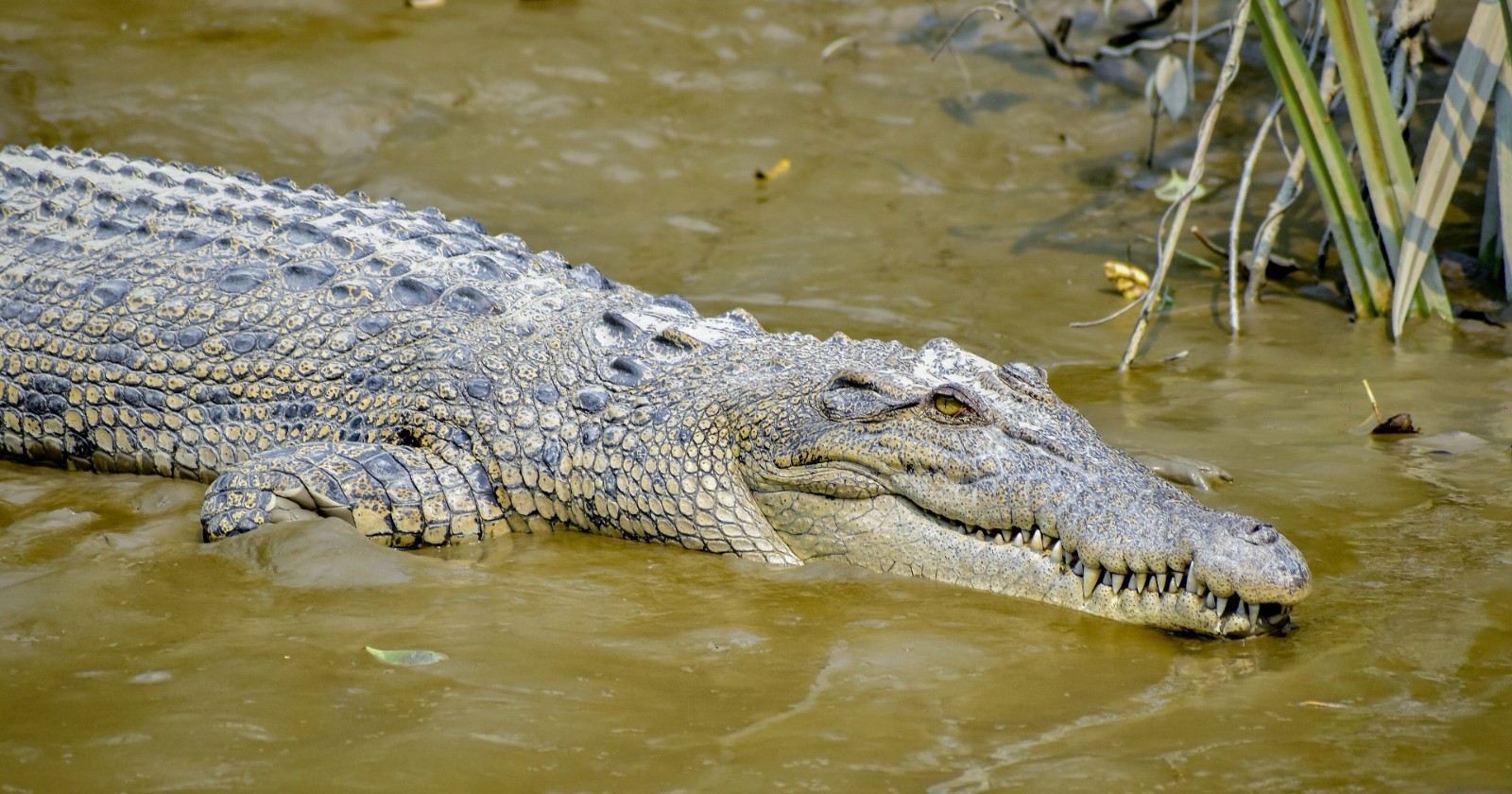
A satellite-tracking study of five saltwater crocodiles in Bangladesh’s Sundarbans, published in Wildlife Research with Ruchira Somaweera as first author, found that the three animals that had been kept in captivity, including a female held for roughly 22 years, showed no indication of homing (navigating back to a familiar place) toward the facilities that had held them. They kept to modest stretches of mangrove channel, moving and ranging on a scale the authors call broadly similar to that of a wild crocodile tagged and, by the paper’s account, released where it was caught.
The fifth animal did not fit that pattern. A male captured in Pajlakandi village in Shariatpur district, kept at a breeding centre for about 16 months and then released at a site the paper puts 131.8 kilometres from his capture point, covered up to 34.3 kilometres in a single day. The area he was estimated to use came to about 2,515 square kilometres, and the paper reads his consistent movements to the north as heading back toward where he was caught.
The project was funded by Germany’s development ministry and implemented by IUCN Bangladesh with the Bangladesh Forest Department. Its results bear on a live problem for the country’s crocodile programme, which has been releasing animals for years with, according to the paper, no record of how they fared afterwards.
Would a crocodile kept in captivity try to go back to where it was held?
Wild crocodiles that are caught and moved often try to return. In one Queensland study, a crocodile flown 126 kilometres overland across Cape York Peninsula travelled more than 400 kilometres in 20 days around the tip of the peninsula to reach its capture site, which those researchers called the longest homeward travel yet reported for a crocodilian. In Australia’s Northern Territory, five large males released 100 to 320 kilometres away moved at sea in the direction of their capture sites, and all five were kept from getting home because they were unable or unwilling to swim around the Cobourg Peninsula.
That record raises an obvious question for programmes that release captive crocodiles. An animal that learned to treat its enclosure as home might head back toward it, and toward people, rather than settle in the habitat it was meant to repopulate.
Bangladesh has particular reason to want the answer. The paper describes the saltwater crocodile as the only crocodilian with wild breeding populations in the country, and its known populations are confined to the Sundarbans, the mangrove forest of the Ganges delta. Hunting for skins until the 1970s cut numbers sharply. The most recent survey the authors cite estimated about 140 mature animals, and despite legal protection since 1973 the paper reports no measurable sign of recovery.
The Karamjal Crocodile Breeding Centre, established in 2000, lists producing animals for release among its stated objectives. By 2016 fewer than 20 hatchlings had gone into the wild, and the paper cites a personal communication for about 200 more juveniles and hatchlings released since. Their survival and movements after release, it says, remain entirely undocumented.
What did the three captive females do once they were free?
Juliet, about 2.8 metres long, was caught at Vodra Khal in 2002 and is estimated to have spent about 22 years in captivity, with Table 1 listing the Karamjal centre as where she was kept. Madhu, about 2.26 metres, had been in captivity for more than eight years and was held individually in a zoo cage at Sagardari, Jessore; she was released at a direct distance of 76.7 kilometres from there. Potia, about 2.1 metres, was born at Karamjal. Juliet and Madhu went into Vodra Khal in March 2024, and Potia into Charapotia Khal in January 2025. The paper puts Juliet’s and Potia’s release sites about 27.2 kilometres from the centre.
All three are female. The authors say they had reached or passed the minimum known breeding size and age for the species, which they give as 2 to 2.3 metres and at least 12 years, indicating potential reproductive capacity. The same passage also calls them subadults, and the paper gives no capture or birth date for Madhu or Potia, so their ages cannot be checked.
Each crocodile carried an Argos satellite transmitter fixed between the bony keels on the back of its neck. Juliet’s tag ran for 71 days, Madhu’s for 127 and Potia’s for 83. Juliet averaged 1.97 kilometres a day, Potia 1.61 and Madhu 0.51, with largest single days of 6.51, 5.43 and 3.66 kilometres.
Measured as the area where each animal was estimated to spend 95 percent of its time, Juliet’s range came to 38.41 square kilometres, Potia’s to 33.31 and Madhu’s to 14.06. The study’s abstract puts the ranges of the captive and wild-released animals at 14.2 to 125 square kilometres, which does not match its own results table, where the four figures run from 14.06 to 42.18. This article uses the table.
The paper reports no sign of homing toward the facilities that had held them, and none of the rapid long-distance bursts that studies in northern Australia have documented in crocodiles immediately after translocation. The authors suggest that animals raised in artificial surroundings may lack the spatial memory or navigational cues wild crocodiles use to find their way back, and that quiet release sites, which they presumed to be rich in prey, gave little reason to roam.
One detail in Table 1 complicates Juliet’s case. It lists Vodra Khal as both her 2002 capture site and her release site, and its approximate coordinates for the two points lie about 2 kilometres apart. She could still have headed for the centre, but the channel she was set down in may not have been new ground to her. The paper does not discuss this; it is this article’s reading of the table.
The study’s 27.2-kilometre figure does not match the approximate coordinates in its own Table 1. By this article’s calculation, Juliet’s and Potia’s release sites lie about 21 and 15 kilometres in a straight line from the Karamjal centre, against the 27.2 kilometres the text gives for both. A route along the winding channels could be longer than a straight line, but the authors do not say how they measured the distance.
Why did the relocated male behave so differently?
Harbaria, a wild male of about 1.9 metres, was caught at night by spotlighting and, according to the text, released at the point of capture about four hours later. Table 1’s approximate coordinates for the two points, both on Harbaria Khal, lie about 9 kilometres apart. He averaged 1.94 kilometres a day, with a largest day of 6.98, over an estimated 42.18 square kilometres.
Jongra, captured at Pajlakandi, averaged 9.44 kilometres a day. His 34.3-kilometre maximum was nearly five times the largest day of any other animal in the study, and his estimated range of 2,515.26 square kilometres was about 60 times Harbaria’s. The authors suggest that translocation may have triggered increased exploratory or dispersal behaviour and broader space use, possibly reflecting searching or unfamiliarity with the new environment.
Unlike the 27.2-kilometre figure, Jongra’s 131.8 kilometres is shorter than the roughly 142 kilometres between Table 1’s coordinates for Pajlakandi and his release site, so a channel route cannot explain it. Either way, he was released more than 130 kilometres from where he was caught.
In the study’s statistical tests, Jongra moved significantly farther each day than both the captive-reared animals and Harbaria, while the captive-reared animals and Harbaria did not differ significantly. The authors report the same pattern for range size, but each animal has only one range estimate, and they do not explain how the rank-sum test they name could be applied to single values.
With one crocodile each in the wild-released and translocated groups, the comparisons describe these five individuals rather than captive-reared, wild-released or translocated crocodiles in general.
One sentence needs care. In its section on the captive-reared animals, the paper says none of the tracked individuals showed movement patterns indicative of homing. This article reads that as most likely referring to those three, since the paper’s discussion of Jongra treats his consistent northward movement as evidence of homing toward his capture site; the paper does not say which it means. Nothing in it says he reached Pajlakandi.
Which crocodiles should Bangladesh put back in the rivers?
Any recommendation has to work within short tracks. No tag lasted beyond about 127 days, and Harbaria’s lasted about 53. The authors write that the exact cause is uncertain but that the clustered timing of the failures suggests a shared problem such as hardware malfunction or physical damage, and that battery depletion is unlikely because the final messages showed adequate voltage. They consider the tracking long enough to have revealed homing had it occurred. What any of the five did after its signal ended is unknown, and the study offers no evidence on long-term survival or breeding.
Size is the practical argument. Hatchlings and juveniles are vulnerable to predators and take years to breed. Subadults and adults skip much of that risk and could add to the population sooner, provided they stay where they are put.
On that narrow question, the authors call the early results from the three captive-reared animals promising indications that releasing mature crocodiles is feasible, while noting that their long-term movements remain uncertain. They recommend soft releases, in which crocodiles first spend time in semi-natural enclosures with natural substrates, live prey and varied habitat, and call for more animals, both sexes, more seasons and longer tracking.
Translocating problem crocodiles gets the opposite verdict. Citing Jongra’s case, the paper notes that translocated animals’ long return movements can take them through densely populated or livestock-rich areas, recreating the very conflict that removal was meant to solve. It points to management approaches that release animals behind barriers they cannot cross, or keep them permanently in captivity for breeding, research or commercial use.
For wild crocodiles, the tracking record points to a capture site as a place learned by living in it, and some have travelled hundreds of kilometres to get back to one. The tracks of Juliet, Madhu and Potia suggest captivity need not become that kind of place, whether an animal spent two decades in it or was born into it. If that holds in larger and longer releases, where a released crocodile stays may depend more on the channel it is set down in than on the years it spent behind a fence.