
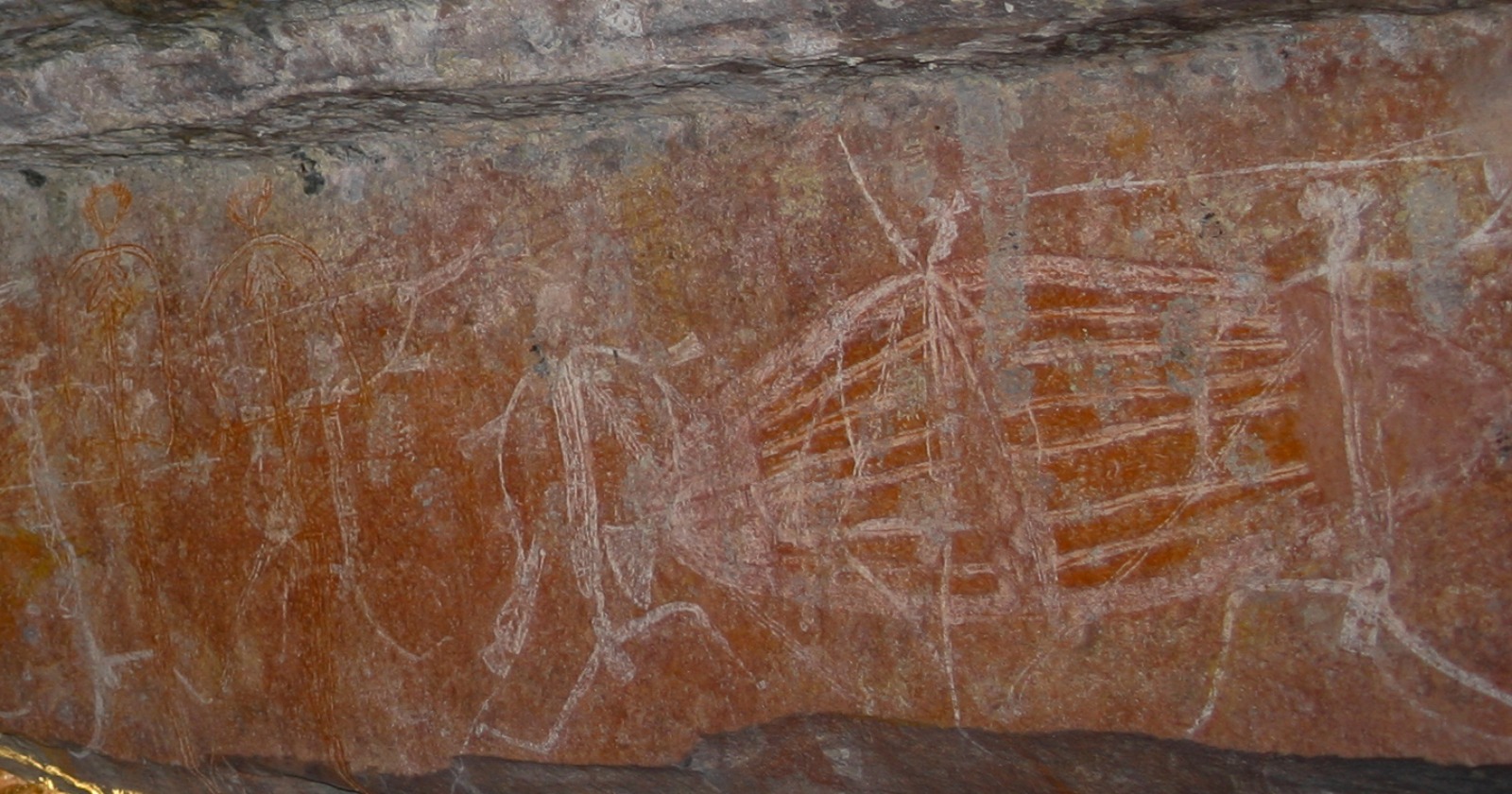
A Rainbow Serpent in the rock art of western Arnhem Land is a composite creature: a snake body carrying parts borrowed from other animals, most often the head of a macropod, sometimes a crocodile head, sometimes fish fins or human breasts. Rainbow Serpents are Ancestral Beings credited with acts of creation and destruction, and people across the region still tell stories about them.
A survey published in Australian Archaeology has now counted them across one small area of Amurdak Country and found something the regional record does not otherwise contain. At Awunbarna, also known as Mount Borradaile, 29 Rainbow Serpent paintings occur at 21 rock art sites, and the authors argue 20 of those paintings were made after contact with Europeans. Across the whole of western Arnhem Land only 52 recent Rainbow Serpent paintings are known. Awunbarna holds 38.5 per cent of them.
The count and the cluster
The survey team has recorded and analysed 165 Awunbarna rock art sites since 2018, out of 167 known. The 21 sites carrying Rainbow Serpents are 12.6 per cent of the 167 known.
The comparison that gives the number its force is with the neighbours. At Namunidjbuk to the northeast, two Rainbow Serpent paintings turn up across 352 recorded sites, one post-contact and one much older. At Injalak Hill, next to Gunbalanya to the south, two turn up across 232 sites, both recent, and one of them depicts Yingarna in human form. Yingarna is the first mother in the accounts the paper sets out, the Ancestral Being who created the region’s clans and told them the languages they should speak.
Spatially the contrast is sharper still. Outside Awunbarna, the region’s Rainbow Serpent paintings are scattered across seven survey zones of 1,000 square kilometres each, plus the two at Namunidjbuk. The Awunbarna paintings sit inside an area of 27 square kilometres, roughly 4.5 kilometres by 6. The authors report that the other 32 recent Rainbow Serpents are widely dispersed, with no other significant cluster within an area smaller than 100 square kilometres. The paper names only one other large cluster: 22 older Yam style Rainbow Serpents strung along Twin Falls Creek on the Arnhem Land plateau, eleven on each bank.
Adding the Awunbarna sample, together with the two paintings each at Namunidjbuk and Injalak Hill, raises the known western Arnhem Land total to 139 Rainbow Serpent rock paintings, of which 70 are Yam style, 52 recent and 17 transitional between the two. Awunbarna’s 29 are 20.9 per cent of that total.
The recent paintings run to twice the length of the older ones
The nine Yam style Rainbow Serpents at Awunbarna, the older group, run from 0.32 metres to 2.0 metres long and average 1.14 metres. All of them have line infill, all have macropod heads, and eight are on shelter walls with one on a ceiling.
The 20 recent ones run from 0.9 metres to 6.1 metres and average 2.4 metres, by the paper’s text, although its own table lists three of the 20 below that 0.9 metre floor, the smallest at 0.64 metres. They are more varied in colour, infill and placement, the three things the paper tracks over time: red, white and red, yellow and red, white and purple; infill of several kinds; walls and ceilings both. Eight have macropod-like heads, eight have snake heads, two have crocodile-like heads, one has a goanna-like head and one has a double snake head.
This matches a pattern Taçon and colleagues reported for the region three decades ago, in the 1996 regional tally that the new paper draws its wider totals from; for where the styles sit in time the paper points to Taçon and colleagues’ 2020 western Arnhem Land rock art chronology. They wrote in 1996 that “Yam Rainbow Serpents are generally smaller than Modern”, and the Awunbarna sample is consistent with it.
The largest recent Rainbow Serpent at Awunbarna, on the ceiling of the site the team labels AW5, measures 6.1 metres in a straight line and 6.88 metres if the curve of the body is followed. It has a crocodile-like head with a tongue between ten upper and eight lower teeth, and fish fins behind the head. An arm or flipper hangs from the body about one-third of the way to the tail, and a prominent backbone shows indications of vertebrae and ribs, surrounded by areas of red hatching on a white body. It is not the region’s largest. The paper reports a recent Rainbow Serpent recorded elsewhere in western Arnhem Land at 20 metres long.
A whale, a giant, and 124 metres of placed stone
Three other things at Awunbarna are set out in detail here: the whale and the giant, which fall among the paper’s previously undescribed instances, and a stone arrangement it calls unique. The paper sets the whale and the stone arrangement against the rest of Australia, and the giant against the rest of Awunbarna.
One site holds a painting of a whale, white with a red outline, just over two metres by one, positioned so that it appears to be swallowing a woman. A baleen whale filter-like design hangs down from its mouth. The authors read it as most likely a humpback, and note that no other whale painting is known from any rock art site in western Arnhem Land, and that it is the only known rock art depiction of a whale in Australia showing baleen. Most Australian rock art whales are engravings rather than paintings, such as those of the Sydney Basin, where 101 whale images are recorded. In November 2020, three humpback whales swam up the East Alligator River a few kilometres from the site, which the authors offer only as evidence that seeing one there was possible.
At another site is the largest human figure at Awunbarna, a male giant just over 2.1 metres long, lying on its side with one arm raised, five fingers on each hand, four toes on one foot and three on the other, and fine hatched infill across the torso.
The third is a stone arrangement. It covers an area 38.2 metres by 37.5 metres and is made from 124 metres of deliberately placed stone, with a winding 16 metre neck running from a circular body to a boulder shaped like a crocodile head, pointing northwest at 326 degrees. Several further arrangements lie nearby, among them an oval built from 117 metres of stone and a snake-like curve of 34.2 metres with a large head stone. The authors record the Rainbow Serpent arrangement as one of only three known in Australia, the others both in Queensland.
The 124 metres is where the coverage of this study slipped. Popular Science described the arrangement as 407 feet long, and its standfirst rounded that to nearly 410 feet. The figure converts the 124 metres of stone the builders laid down, which is the total run of placed rock, and the serpent itself fits inside a footprint of roughly 38 by 38 metres.
Charlie Mungulda, senior Amurdak Traditional Owner and a co-author of the paper, records that the arrangement was the ground for an initiation ceremony called Morak, held in the late dry season for young men of about eighteen and older. The paper records that the ceremony ceased in the 1970s.
The dating rests on style, layering, pigment and one other site
The finding that recent Rainbow Serpents are larger depends on knowing which paintings are recent, and the paper reports no direct date for any painting in the study.
The post-contact assignment, meaning after about 1640, rests on four lines of indirect evidence. The paintings are in the most recent regional style. They sit in the uppermost layers where panels are superimposed. Seven were made largely in white pipe clay, which sits on the rock rather than staining it and so usually survives only a few centuries and sometimes erodes within decades. And their colour and infill choices are consistent with those tracked in a 500-year sequence at Nawarla Gabarnmang in central-western Arnhem Land, supported by radiocarbon dates and sequence analysis, where the changes accord especially well with Awunbarna for paintings made between 1640 and 1930.
That is a reasonable chain, and it is still a chain of inference. The sample behind the size comparison is also small: nine older paintings against twenty recent ones, at one location.
One figure in the paper is stated two ways. The 12.6 per cent is introduced as the share of the 167 known Awunbarna sites carrying any Rainbow Serpent, older or recent. In the conclusion it is repeated as the share of recorded sites carrying recent ones. Both the set and the denominator have shifted, and the second use is the looser one.
The pigment limb travelled badly in the coverage. Popular Science reports that the white pipe clay starts fading after only a few decades. The paper’s statement is that such paintings usually survive a few hundred years and sometimes erode away in a few decades. The difference matters, because the pigment’s survival time is one of the four things holding the recent dating up.
Why the authors think the paintings were made so big
The authors’ explanation is that senior artists, by repeatedly painting the region’s most powerful Creation Being at great size, were reasserting power over a changing cultural landscape at a moment of upheaval, as buffalo shooting spread across Amurdak and neighbouring Country in the late 1800s. Painting large made an image harder to miss, more costly in time and pigment, and easier for elders to point to when teaching.
A purely strategic reading would misrepresent the case, because much of it runs through Mardayin, which the paper describes as a major regional Arnhem Land ceremony, celebrating the spiritual links between individuals, sites and the Ancestral realm. The paper quotes the late Mawng elder Lazarus Lamilami to the effect that an exceptionally large living creature, a big fish or goanna or even a large yam, is itself understood as maraiin. Very large paintings, the authors argue, could be considered Mardayin for the same reason.
It remains an interpretation, and the paper presents it as one, arguing and concluding rather than reporting. There is no independent test of motive in the data, and the survey cannot rule out other reasons a community might paint bigger. The survey establishes the count, the cluster and the measurements.
One detail cuts in an unexpected direction. At Awunbarna the introduced subjects, the horses and buffalo, were not painted as very large figures, and neither were crocodiles, despite the number of real ones in the country, although two recent Rainbow Serpents were given crocodile-like heads and a third a crocodile-shaped midsection. Awunbarna does hold other very large paintings: fish, goannas, a sea turtle, the whale and the giant. But the site clusters to the north and south hold many large crocodile paintings, and at Awunbarna it was Rainbow Serpents that were repeatedly painted big.
The standout is still the ceiling at AW5, and the 6.1 metres of crocodile-headed serpent on it. According to Mungulda, that is where Rainbow Serpent stories were told to young people, stories that the paper says helped prepare young men for aspects of the Morak.