

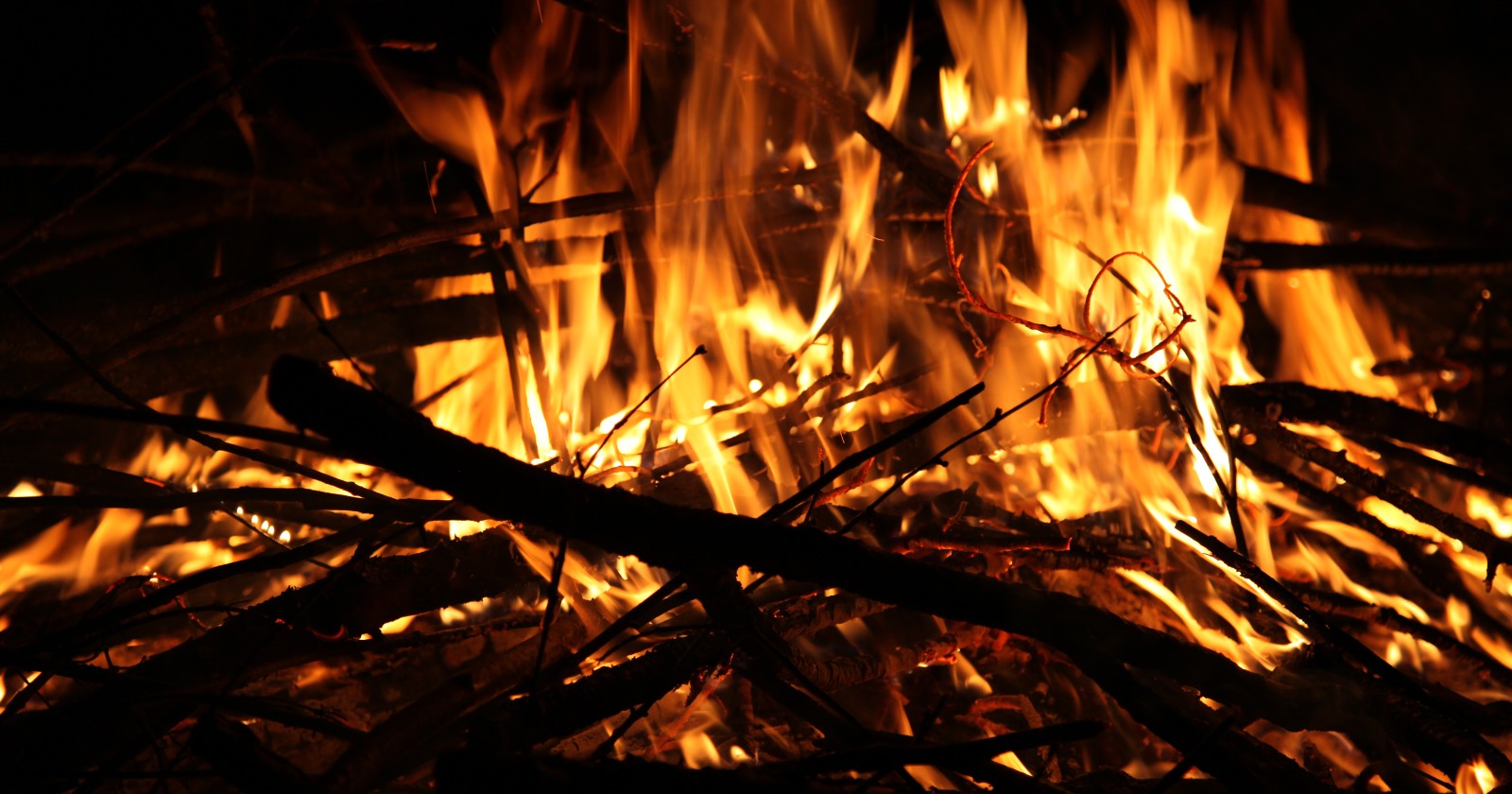
Sit at a campfire after dark and the light is not evenly shared. The faces nearest the fire may be clearly lit, those farther from it less so, and someone directly across the fire may be hidden entirely, by the flames themselves.
That uneven circle is the setting for a review in Proceedings of the Royal Society B published on 2 September. Catherine Hobaiter of the University of St Andrews and Nathaniel J. Dominy of Dartmouth College report that the light around a fire is bright enough to resolve a hand gesture, so dimness is not what limits it. What may have disadvantaged gesture, they argue, is the flicker.
Three explanations for the switch to speech
The other great apes communicate principally through a large, flexible set of intentional gestures. The review credits eastern chimpanzees with more than 140 discrete gestural units and mountain gorillas with more than 120, drawing on recent catalogues of chimpanzee and gorilla gesture, and puts those repertoires an order of magnitude beyond any other signal type, monkey gesture included. Human children produce many of the same gestures while speech is coming online, and adults still understand them.
That leaves a long-standing puzzle. If most of the evidence puts the load-bearing part of meaning in the hands for non-human apes, why did it move into the voice for one of them?
Three answers have been offered. One is that speech is arbitrary and so frees a signaller from iconic resemblance. Another is that tool use kept the hands busy. A third, associated with Robin Dunbar and with Ronald Planer and Kim Sterelny, is that the fireside is where language was finished off, and that firelight is too dim for gesture to work after dark.
Hobaiter and Dominy restate that third argument and then question the premise underneath it.
Light levels at the fireside
Campfire illuminance figures the paper reports in its supplement run from 19 lux at 40 centimetres to 3 lux at 2 metres. That is dim by household standards. The authors nevertheless call the niche photopic, meaning cone vision is working and the eye can resolve the timing and shape of a moving hand.
What the numbers show instead is unevenness. Firelight is ample, the authors write, for intimate conversation or gossip with a neighbour, but may impede communication throughout the fireside niche, which is exactly the situation a storyteller is in.
Colour matters too, and here the paper is more careful than the University of St Andrews release announcing it. The release says the colour of firelight, “emitting almost no blue-light”, allows “an extension to the day without negatively impacting sleep”. Melanopic equivalent daylight illuminance is the measure that weights light by that blue content, and the paper’s own figures split the fire in two. Flames average 30.4 melanopic EDI lux, above the 10 lux mark the authors treat as the ceiling of the range that suits sleep preparation, which they say suggests some level of melatonin suppression. Coals average 1.8, squarely inside that range, with glowing embers providing what the paper calls the best light of all.
Taken together, the authors write, the firelight niche, “or at least its later stages, would appear well suited for vision and the upregulation of melatonin, extending the day for important social interactions with few adverse consequences”.
One unit in the paper’s section on luminance does not parse. The authors’ own preliminary data give luminous intensities at 1 metre ranging from 3 to 61 cd m⁻¹ for scintillating coals and 18 to 435 cd m⁻¹ for flickering flames, while the figure those numbers belong to is captioned as luminance. Candela per metre is a unit of neither quantity: luminous intensity is measured in candela, luminance in candela per square metre. The lux, melanopic and hertz values are unaffected.
The flicker may be the part that hurts
Firelight does not sit still. Its brightness pulses as the toroidal vortex around the flame forms, rises and sheds. That pulsing swings the eye repeatedly between photopic and mesopic conditions, raising receptor noise and lowering acuity. Human retinas take several minutes to settle into liminal light, which is part of why road accidents spike at dusk.
So the property that plausibly penalised gesture is the flux rather than the average brightness. That distinction is where the review departs from the account it argues against, and the authors put it as a testable hypothesis.
The flicker rate matters for a second reason. An earlier laboratory study put a fire’s flicker at 2.5 hertz. The authors’ own preliminary campfire measurements put it at 2.7 hertz, which falls inside the delta band of brain rhythms at 0.5 to 4.0 hertz. Visual cortex neurons tend to lock onto a flickering stimulus, an effect known as photic driving, and delta activity is associated with better attention and memory.
The open and close cycle of the mouth during speech runs at roughly 2 to 7 hertz. A fire flickering at 2.7 hertz therefore sits at the slow end of the rhythm of talking.
That number needs handling with care. The paper’s text generalises to 2.7 hertz, while the figure it rests on reports two dominant frequencies, 1.4 and 2.7 hertz, in the example it shows. Firelight, as the authors put it, exists in a state of living flux, and quantifying it is described as a research priority rather than a solved problem.
The claim is about storytelling
The fireside itself is not a new idea. In a 2014 paper, the anthropologist Polly Wiessner reported Ju/’hoansi conversations she had recorded and found a sharp split. Daytime talk was practical and gossipy, while firelight talk was overwhelmingly storytelling. Dunbar and others have taken the same view, treating the fireside as the place where an existing proto-language was refined.
Hobaiter and Dominy push the claim further back. Their suggestion is that a pre-storytelling proto-language would have had more in common with the communication of modern apes than with the language we use today, and that fireside storytelling is where the shift to arbitrary, generative, hierarchically structured speech happened.
The reasoning rests on a deflationary point about daily life. Tool use, teaching, cooperative hunting and social politics are all done without language by other species. Chimpanzees, the authors note, live in groups of roughly 50 to 70 animals, often close kin or partners of decades, in a territory they have occupied all their adult lives. A group that familiar does not need much explicit signalling to get through a day, and a glance may be the only explicit cue needed to arrange a walk to a fig tree.
Storytelling, the authors argue, is a use of language with no non-human counterpart. At present there is no evidence that apes do it, though the authors flag ape pantomime as a possible bridge. Storytelling also trades in displacement, the ability to talk about a time and place that is not here. End-of-day fires, the authors suggest, might have provided one of the first occasions for a scattered group to reassemble and exchange news of what happened while apart.
Everything built on top of the light measurements is inference, and the paper closes with six predictions to make it answerable. They include that gestural comprehension will suffer under firelight relative to steady low light, and more than speech comprehension does. Another is that storytelling speech will match the fire’s rhythm more closely than everyday speech does. A third is that storytellers and listeners will synchronise more than conversational partners do.
The paper’s own account is that the quantification so far is limited. No one, it says, has yet quantified the structural differences between storytelling and mundane speech in a form suitable for cross-species comparison, and quantification of speech tempo in conversation against storytelling remains limited. It cites existing work on storyteller and listener neural entrainment, and on storytelling prosody, as starting points. The authors write that their review risks over-romanticising firelight and that evolutionary scenarios have a justifiably poor reputation.
The instruments have only been pointed at the fire
The claim on offer is large. Language as we use it began at the fireside, on this account, rather than being polished there.
What is narrow, and strange, is the mechanism proposed for it. A light source pulsing near the tempo of human speech, lighting a circle unevenly and possibly hiding the far side of it, is where the authors say a gestural species plausibly began putting the load-bearing part of meaning into its voice.
The authors’ own instruments have so far been pointed at the fire. What happens when they are pointed at the people around it?