

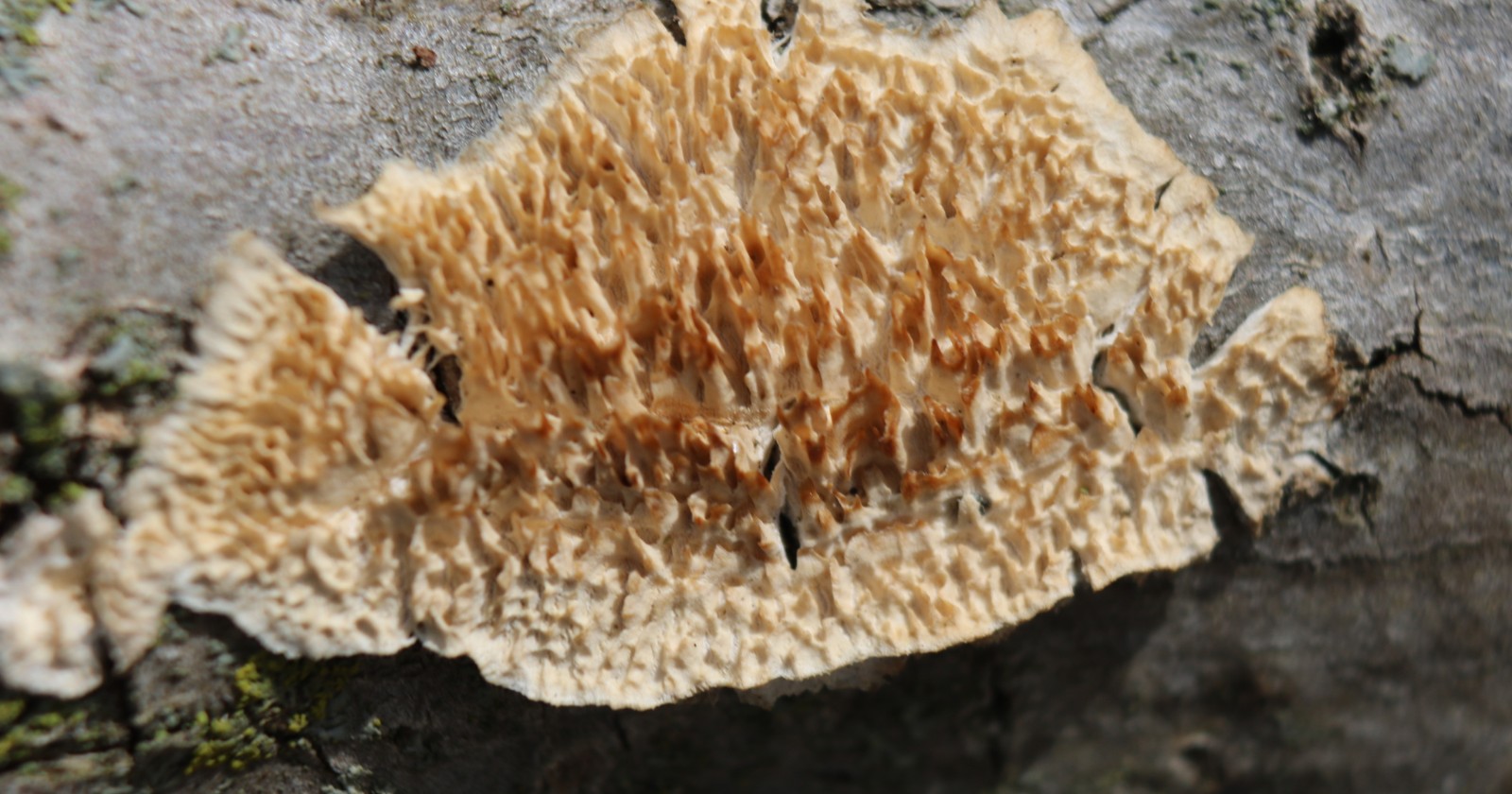
A millilitre of water pumped off a gas wellhead in Antrim County, Michigan, holds between 4,200 and 6,800 fungal cells.
That count, reported in The ISME Journal, comes from formation water drawn out of producing shale-gas wells at depths of 247 to 556 metres. Separately filtered samples of the same waters yielded 205 pure fungal cultures, which cluster into 67 distinct groups, 13 of which sit below the sequence-similarity threshold conventionally used to say a fungus belongs to a described species.
Fungi in the deep subsurface are not a new observation. The paper’s own introduction says a growing number of studies have detected them, and its conclusions place them as present and diverse “as previously reported”. What the authors say they could not find is an earlier count: they report being unable to locate previous estimates of fungal biomass in subsurface waters.
Devonian mud
The material those fungi are living in was laid down in the Upper Devonian, between 382.7 and 358.9 million years ago, as planktonic algae and wood settling into mud. It is still there, in a rock running up to 25 percent organic matter by weight.
The Antrim Shale is one of the largest sources of biogenic methane in the global subsurface, which is why there are wells in it at all. Methane made up 86 to 97 percent of the gas coming up with the water, and the carbon isotopes point to most of it being microbial in origin, made from the fossil carbon rather than cooked out of it by heat.
That is the raw material. The question the study asks is who is at the table.
The water came down later, and not all of it together
Ice sheets advanced and retreated across the Michigan Basin repeatedly over the past two million years or so, prising open natural fractures and pushing meltwater down into the rock. Three of the six sampled wells still plot isotopically with late Pleistocene glacial meltwater.
The other three do not. The two saltiest plot as remnant basinal brine, ancient seawater concentrated by evaporation, and one plots with modern local rainfall, which the authors read as recent recharge through a more permeable limestone below.
The chemistry follows the same split. The shallowest well, Conant at 247 metres, produces fresh water at 448 milligrams per litre of total dissolved solids. The deepest, Mancelona West at 556 metres, produces brine at 112,000.
Those wells have been pumping daily for at least ten years since drilling or their last workover, each having produced more than a million litres cumulatively. The team took 80 litres from each wellhead into sterile containers.
Counting cells took two stains and a microscope, on water fixed in glutaraldehyde and drawn down onto black polycarbonate filters. Total cells, stained with DAPI, ran from 41,000 to 69,000 per millilitre. Fungal cells, stained with calcofluor white, gave the 4,200 to 6,800 figure, and more than 99 percent of the fungal biomass was single cells.
Where the fifth-of-the-biomass figure comes from
The study’s own section heading says fungi constitute a fifth of the biomass in the Antrim Shale. Three different figures are in play behind that sentence and they do not agree, and only two of them are independent measurements.
Set the two microscopy ranges side by side and fungi are on the order of one counted cell in ten. That arithmetic is ours; the paper plots the enumeration ratio in a figure without stating a single number for it in the text.
A second ratio comes from quantitative PCR on marker genes, and it is far smaller. By that method fungal to bacterial cells ran from 1 in 7,028 to 1 in 713, with a median of 1 in 2,572. The authors note that molecular approaches such as qPCR typically produce lower relative values for fungal abundance.
The third figure is the headline one, and it is not a third measurement: it is the qPCR ratio re-expressed in carbon. Cell counts were turned into carbon using 10 femtograms of carbon per bacterial cell and 6,469 femtograms per fungal cell, giving fungal to bacterial carbon of 1:10.86 at one end and 1:1.10 at the other, median 1:4.7. The 1:1.10 end, the one most favourable to fungi, carries a standard error of 1:71, which is a way of saying not much. The qPCR figures carry the same problem, with standard errors of 1:6,669 on the 1 in 7,028 and 1:1,107 on the 1 in 713.
The conversion factor is the weak joint. Subsurface-specific factors for fungi are currently unavailable, the paper states, so the comparisons rely on factors developed for pelagic organisms that have not yet been validated for subsurface fungal communities. Published marine estimates of fungal cellular carbon run from 6,469 to 203,750 femtograms per cell, and the lowest was chosen as a conservative approximation.
The stain has its own slack. Calcofluor white binds chitin and cellulose both, chitin turns up in various protists and animals, and some fungal lineages lack it, all of which can push a calcofluor estimate to as much as twice what an ergosterol-based method returns. And because only free-living cells were filtered out of pumped water, anywhere from 20 to 80 percent of microbial biomass in comparable settings sits in biofilms instead, making the counts what the paper calls first-order approximations rather than uniform subsurface values.
The comparison the coverage seized on needs the same handling. The paper puts its counts against published marine values of 8.1 to 1,980 fungal cells per millilitre and calls its own numbers comparable to, or perhaps slightly higher than, those. The University of Michigan release flattens that into a straight comparison, and adds a figure of roughly 250 fungal cells in a single drop and more than 12 trillion in an Olympic-sized pool. Neither number is in the paper.
Two hundred and five cultures
The cultivation is the part that does not depend on a conversion factor. Water was filtered on a coarser membrane, shaken loose into sterile water, spread onto two kinds of agar and incubated at 17 degrees Celsius to approximate the temperature the cells came from. Two hundred and five axenic cultures came out.
Clustered at 98 percent similarity, those 205 strains resolve to 67 distinct groups, 34 of which also turned up in the DNA sequenced straight from the water. All were Ascomycota or Basidiomycota, across 15 fungal orders, dominated by classes the paper describes as well-established degraders of recalcitrant carbon compounds at the surface.
One of them, the white rot fungus Irpex cf. lacteus, was detected in every well by ITS amplicon sequencing and was also recovered in culture. White rot fungi are the group that breaks down lignin, the compound that makes wood hard to eat, which is a suggestive thing to find in water drawn off buried Devonian plant matter.
Twenty-six of the 67 culture groups could not be assigned to a genus, which the authors put down to limited sequence similarity and ambiguous database matches. Thirteen fell below the 98 percent benchmark to any known taxon.
One went much further. The paper singled out for phylogeny the isolate with the lowest similarity to any reference in the fungal database, 74 percent. That isolate is designated Teichospora sp. QM01, and the phylogeny, built from a different gene, put it clearly outside every established Teichospora species, its closest relative a fungus known for decomposing lignified plant material.
Representatives of every group identified have been deposited, cryopreserved and dried, at the University of Michigan Herbarium. The paper calls this the first public collection of its kind from the subsurface, which matters more than the novelty count, because a sequence can only be re-read, and a living culture can be re-grown, tested and given a formal description.
Dormancy, oxygen, one basin
Active fungi have been detected in subsurface ecosystems, the paper notes, but substantial evidence suggests many microorganisms in extreme environments may exist in a dormant rather than metabolically active state, and detection does not uniformly indicate activity. Nothing in this study measures a fungus doing anything down there.
Oxygen complicates the isolation. All of it was done under aerobic conditions, which likely introduced bias toward aerobic and facultatively anaerobic taxa. The paper reads the formation as prevailingly anoxic, on the strength of the archaeal methanogenesis it hosts. It measured trace dissolved oxygen of 0.1 to 0.6 percent and says pumping water to the surface can introduce exactly that much; dark oxygen from microbial dismutation has been proposed as an endogenous source in other ancient subsurface waters.
Then there is scope. This is one geological formation in one sedimentary basin. The rarefaction curves saturated within each well but kept climbing as wells were added, which is read as capturing only a portion of the diversity present.
A contaminant question runs alongside all three. Plant DNA, particularly pine, showed up even in wells with no sign of recent surface recharge, and land plants accounted for 64.5 percent of the eukaryotic reads before being discarded. The cause could not be determined; ancient DNA, hydrological connectivity, primer bias and an expanded prevalence of heterotrophic metabolic strategies are listed as candidates. Human-associated organisms such as Malassezia and common surface bacteria were specifically screened for and not detected, and 23 isolates that grew on control plates were excluded along with every community sequence matching them.
Two smaller things matter if this study gets quoted back at you. The paper gives its fungal sequence total as 689 operational taxonomic units in the abstract and results, then refers once to 749 in a later sentence, and never reconciles the two. And the tardigrades in several headlines are a single word in a list of DNA signals, with no counts, no images and no specimens.
The university’s release also describes the 689 as unique species and the 13 as species not described before. The paper’s line is that sequence data alone are insufficient to confirm true novelty, and its candidate taxon is either a previously unsequenced species or an uncharacterised lineage. Its counter-argument is that the 13 exist as living cultures, which it calls direct evidence of undescribed diversity. What it does not claim is 689 new species.
The gas operator, Riverside Energy, provided well access and sampling support, and two of the co-authors are affiliated to Riverside Energy Michigan. The authors declare no competing financial interest.
The long meal
What the study proposes, carefully, is a food web running on fossil carbon. Saprotrophic fungi of the kind found here break down refractory material at the surface, and the suggestion is that they may be doing the same to buried algae, wood and bitumen underground, releasing organic acids, alcohols, carbon dioxide and hydrogen that feed the bacteria and the methanogens.
That is a proposal offered as such, not a demonstration. The paper does report evidence of ongoing microbial activity in the formation waters, from dissolved inorganic carbon and carbon isotope values, but that evidence is microbial in general and says nothing specific about the fungi.
The algae sank into that mud while the first forests were spreading across the land above, and the meltwater came down onto them much later. Whatever has been happening between them since, some of it now sits in a freezer in Ann Arbor, alive, on a plate that grows at 17 degrees, waiting for someone to give it a name.