

Limonene is the plant terpene behind the smell of citrus peel. It is also in pine and mint and in a long list of consumer products, and the paper calls its production by a mammal an unusual proposition, though limonene has been reported in the secretions of other bat species before.
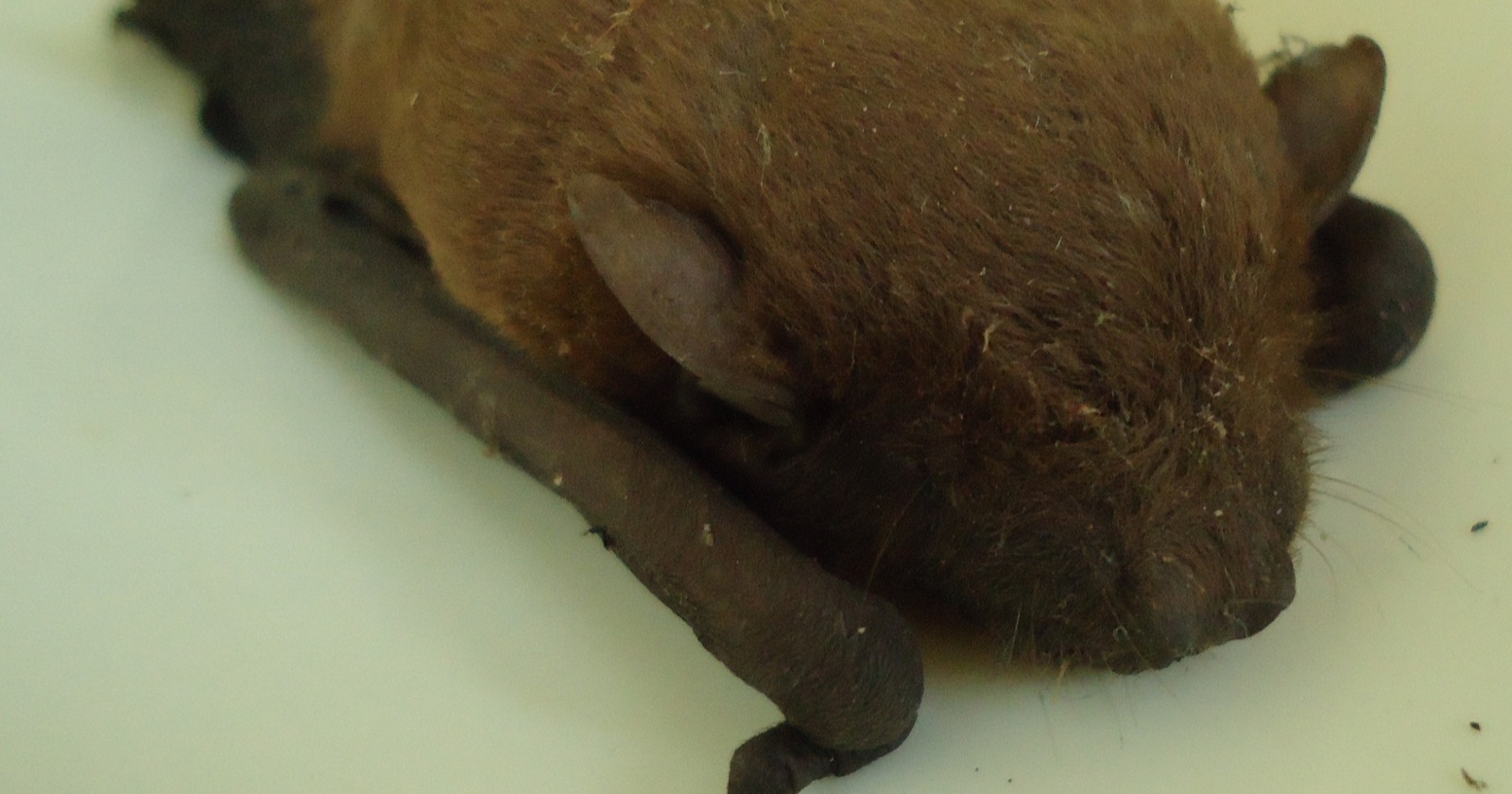
The Asiatic lesser yellow house bat is one anyway. Limonene comes off a gland on its snout, and most individuals of a cricket the bat hunts moved away from the smell of it. In a Y-shaped glass tube run in complete darkness, 44 of 47 crickets chose the arm with clean air over the arm carrying bat scent, and a bought standard of limonene, with no bat anywhere in the apparatus, sent 34 of 38 crickets the same way. The work, olfaction beyond acoustic cues in the bat and insect arms race, is published in eLife by a team spread across four laboratories at three Chinese universities, led from Northeast Normal University.
Bat scent in a glass tube
The apparatus was a Y-shaped glass tube, 35 mm across, with a 300 mm stem and two 200 mm arms. One arm was fed air from a chamber holding one of eight adult Scotophilus kuhlii, picked at random for each trial, and the other was fed air from an identical empty chamber. Each line carried an activated carbon filter bottle, and airflow was set to one litre a minute per arm.
Trials began at 23:00 in the dark. A cricket counted as avoiding the odour if it entered the clean arm and stayed for ten continuous seconds, and as not avoiding if it did the same in the bat arm or shuttled between the two without settling anywhere that long. Of 47 Loxoblemmus equestris tested one at a time, 44 avoided, one entered the bat arm and two shuttled, a chi-square of 35.76 on one degree of freedom at p below 0.001.
The control run matters. With no bat in either chamber, 24 crickets split 13 to 11 between the arms, a chi-square of 0.17 at p equal to 0.68, which the authors read as no significant bias in the apparatus itself; the side the bat sat on was randomised from trial to trial. Video was analysed by an experimenter blinded to the treatment conditions.
The diet check that came first
Before any of that, the team had to establish that this bat eats this cricket. They caught 30 S. kuhlii from a colony in a Chinese fan palm in Guangzhou on 10 July 2022, held each one in a washed cotton bag for two hours, collected the droppings and sequenced the insect DNA in them.
Two genetic markers were used. The 16S marker returned 426,832 insect sequence reads sorted into 323 operational taxonomic units, and the COI marker returned 1,805,577 reads and 534 units. Within the order Orthoptera, the cricket family Gryllidae accounted for 94 percent of sequences under 16S and 93.5 percent under COI. Gryllidae also turned up in half the bats, 15 of 30, and a phylogenetic analysis placed at least seven cricket species among the prey.
An ultraviolet light trap and a Malaise trap, run over eight nights at a grassland foraging site about a kilometre from the roost, caught 80 crickets, 70 of them L. equestris. Moths and crickets were the two most abundant groups collected there, but moths barely moved in trial runs of the Y-tube, which ruled out any reading of their odour behaviour, so the crickets got the experiment.
From six compounds down to one
Air drawn off the bats was trapped on a resin column, washed off with solvent, and run through a gas chromatograph whose outflow was split two ways, two thirds to a chemical detector and one third across a live cricket antenna. A pooled sample from eight bats produced antennal depolarisations above 0.1 mV in all five crickets tested, and nothing in the three crickets given odour-free control samples.
Mass spectrometry on the same extracts named six compounds. Two of them, 2,2-dimethylheptane and limonene, came off the column at the same moments as the antennal responses. Four commercially available standards were then presented to antennae one at a time, and 2,2-dimethylheptane was not among them, so the other compound that had tracked an antennal response went untested. Of the four, only limonene beat a hexane solvent control, and its response was concentration dependent, with the 1 percent and 10 percent solutions the two that cleared the control.
Limonene alone then moved the crickets. Thirty-four of 38 individuals, 89.5 percent, chose the limonene-free arm of the same maze against a 10 percent limonene solution at 5.87 x 10⁻⁷ mol per microlitre.
A separate sampling round located the source. Volatiles from the hair, droppings and snout gland secretions of nine bats were compared, and limonene appeared in hair and in snout secretions but not in droppings. Hair is likely a passive carrier, the authors write, which points the origin at the gland.
A plant compound on a mammal
It seems implausible, the authors write, that crickets could rely on limonene by itself to tell a bat from a leaf. The compound is common in mint, in citrus peel and in pine, and nothing in these experiments shows how a cricket separates one source from another.
Two ways out are offered, and the paper calls them non-exclusive rather than alternatives. Neither is tested here. Limonene may be one cue among several, since cricket antennae also responded to other bat volatiles during the chromatography runs. And crickets may also read limonene in context, alongside other bat-specific compounds or at a particular place and hour of the night.
There is a contamination question too, and the paper argues against it rather than asserting past it. Glassware was rinsed with ethanol and dried at 120 degrees Celsius, the bats were held in stainless steel cages, sampling ran in a dedicated odour-free room, and limonene was absent from empty-chamber air blanks, from clean swabs and from the droppings while being present in hair and snout secretions. Limonene has separately been reported in secretions of other bat species, and skin microbes carrying terpene-building enzymes are a candidate source, though the biosynthetic pathway remains to be determined.
The experiments establish that the compound is sufficient to trigger avoidance. Whether it is necessary, and whether it is what wild crickets key on, is not settled here. eLife‘s public assessment calls the evidence important and the chain of it coherent and convincing, wording that grades the study’s methods and reach rather than any survival benefit, and the paper states that direct observation of bat and insect encounters in manipulated olfactory environments will be needed to measure that.
A grassland sprayed with the molecule
The field test ran over nine nights between 24 June and 16 July 2024, inside the bats’ foraging range at the site where the crickets had been collected. Four plots of 5 by 5 metres were set out in a line 100 metres apart, two randomly assigned each night to limonene and two to hexane alone, each with an acoustic recorder half a metre above the ground facing down.
Recording ran for 40 minutes from 19:50. One millilitre of solution was then sprayed across the 25 square metres between 20:30 and 20:40, and recording ran again for 40 minutes from 20:50. Calls were counted by matching spectrograms against ten templates after band-pass filtering from 3 to 6.5 kilohertz, a window chosen for a species whose dominant call frequency sits near 5 kilohertz and which the authors state does not overlap the other crickets on the site. Fifteen plot-nights passed quality control, eight limonene and seven control, across 1,200 recordings of 55 seconds each.
Before the spray the two sets of plots were not significantly different, at 245 plus or minus 143 calls a minute in the plots about to receive limonene against 207 plus or minus 133 in the controls, at p equal to 0.720. Afterwards the limonene plots fell to a mean of 130 calls a minute with a standard deviation of 139, while the control plots rose to 298 plus or minus 126, a rise the authors read as consistent with the species’ natural crepuscular activity peak. The raw call counts and behavioural data are deposited.
The quiet has two readings and the recordings cannot choose between them. The crickets may have left the sprayed squares, or may have stopped singing where they sat. Either way the result is an animal that has become harder for a bat to find.
The arms race had a second channel
The bat and insect contest is, in the paper’s phrase, a quintessential predator and prey system, and it has been told almost entirely in sound. Over 50 million years of this arms race insects evolved ultrasound hearing, sound-absorbing scales, acoustic decoys and ultrasonic jamming, and auditory detection alone arose independently in at least seven insect orders.
The paper’s suggestion is that the dominant acoustic narrative may have narrowed what got looked for. Bats produce gland-borne volatiles that in several other species serve communication between bats, and this study does not test what the snout secretions are for in S. kuhlii. It shows a cricket responding to whole-body bat odour, and to one compound that the snout secretions contain.
A glass tube, eight bats’ worth of trapped air and 15 usable plot-nights across nine nights in a Guangzhou grassland do not overturn a story that size, and they do widen it. The animals in it smell as well as hear, and at least one of them appears to be eavesdropping on the other’s chemistry.