

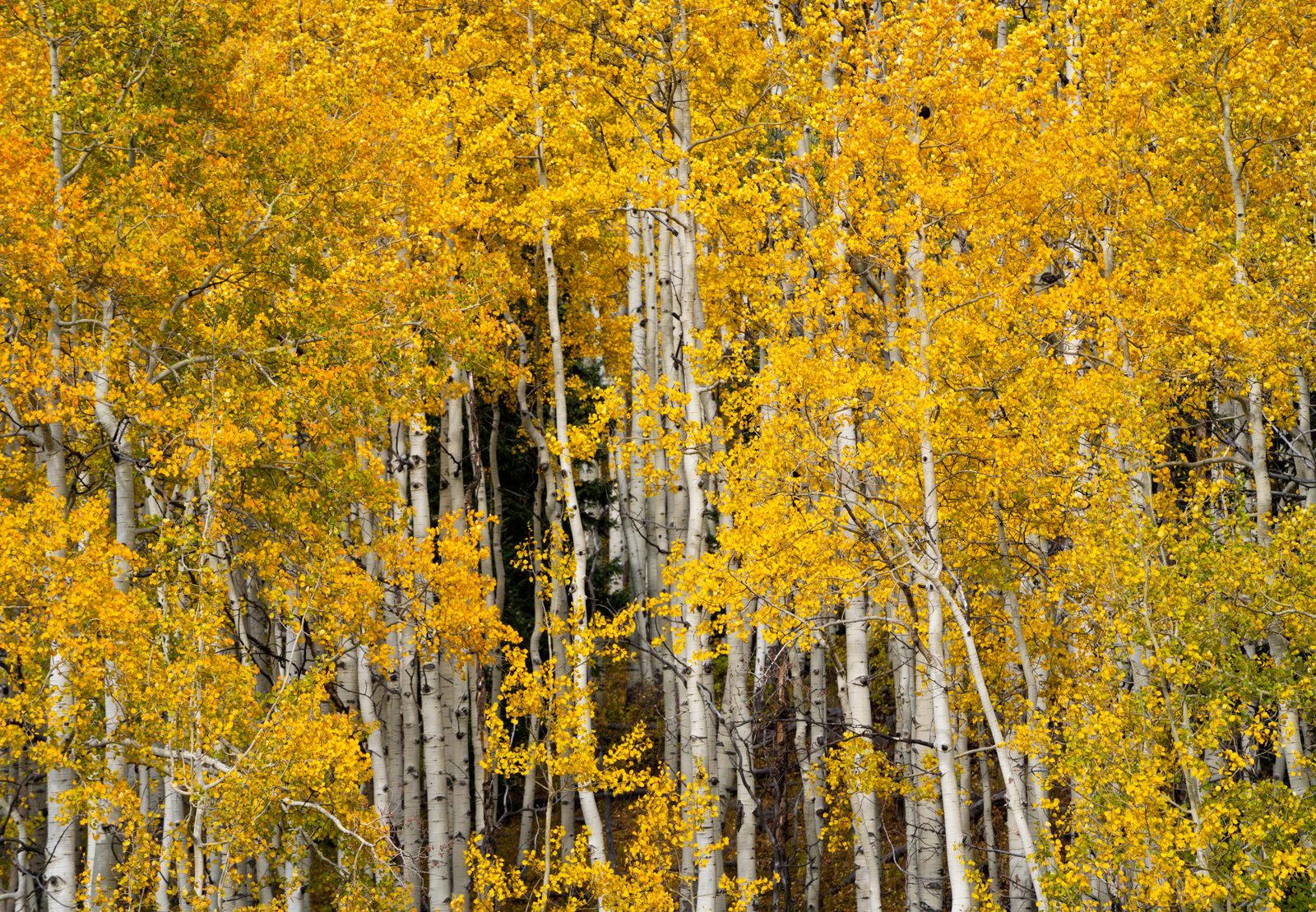
In south-central Utah, on the western shore of Fish Lake, a stand of quaking aspens looks like an ordinary forest. It is not. Roughly 47,000 stems belong to one genetic individual called Pando, Latin for “I spread,” covering about 43 hectares through a shared root system.
The familiar figures are extraordinary even before age enters the story. A current summary from Friends of Pando, which links the measurements to the original research, gives an area of 106 acres and an estimated weight of 13.2 million pounds, or close to 6,000 metric tonnes. Pando is therefore widely described as the world’s largest tree by weight and land area, although broader claims about the largest organism depend on what is being measured.
Its conservation problem is real, but the phrase “Pando is dying” now requires qualification. A peer-reviewed 2018 study in PLOS ONE documented poor replacement of mature stems and found mule deer strongly associated with unsuccessful regeneration. Protection has expanded considerably since then, however, and new shoots are surviving in managed areas.
One seed, tens of thousands of stems
Quaking aspen (Populus tremuloides) can reproduce from seed, but it can also produce new stems directly from its roots. These stems are called ramets. Each carries the same inherited genetic identity as the original plant, even though mutations can arise in different tissues as the clone grows.
Over time, one genetic individual, known as a genet, can spread across a hillside while older stems die and younger ones replace them. The visible trunks are temporary modules rather than separate trees in the usual sense. Pando represents this strategy at an exceptional scale.
Individual stems generally survive for roughly a century, while the underlying clone can persist for thousands of years by producing replacements. That distinction is why counting tree rings in one trunk cannot reveal Pando’s true age. The organism’s continuity lies in the regenerating clone, not in any single stem.
How the age estimate changed
A genetic project led by Rozenn M. Pineau sampled Pando and neighboring aspens extensively. Pineau’s affiliations on the current paper include the Georgia Institute of Technology and the University of Chicago. The researchers sequenced more than 500 samples from leaves, roots, bark, and other tissues, then separated Pando’s somatic mutations from inherited differences involving neighboring clones.
Early coverage of the 2024 preprint reported an estimated age between 16,000 and 80,000 years. That is the range repeated throughout the original draft, but it is no longer the current result. The reviewed preprint published by eLife in March 2026 gives a revised estimate of approximately 12,000 to 37,000 years.
The paper has received public review through eLife, but it is not a final version of record. The eLife assessment calls the study useful while judging the evidence for some conclusions incomplete because the researchers used relatively low-coverage, reduced-representation sequencing. The age range should therefore be treated as a model-based estimate, not as a settled birth date.
Reading time through mutations
Somatic mutations are genetic changes that appear in an organism’s cells during its lifetime. They accumulate as cells divide, giving researchers a possible molecular clock. In principle, stems that share more recent growth history should carry more mutations in common than stems separated by a longer chain of cell divisions.
Pineau’s team expected nearby stems to be more closely related genetically than stems on opposite sides of the clone. A spatial signal appeared at short distances, but it weakened across Pando as a whole. The researchers suggest that rapid root growth may mix genetic lineages or that some mechanism limits the transmission and accumulation of mutations.
The revised phylogenetic models produced the 12,000–37,000-year estimate, supported by a long record of aspen pollen in nearby lake sediments. Even the lower end makes Pando older than the first cities and the entire written historical record. The upper end would place its origin deep within the last ice age.
What 6,000 tonnes of aspen looks like
Pando’s approximately 43 hectares would hold about 60 full-sized international soccer pitches. Its estimated mass is close to six million kilograms. That mass is distributed across tens of thousands of stems and an underground system that has never been completely excavated or placed on a scale.
The trunks themselves look like ordinary aspens, with pale bark, dark scars, and leaves that tremble in light wind. Walking through the clone feels like walking through a forest because the single organism is spread across an entire landscape. Its unity becomes visible through genetic sampling and maps rather than through casual observation.
Calling Pando the largest organism on Earth can create confusion. It is more precise to call it the largest known tree by weight and land area, or one of the largest documented clonal organisms. Some fungal clones cover more ground, while ancient seagrasses and other clonal plants compete under different definitions of size and age.
Why browsing became a problem
Pando renews itself by sending tender shoots above the soil. Mule deer, elk, and cattle can browse those shoots before they grow beyond reach. If too few stems survive to recruitment height, mature trunks die without enough younger replacements entering the canopy.
The 2018 PLOS ONE study compared unfenced ground with areas under different fencing and treatment regimes. Mule deer presence was strongly associated with reduced regeneration, while properly protected areas produced the most robust young growth. One older fence that animals could penetrate performed much less effectively.
Historical aerial photographs also showed declining self-replacement beginning approximately 30 to 40 years before that study. The researchers discussed predator removal, hunting restrictions near recreation sites, human development, and persistent browsing as interacting influences. They did not establish predator restoration as a single guaranteed remedy.
Pando is divided by a paved state highway and borders a public campground and private summer homes. Human activity can make the area attractive as a refuge for animals accustomed to people, but the precise ecological effects remain complicated. Drought, insects, disease, livestock, recreation, and management decisions can also affect the clone.
Protection has changed the picture
The early fenced areas demonstrated that Pando could still generate enough young stems when browsers were excluded. The problem was never that the root system had entirely stopped producing shoots. It was that too few shoots survived long enough in exposed or inadequately protected areas.
That management picture changed materially in 2025. According to local reporting published after the project’s completion, new fencing brought more than 80% of Pando into protected zones. Temporary enclosures can also shelter smaller patches until shoots reach approximately three to four metres and become harder for deer and elk to browse.
Friends of Pando now rejects the categorical description of the clone as dying. Its current field summary reports new growth across every monitored section and argues that a complete historical stem census does not exist. Without that baseline, the organisation says researchers cannot yet calculate whether the clone is currently losing more stems than it replaces.
This does not erase the peer-reviewed evidence of deterioration or the continuing risk in exposed areas. It means the most accurate present-tense description is more careful: Pando experienced serious recruitment failure, browsing remains a threat where wildlife controls are absent or breached, and expanded protection has created a credible route toward recovery. Long-term monitoring will show whether the new stems survive in sufficient numbers.
An organism recorded through sound
The bioacoustic story also needs a corrected timeline. Jeff Rice and Lance Oditt captured simultaneous above-ground and below-ground recordings on July 12, 2022, during a thunderstorm. Their conference abstract appeared in 2023 through the Journal of the Acoustical Society of America.
A hydrophone registered low-frequency vibrations as wind moved Pando’s leaves and branches. In a separate test, lightly striking a branch approximately 90 feet away produced a signal at the hydrophone. These observations suggest that vibrations can move through the tree and surrounding ground, but they do not prove that the recording captured a message or an internal biological state.
Rice approached the project as a sound artist, while the team proposed that similar methods might eventually help investigate Pando’s hidden hydraulic and root structures. The work remains exploratory. Its immediate achievement was to make an organism spread across 106 acres perceptible through sound.
What can be said securely
Pando’s precise age is still uncertain, and the once-repeated 80,000-year figure should no longer be presented as the current genetic result. The reviewed preprint places the clone at approximately 12,000–37,000 years old, while its reviewers caution that the evidence is incomplete. Further whole-genome sequencing could narrow or change that range.
Claims that Pando is the oldest or largest organism also depend on the category being used. What is secure is that it is one genetically verified quaking-aspen clone, that it covers approximately 43 hectares, that it contains an estimated 47,000 stems, and that its estimated mass approaches 6,000 tonnes. Its method of renewal is equally clear: new stems must repeatedly survive long enough to replace the old ones.
What protecting Pando now requires
The immediate work is practical rather than exotic. Existing fences must be maintained, breaches detected, and vulnerable shoots protected until they grow beyond browse height. Managers also need continued wildlife monitoring, a reliable census of stems, and coordinated decisions about deer, elk, livestock, recreation, fire, and forest treatments.
The 2025 expansion means the conservation story is no longer simply one of an unprotected organism being consumed without replacement. Most of Pando is now within managed protection, and regeneration is visible. The unresolved question is whether that progress will produce enough mature recruits across enough of the clone to reverse the deterioration documented in earlier studies.
Pando has been replacing its visible parts for at least twelve millennia. The stems standing today are young compared with the lineage beneath them, and most will disappear within another century. Whether the clone continues for thousands more years depends on giving the shoots already breaking through the Utah soil enough time to become the next canopy.