
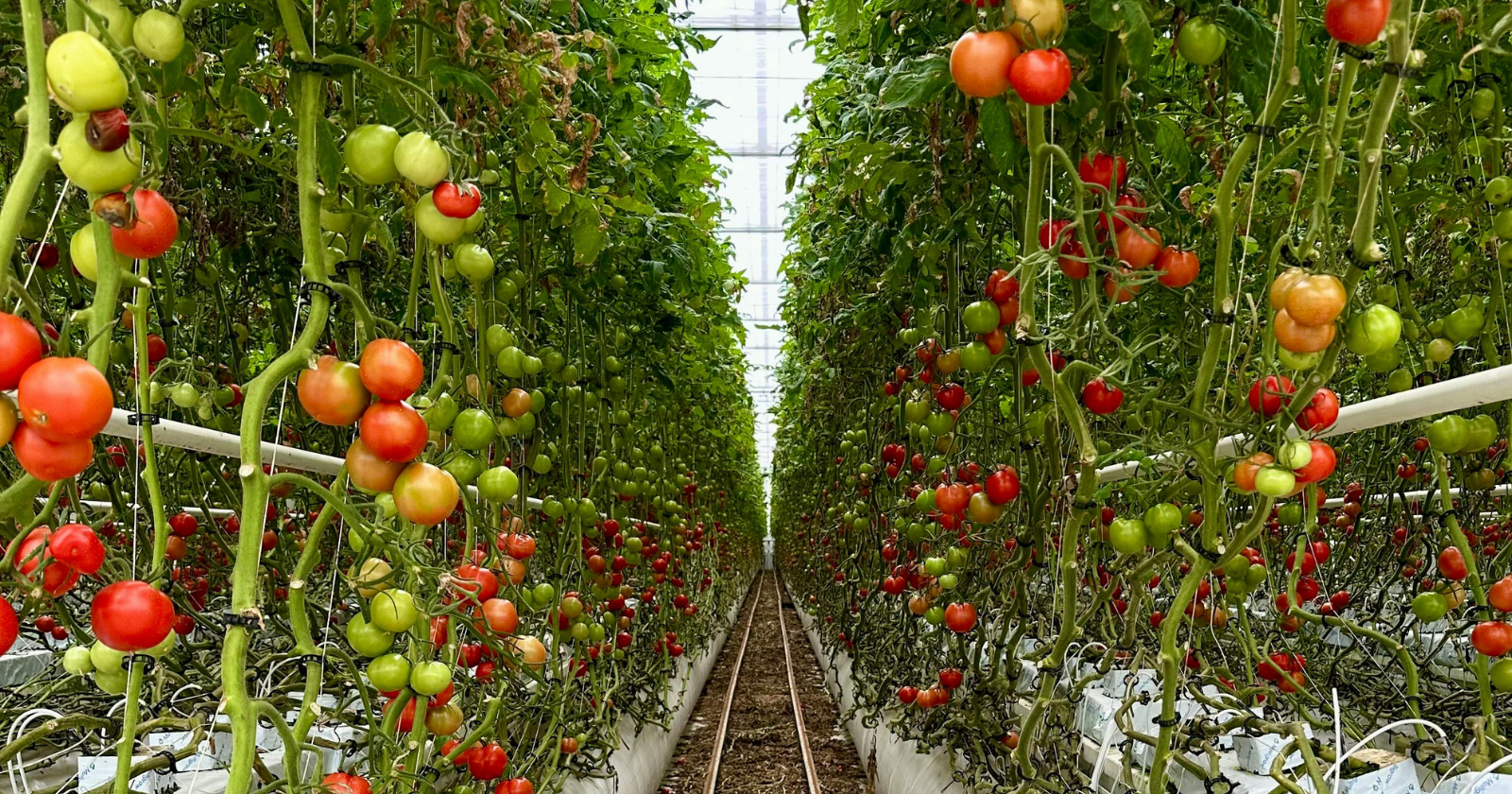
In 2014, a team at Wageningen University in the Netherlands reported that a single gene borrowed from a wild tomato relative let modern hybrids tolerate light around the clock, and that plants carrying the gene produced up to 20 percent more fruit under continuous illumination. The gene has an ungainly name: type III Light Harvesting Chlorophyll a/b Binding protein 13, or CAB-13. It sits on chromosome 7. The paper, published in Nature Communications, reported a dominant locus on the lower arm of chromosome 7 in wild tomato species that confers the tolerance. The finding has quietly shaped how greenhouse tomato research has been argued about ever since.
Most cultivated tomatoes cannot handle 24-hour light. Leave the lamps on and the leaves yellow, the plants stop growing, and yield collapses. The injury has been documented since the 1920s. Peppers, lettuces, and roses shrug it off. Tomatoes wilt under the same treatment. That sensitivity is what the Wageningen group set out to work around.
The result is a useful case study in how one gene, moved from a wild plant into a commercial one, can shift what a crop is physically capable of.
What the Wageningen group actually did
Lead researcher Aaron Velez-Ramirez and colleagues screened wild tomato accessions for the ability to tolerate continuous light, then mapped the trait to a locus on the lower arm of chromosome 7. They used introgression to move the region into modern F1 hybrid lines, with Solanum pennellii and Solanum habrochaites as the wild donors in the yield trial. The transferred segment carried CAB-13, a light-harvesting chlorophyll-binding protein.
Plants carrying the wild-tomato version of CAB-13 grew under 24-hour light without the mottled chlorosis and stalled photosynthesis that wrecks conventional cultivars. In the trial, the line with the most backcrosses yielded up to 20 percent more under continuous light than the same line under a 16-hour photoperiod. Modern Farmer’s write-up of the study quotes Velez on why the question matters commercially: farmers already run greenhouse tomatoes under artificial light during the day, and pushing that further has obvious appeal in northern latitudes with short winter photoperiods.
This is one study, not settled consensus. The 20 percent figure is a ceiling, not an average — it comes from a single best-performing line, under one light regime, in one Dutch greenhouse over the 2012–2013 winter season. It is a finding from that dataset, not a universal rule about every tomato variety in every greenhouse.
Why tomatoes get sick under constant light in the first place
The reason ordinary tomatoes fail under continuous illumination is not fully understood. Two mechanisms are usually named. The first is carbohydrate build-up: without a dark period, sugars produced by photosynthesis accumulate in the leaves faster than the plant can move them out, and the photosynthetic machinery starts to shut itself down. The second is circadian asynchrony. Plants, like animals, run internal clocks. When the external light signal never changes, the clock drifts out of phase with the plant’s own metabolism, and things break.
CAB-13 appears to sit somewhere in that mess. The Wageningen group did not claim to have solved it. Velez told Modern Farmer that the underlying biology is complex enough that a full mechanistic explanation was still missing.
Related work has looked at how tomato transcription factors coordinate flowering and stress tolerance across daily cycles. A 2017 paper in Scientific Reports described a tomato DOF transcription factor called TDDF1 that oscillates with the daily rhythm, and reported that overexpressing it accelerates flowering while also improving drought, salt, and pathogen resistance. It is a different gene, but it hints at how tightly tomato development is wired to the day-night cycle the CAB-13 work was trying to bypass.
What 20 percent means, and does not mean
A 20 percent yield lift sounds like a lot. It is worth sitting with what it describes.
The comparison is between continuous-light-tolerant hybrid lines grown under 24-hour light and the same lines grown under a 16-hour photoperiod, inside a research greenhouse. It is not a comparison of 24-hour tomato farming against ordinary field agriculture. It is not evidence that any grower can flip on the lights and pick up a fifth more fruit. Running lamps 24 hours a day is expensive, and the electricity bill is real. Velez himself noted that the practical benefit would fall to growers in dark climates, where the marginal photon is worth more.
Research on continuous-light agriculture in other crops has found real gains where the daily light integral is held constant. A 2026 Frontiers in Plant Science paper from Wageningen reported that lettuce grown under continuous light at a fixed daily light integral improved light-use efficiency by 7 to 11 percent compared with an 18-hour photoperiod delivering the same total light, with fresh and dry mass rising accordingly. Lettuce tolerates continuous light natively. Tomatoes, without CAB-13, do not.
Lighting geometry matters as much as genetics
Even with a light-tolerant tomato, the shape of the light delivery changes the outcome. A 2024 study in Scientific Reports found that intra-canopy LED lighting outperformed top-mounted LEDs in tomato yield and in the expression of genes responsible for lycopene, phytoene, and vitamin C synthesis. Intra-canopy lighting alone raised fruit yield by 28 percent against unlit controls; top lighting alone managed 12 percent. Where the light sits changes what the fruit becomes.
Combine that with a CAB-13-carrying hybrid and the practical picture starts to look less like a single miracle gene and more like a stack of engineering decisions. Genetics, lamp placement, spectral composition, and photoperiod are all levers. CAB-13 removes one specific limit. It does not remove the others.
Wild relatives keep doing this
The pattern of a useful trait sitting in a wild relative of a domesticated crop is not new. Domestication tends to strip diversity out of a cultivated species by design. Breeders selected for fruit size, uniformity, shelf life, and disease resistance in specific environments. Traits that were not useful in those environments, like tolerance to unusual light regimes, tended to fall away. The wild relatives kept them. The Wageningen team found exactly this: every wild tomato accession they tested but one tolerated continuous light, while almost every cultivated genotype failed.
The same logic runs through disease-resistance breeding, though the reservoir is not always a wild species. A 2024 study in Frontiers in Plant Science used combined transcriptome and metabolome analysis to trace Fusarium wilt resistance in chieh-qua, a wax gourd, to lines isolated as natural mutations from the inbred cultivar “feicui”. The resistant line came from within the crop’s own diversity, not from an engineered construct. The lesson runs in the same direction as CAB-13: what breeders need is often already present in a plant somewhere, if you can find it and move it.
Communication between plants is a separate story, but a related one
Tomatoes also talk to each other, in a chemical sense. Damaged plants release airborne volatiles that neighbouring plants can detect and convert into their own defensive compounds. A 2023 paper in Nature Communications identified the enzyme that does it: a tomato UDP-arabinosyltransferase, UGT91R1, which converts an airborne signal from infested neighbours into a stored defensive glycoside. That is a different gene, a different chromosome, and a different problem. It is worth mentioning because it points at the same underlying fact: the useful biology of a crop is often distributed across small, specific genes doing specific jobs, not one master switch.
What CAB-13 does not settle
The 2014 paper does not claim that continuous-light tomato farming is now viable at scale. It does not claim that 24-hour illumination is a good idea economically. It does not claim to have found the master regulator of photoperiod tolerance. It reports that a single locus from a wild tomato relative, moved into modern hybrids, removes one particular failure mode and, in that specific set of trials, lifts yield by up to 20 percent.
What would settle the broader question is longer-term commercial trials across multiple hybrid backgrounds, energy accounting for the light input, and fruit-quality analysis (sugar, acidity, lycopene) under continuous versus cycled light. Some of that work has been done piecemeal. A single, integrated verdict has not.
The CAB-13 story sits alongside other cases in which infrastructure and biology co-produce a yield result in unexpected ways. Science Blog has covered how a rare desert milkvetch at Nevada’s Gemini solar farm produced eight times more flowers and ten times more fruit under the panels than in the open desert, not because of any genetic change, but because the panel rows held rain in the soil. Different mechanism, same shape of surprise: alter one variable, and a plant’s output shifts more than intuition predicts.
The long view
More than a decade after the Wageningen paper, CAB-13 is not on the label of any supermarket tomato that we are aware of. The finding lives in the research literature and in follow-up work on light quality, photoperiod, and greenhouse energy use. That is often how these stories go. A wild relative gives up a gene. A breeding program moves it into a cultivated line. The lamps stay off in most greenhouses, because the electricity is more expensive than the extra tomatoes. And the gene waits, on chromosome 7, in case the economics of light ever change.