

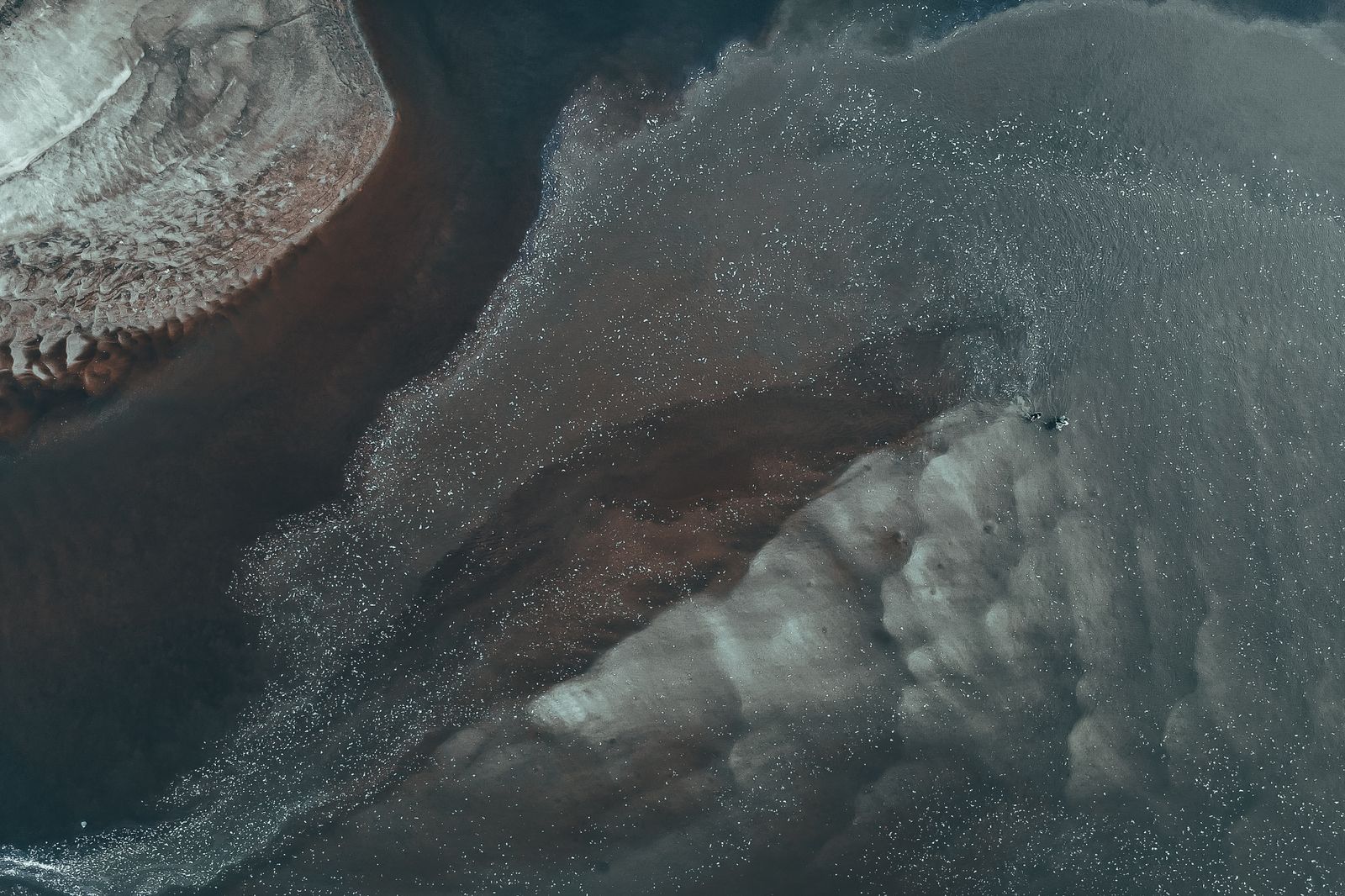
Every year, a river of dust lifts off a dry lakebed in northern Chad, climbs into the atmosphere, and drifts west across the Atlantic until some of it settles on the canopy of the Amazon. The load reaching the basin is estimated at around 27.7 million tonnes, and it carries the phosphorus that keeps the world’s largest rainforest from slowly starving its own soil.
That number comes from a 2015 paper in Geophysical Research Letters led by Hongbin Yu of the University of Maryland and NASA’s Goddard Space Flight Center, which used seven years of lidar measurements from NASA’s CALIPSO satellite to estimate dust deposition and phosphorus input into the Amazon Basin from space. The phosphorus riding along with the dust came to roughly 22,000 tonnes a year, close to what ecologists calculate the forest loses to rain and flooding.
The lakebed is called the Bodélé Depression. It sits between the Tibesti and Ennedi mountains in Chad, and satellite data has repeatedly identified it as the single dustiest place on Earth.
The delivery is seasonal. The Amazon receives its share mainly during the northern winter and spring, when the northeasterly trade winds are aimed at South America. In northern summer and autumn, as the Intertropical Convergence Zone shifts north, the same plumes swing toward the Caribbean and North America instead.
The Amazon, for all its green, sits on soil that is chronically short of phosphorus. Rain leaches nutrients out faster than the bedrock releases them. Without a fresh supply from somewhere, productivity would decline.
That somewhere is a desert basin roughly 5,000 kilometres away.
What the Bodélé actually is
The Bodélé Depression is the dried floor of what used to be Lake Mega-Chad, an inland sea that covered a large stretch of the central Sahara during a wetter African climate thousands of years ago. When the lake dried, it left behind sediment made largely of diatomite: the compressed skeletons of freshwater algae.
Diatomite is soft. It breaks apart easily under wind. And the skeletons themselves are rich in phosphorus, iron and other elements that plants need.
The geomorphologist Charlie Bristow and colleagues have argued for years that this ancient lake bottom is essentially a phosphorus reservoir the Sahara is slowly exhaling, particle by particle, into the trade winds. Their 2010 paper in Geophysical Research Letters, with Karen Hudson-Edwards and Adrian Chappell, made the case for West African dust fertilising both the Amazon and the equatorial Atlantic.
Watch the migration of dust here:
The wind that does the work
In the mid-2000s, atmospheric scientists set up instruments across the Bodélé to figure out why this one basin produces so much airborne dust. What they found was a wind funnel. Air squeezed between the Tibesti and Ennedi highlands accelerates into what the researchers named the Bodélé low-level jet.
The climate scientist Richard Washington, Professor of Climate Science at the University of Oxford, led that work with Martin Todd of the University of Sussex. In his own account of how Saharan dust is generated, Washington describes an astonishing wind concentrated between the two mountain ranges, regularly exceeding 16 metres per second near the surface—a moderate gale on the Beaufort scale. Other low-level jets exist across the Sahara, he notes, but none as grand as this one.
The jet scours the diatomite floor, lifts the fine particles high into the atmosphere, and hands them to the easterly trade winds. From there, the dust rides west.

The Bodélé jet does not explain the whole Sahara, though. Washington writes that in the early 2010s, when the same group turned to summer dust storms further west, the picture changed. In summer the largest sources shift toward Algeria, Mali, Niger and Mauritania. After deploying around 30 tonnes of meteorological equipment across the region with the assistance of the Algerian meteorological service, the team found that roughly 80 percent of summer Saharan dust emissions come from thunderstorms.
These are dry thunderstorms. Clouds sit more than five kilometres above a bone-dry surface, rain evaporates before hitting the ground, and the evaporation cools air that then plunges down and spreads across the desert floor as a wall of wind, raising huge plumes. Satellites tracked more than 1,500 of these events, many travelling hundreds of kilometres, mostly at night.
Climate models used to project future dust levels do not zoom in finely enough to simulate individual thunderstorms. A commonly cited figure is that emissions could rise by up to 13 percent by the end of the century, but the models producing that estimate do not resolve the process that makes most of the summer dust in the first place.
A five-thousand-kilometre commute
The transatlantic crossing takes about a week to ten days, according to forecasters who tracked a July 2026 plume heading for the Caribbean and the Gulf Coast. Trade winds carry it in a layer of dry, dust-laden air that meteorologists call the Saharan Air Layer.
NOAA’s Atlantic Oceanographic and Meteorological Laboratory describes the layer as two to two and a half miles thick with its base about a mile above the ocean—very roughly 1.5 to 5 kilometres up—with new outbreaks moving over the tropical North Atlantic every three to five days. The same warmth, dryness and strong winds that define it have been shown to suppress tropical cyclone formation and intensification.
Local coverage in the United States tracks this every year, because the tail end of these plumes reaches the Caribbean, the Gulf Coast, and sometimes Texas. In July 2026, forecasters followed a plume that had crossed more than 5,000 miles of ocean as it hazed the skies over Miami and then pushed dust into coastal Texas and Louisiana.
Most of that dust never makes landfall in North America. It settles into the ocean, or continues southwest. One system, running on wind and sediment, quietly links a Chadian lakebed, an Amazonian canopy, and the storm track that eventually threatens the U.S. Gulf Coast.
Why the Amazon needs it
Tropical rainforest soils are old and heavily weathered. Warm rain, year after year, dissolves minerals and washes them into rivers. Phosphorus is particularly vulnerable to this because it binds to iron and aluminium oxides and gets locked away or lost downstream.
The forest recycles most of what it has. Leaves fall, decompose, and their nutrients are pulled back up through roots almost immediately. But the recycling is never quite complete. There is always a slow leak.
African dust closes the loop. Fine mineral particles rain down on the canopy and forest floor, weather in place, and release phosphorus and iron into the soil.
How much of that comes from the Bodélé specifically is genuinely contested. An influential 2006 paper in Environmental Research Letters by Ilan Koren and colleagues described the depression as a single spot in the Sahara supplying most of the mineral dust reaching the Amazon. A 2020 paper in Geophysical Research Letters, with Yu again among the authors, used satellite-constrained trajectory analysis and reached the opposite conclusion, published under the title “Disproving the Bodélé Depression as the Primary Source of Dust Fertilizing the Amazon Rainforest”. It points instead to the El Djouf, further west, as the preferred source of intercontinental transport.
The Bodélé’s standing as the dustiest place on Earth is not in dispute. Its exact share of the Amazon’s fertiliser is. Nor is the direction of the flux in doubt: without African dust, the Amazon would be running a phosphorus deficit that its own geology cannot cover.
The dust is not just dust
A 2013 paper in The ISME Journal by Jocelyne Favet and colleagues analysed desert sand from Chad and dust that had blown to the Cape Verde Islands, and found it carrying a great deal of microbial life. High-throughput sequencing showed samples dense with bacteria across four phyla, dominant fungal groups led by Ascomycota, and two freshwater algae isolated from the sand. The microbes travelling with the dust included nitrogen-fixing bacteria of the sort that nodulate Acacia species and others that fix nitrogen in association with grass roots.
The authors reported few pathogenic strains and concluded that African dust is not a large threat to public health. What it does carry, in addition to phosphorus, is a community of soil organisms adapted to harsh conditions.
What decides how much arrives
The plume is not on a fixed schedule. How much reaches the Amazon in a given year depends on atmospheric conditions across two hemispheres.
Work reported by Agência FAPESP on a 2026 study in Geophysical Research Letters, led by Luiz Augusto Toledo Machado at the University of São Paulo’s Physics Institute, found that cold air masses pushing into the United States and high-pressure anomalies in the South Atlantic shift heavy rainfall along the tropical Atlantic. That shift decides whether the Amazon receives dust-laden air or air already scrubbed clean by rain over the ocean. The team used daily black carbon measurements from the Amazon Tall Tower Observatory for January and February between 2015 and 2022.
Coverage of the same research on how U.S. cold waves influence African dust transport made the point plainly: the atmosphere does not respect borders. A cold front over the Great Plains can nudge a rainband over the Atlantic, and that rainband decides whether Chadian sediment reaches Brazilian trees.

Old lakes, old forests
The dust arriving from Chad is old, but not as old as it can sound. The diatomite in the Bodélé is the compressed remains of algae that lived in a lake that dried out a few thousand years ago, at the end of a wetter African period. The forest receiving it has been assembling itself for far longer than that.
Deep time keeps surfacing in unexpected places. Science Blog has reported on an Antarctic seafloor core preserving the roots and pollen of a temperate rainforest that once grew 900 kilometres from the South Pole, and on how a moth outbreak in Siberia is leaving behind enough dead wood to reshape fire behaviour across the taiga. Forests are not static features. They are balances, held up by conditions that shift.
The Amazon’s balance, on the phosphorus side, depends on a wind that runs between two mountain ranges in Chad, on thunderstorms over the western Sahara, on cold fronts over North America, and on the trade winds holding steady across an ocean.
Somewhere over the Atlantic right now, a plume of pale dust is drifting west at the height of a small aircraft. Some of it was once a lakebed. Some of it is bacteria. And when the next rain falls over Manaus, a little of what was the bottom of a Saharan lake will come down with it.