

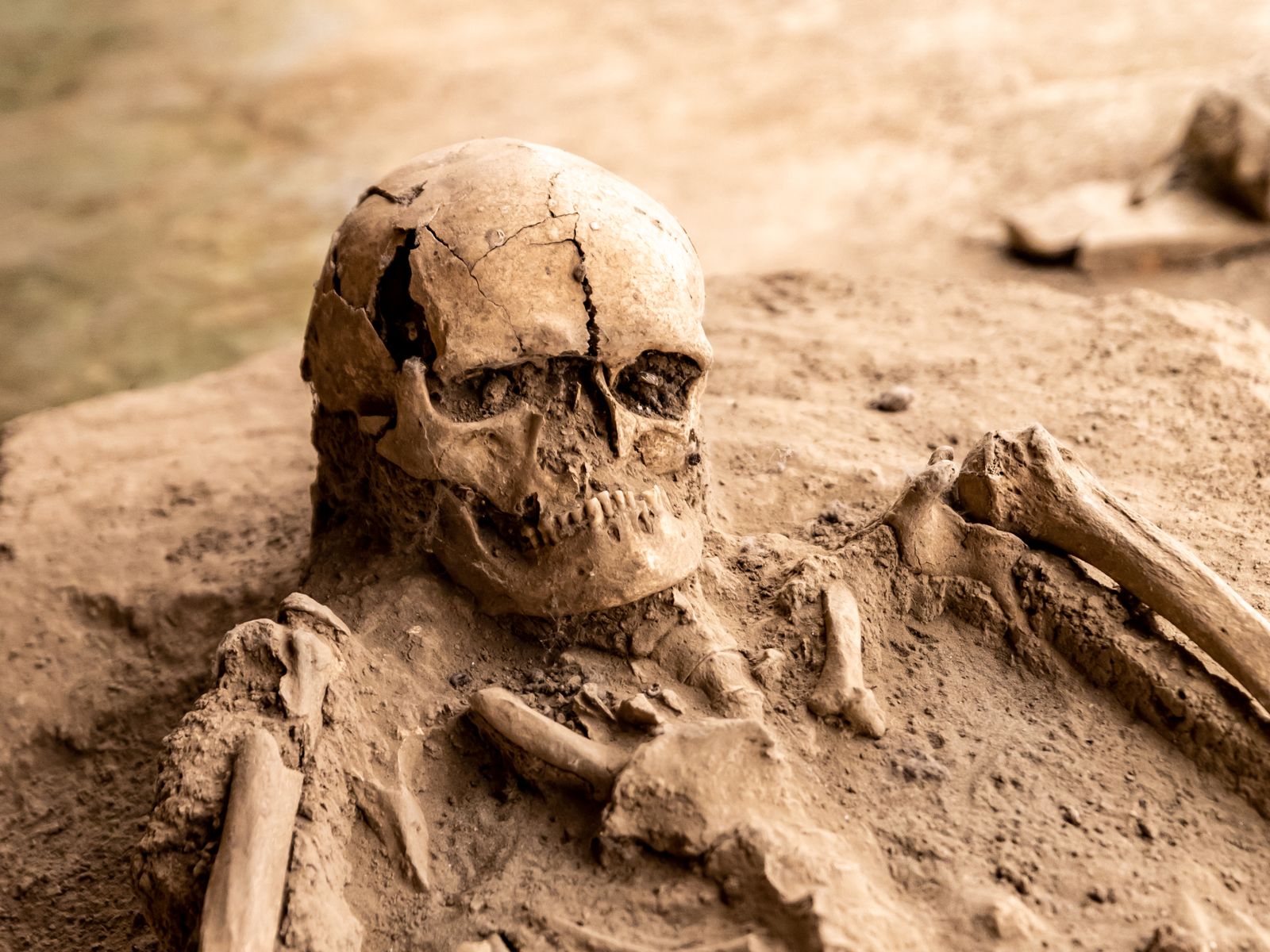
The skull cap now catalogued as Neanderthal 1 was almost quicklime. In August 1856, quarrymen working the Kleine Feldhofer Grotte in Germany’s Neander Valley were stripping the cave of its limestone deposits when they hit a layer of hardened mud two metres below the entrance. Sixteen bone fragments came out with the sediment. The workers, expecting nothing more interesting than a cave bear, tossed the pieces onto the debris heap outside. The cave itself was gone within weeks — blasted apart and burned for lime.
What survived was a skull cap, two femurs, part of a pelvis, and pieces of arm and shoulder. What almost did not survive was the recognition that they belonged to a person.
A teacher who asked to see the bones
The quarry foreman had heard rumours that old bones sometimes fetched a small price from collectors, and mentioned the find to a local schoolteacher named Johann Carl Fuhlrott. Fuhlrott taught natural history in the nearby town of Elberfeld and kept a private cabinet of fossils. He walked over to the quarry, examined the pieces the workers had set aside, and asked to take them home.
According to an account published by the Davidson Institute of Science Education, the quarrymen had assumed the remains came from a bear. Fuhlrott saw something else in the low, thick-browed skull cap: a bone that looked human but wrong for a human. The forehead sloped back. The brow ridge was a heavy shelf of bone. The femurs were bowed and unusually robust.
He wrote to Hermann Schaaffhausen, an anatomist at the University of Bonn. In 1857, the two men jointly presented the find to the Lower Rhine Medical and Natural History Society, arguing that the bones came from an ancient and previously unknown form of human. This was three years before Darwin published On the Origin of Species. The idea that humans had earlier forms at all was still contested.
Why the quarry destroyed the evidence
The Kleine Feldhofer Grotte sat in a limestone gorge about 12 kilometres east of Düsseldorf, named for a 17th-century hymn writer, Joachim Neander, who used to walk there. By the mid-19th century the Rhineland was industrialising fast, and limestone from the valley was being burned into quicklime for construction mortar and steelworks flux. The gorge was quarried away completely. Today the original cave floor sits roughly 20 metres below the modern ground surface.
Which means the 16 fragments Fuhlrott rescued were, for more than a century, the entire physical record of the site. No stratigraphy. No associated tools. No animal bones for context. Everything that might have told archaeologists how old the skeleton was, or what it had been buried with, had gone into the kilns.
The bones themselves were dismissed for decades. One prominent pathologist, Rudolf Virchow, examined the skeleton in 1872 and declared it a modern human with rickets and repeated head trauma. Others suggested a Cossack cavalryman from the Napoleonic wars. The idea that Europe had been home to a different kind of human was, for many Victorian scientists, unacceptable.

The species that got its name from the valley
In 1864, the Irish geologist William King formally proposed the name Homo neanderthalensis — the human from the Neander Valley. Thal is the older German spelling of Tal, meaning valley. The spelling was standardised to Tal in 1901, but the species name kept the old h, which is why Neanderthal is pronounced with a hard t in scientific usage rather than a th.
By then, similar remains had begun turning up elsewhere. A child’s skull had been found in Belgium in 1829 and a partial skull in Gibraltar in 1848, both before the Neander Valley find, but neither had been recognised as anything unusual at the time. The 1856 skeleton was the one that forced the argument, because Fuhlrott and Schaaffhausen were the first to insist, on the record, that the bones represented a distinct ancient human. The Smithsonian has traced how that argument slowly won over the field as more skeletons emerged across Europe and the Near East.
What later digs added — and corrected
For most of the late 19th century, Neanderthals were reconstructed as brutish, stooped, apelike creatures. The famous 1908 reconstruction of the La Chapelle-aux-Saints skeleton by the French palaeontologist Marcellin Boule showed a hunched figure with bent knees and a shuffling gait. That image lodged in popular culture for fifty years. It was also wrong. The La Chapelle individual, it later emerged, had been an elderly man with severe osteoarthritis. Healthy Neanderthals walked fully upright.
The correction came in stages, but the biggest single reset happened in the 1950s in northern Iraq. A Smithsonian anthropologist named Ralph Solecki, working with a team from Columbia University and local Kurdish labourers, excavated a cave called Shanidar in the Zagros mountains. They pulled out the fossilised bones of eight adult and two infant Neanderthal skeletons, spanning burials from roughly 65,000 to 35,000 years ago.
The Shanidar skeletons showed injuries that had healed. One individual had lived years after losing the use of an arm. Another had survived a crushing blow to the skull. These were people whose communities had cared for them. Pollen recovered from one of the graves led Solecki to argue, controversially, that flowers had been placed with the dead — an interpretation still debated, but one that broke the brute-caveman image for good. Solecki titled his 1971 book Shanidar: The First Flower People.
One of the Shanidar skeletons, a male who stood about 5-foot-6 and died between the ages of 40 and 50, now sits in a sealed case at the Smithsonian National Museum of Natural History. Rick Potts, director of the museum’s Human Origins Program, has described the specimen as one of the most valuable in their collection. A deep cut to one of its ribs, deep enough to have collapsed a lung, makes Shanidar 3 the oldest known individual who may have been murdered.
The genome that rewrote the family tree
In 1997, a team led by Svante Pääbo, then at the University of Munich, extracted mitochondrial DNA from the original Neander Valley humerus — the same bone Fuhlrott had carried home in his satchel 141 years earlier. It was the first ancient hominin DNA ever sequenced. By 2010, Pääbo and his team at the Max Planck Institute for Evolutionary Anthropology in Leipzig had a draft of the full Neanderthal nuclear genome.
The comparison with modern human DNA produced a result nobody quite expected: people with non-African ancestry carry between roughly 1 and 4 percent Neanderthal DNA. The two populations had interbred. And then in a Siberian cave called Denisova, Pääbo’s team found a fossilised tooth carrying DNA from a third human lineage entirely, one that had also interbred with both Neanderthals and modern humans.
The clearest evidence came in 2018, when Pääbo’s group announced a 90,000-year-old bone fragment from the Denisova cave belonging to a teenage girl whose mother was Neanderthal and whose father was Denisovan. A first-generation hybrid. According to researchers, the discovery represents a rare direct observation of interbreeding between the two groups.
The picture that emerged looked nothing like the tidy branching tree drawn in mid-20th-century textbooks. Pääbo’s own account of the work, reviewed by the South China Morning Post, described a Late Pleistocene Europe and Asia populated by multiple overlapping human groups that met, sometimes mated, and drifted apart again over tens of thousands of years.
Why they disappeared
Neanderthals vanish from the fossil record around 40,000 years ago, with the last known populations clinging on in the wooded refugia of Iberia and Gibraltar until perhaps 28,000 years ago. The reasons are still argued, but climate is central to most of them. As glaciers advanced and retreated across Europe, Neanderthal ranges fragmented. Modern humans, arriving from Africa with sewn clothing, longer-range weapons, and larger social networks, moved into the same territories.
Researchers note that Neanderthals were intelligent and had large brains comparable to modern humans. Researchers have noted that while Neanderthals had large brains and were adept at using available resources, they may have had less flexibility in adapting to environmental changes compared to modern humans arriving from Africa. Pääbo has offered a gentler version: perhaps Neanderthals were not so much replaced as absorbed, their small populations dissolving into the larger modern human wave that swept across Eurasia.
Either way, the 16 fragments that came out of a Rhineland quarry in 1856 turned out to belong to a lineage that had lived in Europe for at least 300,000 years and left a genetic trace in nearly every living person outside sub-Saharan Africa. From that first misidentified handful of bones we’ve arrived at the current understanding: a species not primitive but different, with its own tools, burials, ornaments, and, we now know, descendants walking around today.
The role of the teacher
Fuhlrott’s part in this is easy to underplay. He was not a professional anatomist. He was a provincial schoolmaster with a fossil hobby, standing in a quarry, looking at pieces of bone that the men working there had every reason to throw away. The nearest scientific institution was in Bonn, a train ride south. The prevailing scientific consensus said that humans had no ancient forms to find. And the physical evidence in front of him was, quite literally, being fed into a lime kiln.
He asked to keep the bones. That was the intervention. Everything downstream — the 1857 paper, William King’s 1864 naming, the century of anatomical argument, the 1997 mitochondrial sequence, the discovery that most people alive today carry a small percentage of Neanderthal DNA — turns on a teacher deciding a skull cap was worth a second look.
The pattern repeats through the history of science. Alexander Fleming noticed the mould on his culture plate. Henrietta Swan Leavitt sat at a desk in Harvard College Observatory measuring the brightness of variable stars and found the yardstick that would let Edwin Hubble measure the universe. Local knowledge, patience, and the refusal to throw something away. Science Blog has written before about the way small acts of attention can reshape entire fields — how a Palo Alto history teacher’s classroom experiment in 1967 became a case study cited in social psychology for decades afterwards.
What became of the bones
The original 16 fragments are held today at the Rheinisches Landesmuseum in Bonn. In 1997 and again in 2000, a small team led by the archaeologist Ralf Schmitz relocated the debris field of the original quarry — long since covered by industrial fill — and sifted through it. They recovered more than 60 additional bone fragments, including pieces that fit directly onto the 1856 skeleton. Genetic testing confirmed at least two other Neanderthal individuals from the same site.
The Neander Valley itself has been rebuilt as a memorial site, with a museum standing above the approximate location of the destroyed cave. A stone marker in the reforested gorge notes where the Feldhofer Grotte used to be. There is nothing left of the cave to see.
Recent work continues to reshape what the 1856 skeleton means. In 2025, a study of a Neanderthal skull recovered from an Italian sinkhole prompted a re-examination of the long-held idea that Neanderthal nasal anatomy was specialised for breathing cold air. The current interpretation is more cautious: their large noses may have evolved for other reasons, and the cold-climate story was overfitted.
That kind of correction is what the field looks like now. A specimen gets found. It sits in a drawer. Someone comes back to it fifty or a hundred years later with a new tool — a CT scanner, a mass spectrometer, a technique for pulling ancient DNA out of a bone that has been in a museum vault since Bismarck was chancellor — and the specimen starts talking again.
The original Neander Valley skull cap has been examined, cast, X-rayed, sampled for collagen, and drilled for DNA. Fuhlrott died in 1877, twelve years before Eugène Dubois found Homo erectus bones on Java and long before the word hominin entered the lexicon. He never knew what he had rescued. He only knew that the men in the quarry were about to throw it away, and that the shape of the forehead was wrong for a bear.