

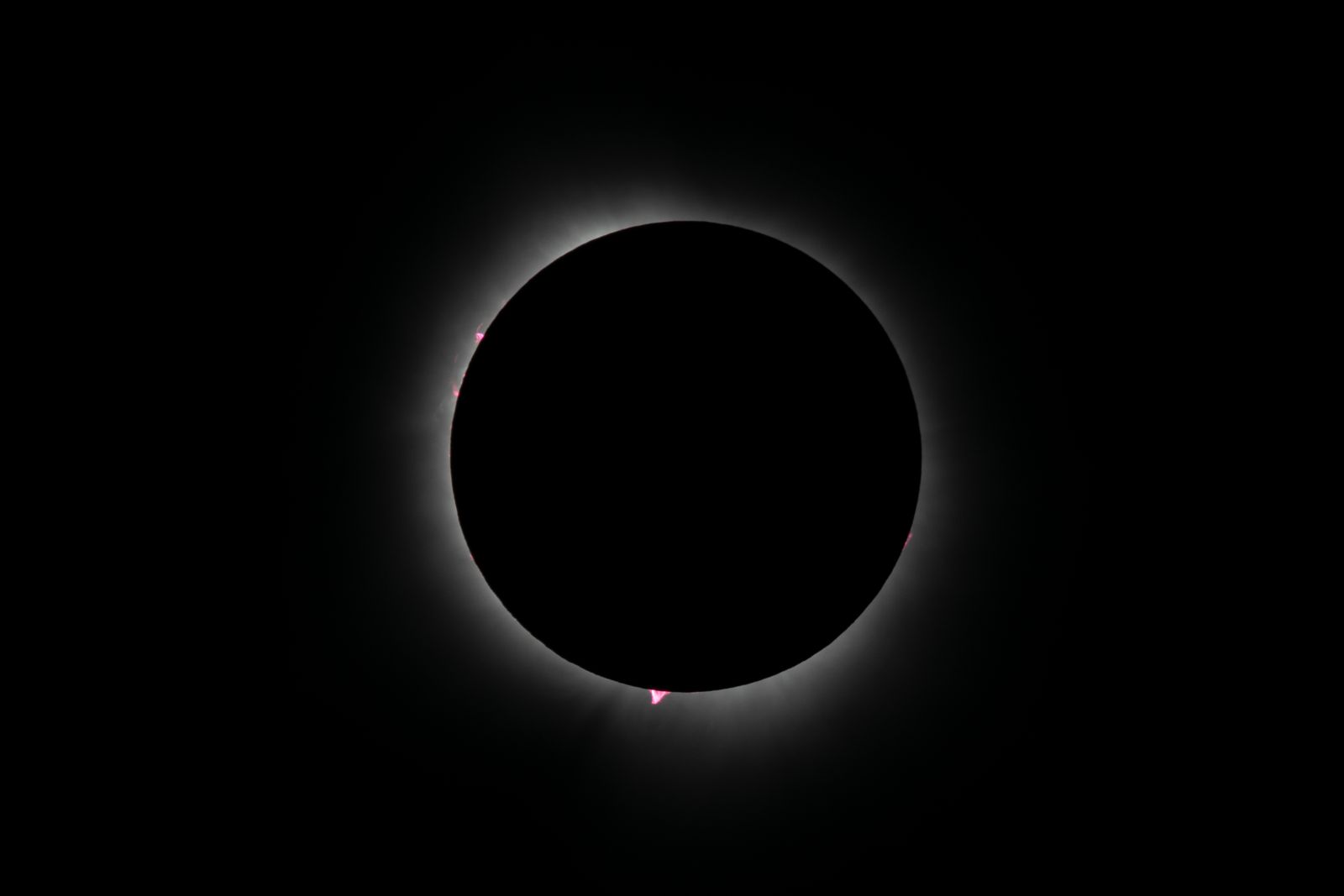
On the morning of August 18, 1868, a French astronomer named Pierre Janssen stood in the coastal town of Guntur, in Andhra Pradesh on the southeastern coast of India, and watched the Moon slide across the face of the Sun. He had travelled from France for a window of totality lasting several minutes. In his hands was a spectroscope — a brass instrument the size of a small telescope that split incoming light through a prism into a rainbow of narrow lines. When the sky darkened and the solar corona flared out around the black disk of the Moon, Janssen aimed his prism at a huge red loop of gas rising off the Sun’s edge. In the resulting spectrum, near the yellow band where sodium always sits, a second bright yellow line burned at a wavelength of roughly 587 nanometres. It matched nothing on Earth.
He had just found helium. The element would not be pulled out of a rock in a terrestrial laboratory for another twenty-seven years.

A prism, a prominence, and a line that didn’t fit
Janssen’s instrument worked on a principle only nine years old at the time. In 1859, the German physicist Gustav Kirchhoff had shown that every chemical element, when heated to incandescence, emits light at a fixed set of wavelengths — a barcode signature unique to that element. Point a spectroscope at a sodium lamp and you see a specific yellow doublet at 589 nanometres. Point it at hydrogen and you see a red line, a blue-green line, a violet line, always in the same places. Kirchhoff’s insight meant that starlight, in principle, carried the chemistry of the star that produced it. Astronomers no longer needed a sample. They needed a prism.
The 1868 eclipse was the first big test of that idea in a working solar observation, as Science Friday recounts in its history of the element. Janssen’s spectroscope caught the flaming prominences that erupt off the Sun’s surface — arches of plasma taller than the Earth is wide. When he decomposed their light, the expected hydrogen lines were there. The unexpected yellow line, close to sodium’s but distinctly off, was not.
He was so struck by the brightness of that line that he suspected it could be seen without an eclipse at all — that the Moon’s shadow had merely made it easier to spot. The next morning, in ordinary Indian daylight, he pointed the spectroscope at the Sun’s edge again. The line was still there.
Two men, 5,000 miles apart, chasing the same yellow glow
While Janssen was setting up in Guntur, a British astronomer named Joseph Norman Lockyer was doing the same work from London. Lockyer had not travelled to the eclipse. He had spent months designing a spectroscope sensitive enough to pick out solar prominences in broad daylight — no Moon required. Later in 1868, Lockyer independently caught the same anomalous yellow line, at essentially the same wavelength.
He compared the position of the line against every element then known and concluded, as Massive Science describes in its history of eclipse discoveries, that the source had to be an element present in the Sun but not yet identified on Earth. He named it helium, from helios, the Greek word for the Sun.
The coincidence became one of the great small dramas of nineteenth-century science. Both men’s letters arrived at the French Academy of Sciences around the same time, and the Academy credited both. A commemorative medal was later struck bearing both their profiles.

Why a chemist wouldn’t touch it for 27 years
To modern ears, discovering an element in the Sun sounds like the ending of the story. In 1868 it was closer to a rumour. Most chemists dismissed the yellow line for the better part of three decades. An element that existed only in the Sun, inferred from a single spectral feature 150 million kilometres away, sat awkwardly with a discipline built on beakers, precipitates, and atomic weights measured on a balance. You could not weigh helium. You could not put it in a bottle. You could only look at a bright line in a prism.
The impasse broke in 1895. The Scottish chemist William Ramsay was studying a uranium-bearing mineral called cleveite. When he treated it with acid, a gas hissed out. Ramsay ran the gas through his own spectroscope, expecting to find nitrogen. He found the yellow line at 587 nanometres — the same signature Janssen had caught during the Indian eclipse. He sent a sealed sample to Lockyer for confirmation. The spectroscopic analysis confirmed helium’s presence.
Twenty-seven years after the element had been named for the Sun, someone finally held a jarful of it in a London laboratory. Earth.com’s account of the discovery notes that humanity had identified helium in starlight before anyone on the planet had ever measured a single gram of it directly.
Why the Sun made helium easy and Earth made it hard
The delay was not a failure of chemistry. It was a fact about geology. Helium is the second-lightest element in the universe, and on a planet with an atmosphere as thin as Earth’s, any helium that reaches the surface simply drifts upward and escapes into space. The Sun, by contrast, is nearly a quarter helium by mass. Its core continuously fuses hydrogen into helium. The element is the Sun’s dominant ash.
What terrestrial helium exists on Earth today is buried, not floating. It is produced by the slow radioactive decay of uranium and thorium deep in the crust, over hundreds of millions of years, and gets trapped inside the same geological formations that hold natural gas. Ramsay’s cleveite worked because uranium had been quietly producing helium inside it since the rock formed. Before spectroscopy pointed chemists at uranium ores, there was no obvious reason to look for a gas that vents itself into the sky.
The 587-nanometre line is now catalogued as the helium D3 line, and it remains one of the most reliable spectroscopic fingerprints in astrophysics. It shows up in stellar atmospheres, in planetary nebulae, and in the debris of exploding stars. A 2026 infrared survey detected helium in a Type Ic supernova — a class of stellar explosion long defined by its apparent lack of helium — and forced a partial rewrite of how astronomers classify dying massive stars. The same barcode Janssen caught in a six-minute window over the Bay of Bengal is still the tool doing the identifying.
Eclipses as a chemistry lab
Janssen’s expedition belongs to a very particular scientific tradition: the eclipse as a natural laboratory. For a few minutes at a time, the Moon does something no man-made instrument could do reliably in the nineteenth century — it obliterates the disk of the Sun and lets the faint atmosphere around it show. Every great eclipse of the era carried a research question with it. In 1868, the question was chemical. In 1919, Arthur Eddington used the total eclipse over the island of Príncipe to measure the deflection of starlight by the Sun’s gravity, confirming Einstein’s general theory of relativity to within the tolerance of his photographic plates.
Janssen himself remained a compulsive eclipse chaser. When a total eclipse crossed Algeria in 1870, Paris was under siege by the Prussian army. According to The Conversation in its history of eclipse expeditions, he escaped the city by hot-air balloon to reach the eclipse path, only to have clouds ruin the observation once he arrived.
Some of the same instincts that sent Janssen to Guntur drove astronomical observations for generations. The 1868 eclipse expedition exemplified a moment when a brief window of access to the sky produced knowledge that could not have been assembled from the ground.
The Guntur coast, then and now
Guntur is not a place most modern histories of physics mention. It sits on the Andhra Pradesh coast of southeastern India, a district town of shrimp farms and cotton fields. In August 1868, it happened to lie on a narrow strip of ground where the Moon’s shadow would touch the Earth for a few minutes on a Tuesday morning. Janssen had chosen it after months of correspondence with the British Indian survey authorities, who provided the observing site and the logistical support. The Times of India has noted the town’s role as the geographic anchor of the discovery.
India in 1868 was a busy destination for European astronomers. The subcontinent’s monsoon-belt latitudes put it in the path of several nineteenth-century eclipses, and Britain’s imperial infrastructure — railways, telegraph lines, cantonment towns — made expeditions there logistically far easier than in remote parts of Africa or the Pacific. Janssen’s Guntur camp was one of at least a dozen scientific parties strung along the eclipse track from the Arabian Sea to the Malay Peninsula. Most were looking at prominences. Most saw the yellow line. Only Janssen and, later, Lockyer worked out that it belonged to something new.
The 150th anniversary of the discovery was marked in India in 2018, with commemorations at observatories that trace their institutional lineage back to the colonial-era survey teams that hosted Janssen. His original spectroscope survives in the collection of the Paris Observatory.
A finite gift from an infinite source
The strange coda to the story is that helium — the element identified in the most abundant object in the solar system, the second most abundant element in the universe — is running low on Earth. Global demand has climbed roughly 10 percent per year over the last decade, and prices have more than tripled. Helium cools the superconducting magnets inside every MRI machine in every hospital, chills the electromagnets at CERN’s Large Hadron Collider, and shields specialty metals during welding. When Qatar, the world’s second-largest producer, was blockaded in the summer of 2017, MRI departments and physics labs on three continents felt the supply pinch within weeks.
The paradox is geological. Helium keeps being produced inside the Earth by uranium and thorium decay, but the process is so slow — on the order of hundreds of millions of years to accumulate commercial quantities — that from a human perspective the supply is fixed. Most of what escapes rock formations rises straight through the atmosphere and out into space, because helium atoms are light enough to reach escape velocity on their own thermal motion. The Sun holds onto its helium because the Sun’s gravity is 28 times Earth’s. Earth cannot.
Which means the situation Janssen would recognise, if he came back tomorrow, is roughly this: the yellow line he caught in his prism on a coastal morning in 1868 still marks the same element, still burns in the same solar prominences, still sits at 587 nanometres. The Sun has not run out. The party balloons and the MRI coolant loops are the ones on the clock. The element named for a star turned out, on this planet, to be a fossil.