

On 1 August 1984, a worker at a peat-cutting company on the edge of Lindow Moss in Cheshire pulled what looked like a lump of wood off the conveyor belt. When it hit the ground, the peat fell away, and a human leg came into view.
The body underneath belonged to a man in his mid-twenties who had been dead for roughly two thousand years. His skin had gone the colour of tanned leather. The stubble on his upper lip was still visible. His fingernails were intact. The peat had held him, more or less whole from the waist up, since a period that overlaps with the Roman conquest of Britain.
An archaeological team arrived on site and lifted the man out of the moss where he had lain by sliding a sheet of plywood beneath a whole block of peat. The block went first to a local mortuary, where police quickly established through radiocarbon dating that the body was at least a thousand years old, and Lindow Man passed into the care of the British Museum.
Why the bog kept him
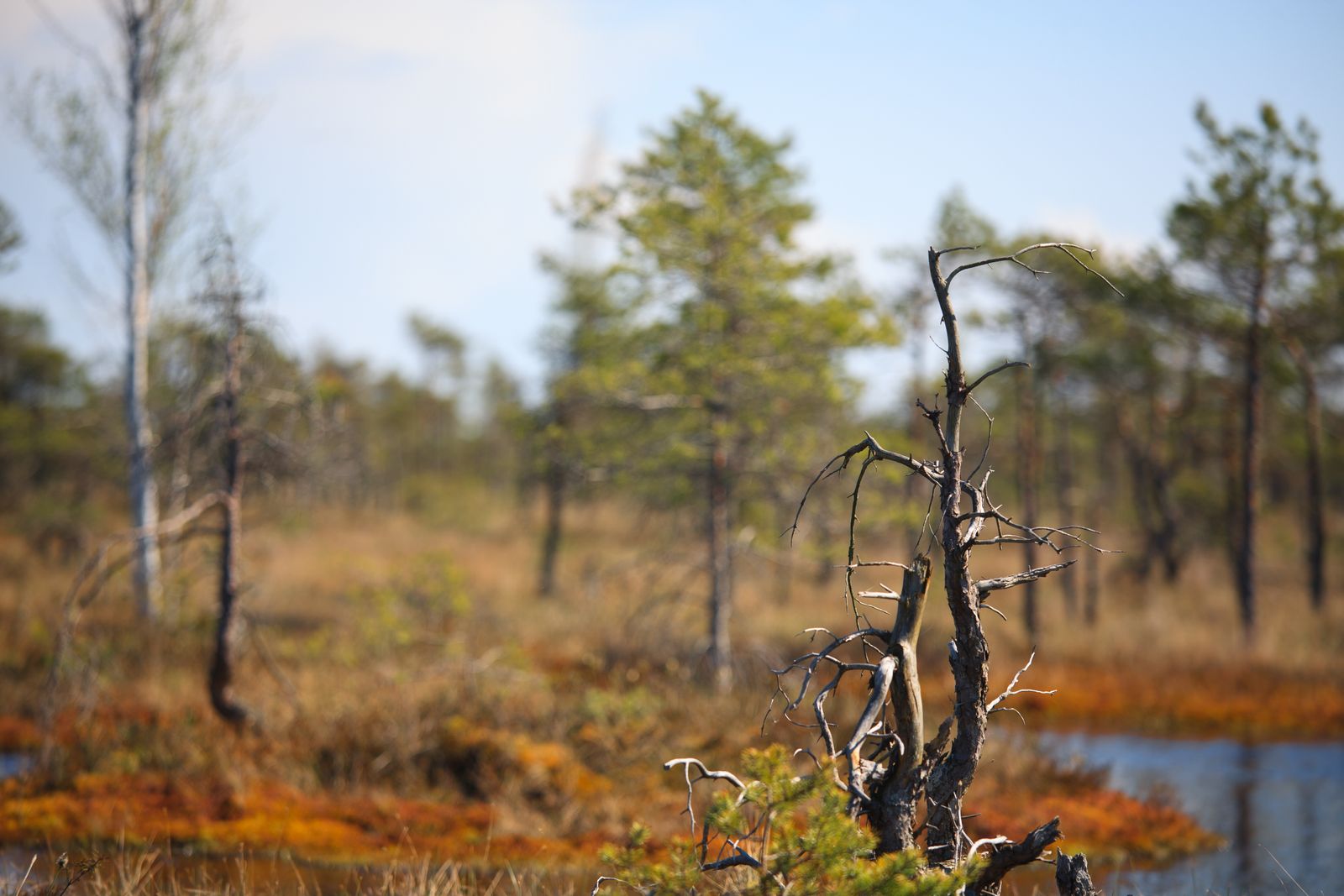
Peat bogs preserve human tissue for reasons that are chemical, not mystical. Sphagnum moss releases compounds that bind to nitrogen and starve bacteria of what they need to break a body down. The water is cold, acidic, and almost oxygen-free. Tannins from the moss soak into the skin and tan it, in the same sense that a leather worker tans a hide.
The trade-off is that acidic peat is hard on bone. Calcium leaches out. The skeleton softens and sometimes disappears entirely, while the skin, hair, and gut contents stay put. This is why bog bodies so often look flattened and rubbery when they come out, and why bogs across northern Europe have yielded so many partial remains alongside butter, weapons, and wooden trackways.
Thousands of bog bodies have been recovered across Britain, Ireland, Denmark, the Netherlands, and north-west Germany over the past century and a half, with many dating to the centuries around the turn of the common era.
What was actually found at Lindow Moss
Lindow Man was not the only body pulled from the moss. A skull of a woman had already surfaced in 1983, complete with an eyeball still in the socket and some remaining hair. That discovery briefly prompted a local murder confession, until radiocarbon dating placed the skull at roughly 1,800 years old.
More body parts turned up on the peat company’s conveyor belt in subsequent years. Some fragments were found near where Lindow Man had lain and are probably pieces of the same body.
The radiocarbon dates for the different finds clustered around the first century, with wide error ranges. Lindow Man’s own date fell somewhere in the first century CE. That window covers the reigns of Augustus, Tiberius, Claudius, and Nero, and takes in the Roman invasion of Britain in 43 CE and the revolt of Boudica in 60 to 61 CE.
How he died, on the evidence
The state of the body allowed pathologists to reconstruct the last minutes in unusual detail. There are signs of blunt force trauma to the head. There is a cord around the neck. There is a wound to the throat. The injuries appear to have been inflicted in quick succession.
Whether this amounts to a ritual killing, a judicial execution, or a straightforward murder is genuinely contested. The traditional reading, popular in the late 1980s, treats him as a sacrifice tied to Iron Age religion. More recent commentary is more cautious. Current Archaeology has questioned whether the ritual-killing framework has been over-applied, and reviewers point out that violent death on its own does not tell you why the violence happened.
What can be said is that whoever killed him also placed him in the bog, face down, with some care about the location.
The last meal
Because his gut survived, so did his last meal. Analysis of the stomach contents identified traces of a griddle-baked cereal preparation, made from wheat and barley, along with pollen and other plant remains consumed shortly before death. The specifics have been argued over for decades, with some analyses reading burn marks on the surviving fragment as evidence for a scorched cake and others as ordinary charring from a hearth.
What the meal does not tell you is the season, the ritual context, or the state of mind of the man eating it. It tells you that shortly before he was killed, he ate a cereal preparation typical of the region and period. That is a smaller claim than the one sometimes made about him, and it is the one the evidence actually supports.
The period he died in
Lindow Man’s radiocarbon window overlaps with the first Roman decades in Britain. Cheshire sat in the territory contested by tribal groups during the first century, including the Brigantes to the north. The BBC’s essay series on Iron Age Britain traces the political pressures that fell on communities in the north-west during exactly the period the Lindow bodies were being placed in the moss.
Whether that political context is relevant to his death is a question the body cannot answer. It is worth noting the overlap without leaning on it.
What bog bodies keep doing for forensics
The techniques developed on Iron Age remains have gone on to matter for much more recent cases. The Irish Examiner has reported on how bog forensics informs the search for the Disappeared of the Troubles, where the same preservation chemistry that held Lindow Man also holds people killed within living memory. A 2023 discovery in Northern Ireland, of remains now known as the Ballymacombs More Woman, dated to more than two thousand years old, was first treated as a possible modern case for exactly this reason.
The chemistry does not care about the century. As forensic anthropologists have argued in The Conversation, the human body never fully disappears, and the trace evidence left behind is often what allows an atrocity, ancient or recent, to be recognised at all.
What Lindow Man is not
He is not a druid, not on any evidence the body itself provides. He is not confirmed as a sacrifice, though the possibility is live. He is not evidence for a single, unified Celtic religion across northern Europe. He is a young man, apparently well-fed, whose hands show little sign of heavy manual labour, who was killed by more than one method within a short space of time, and who was left in a bog on the edge of what would soon be a Roman province.
The reason we know any of this is that peat is a slow, chemical archive. Sphagnum bound to his skin. Tannins tanned him. Cold, acidic, oxygen-poor water held the rest in suspension. A mechanical shovel in 1984 caught him on the way to a fuel depot.
He is now kept in the British Museum, laid on his side, hair still visible, stubble still visible. Visitors tend to go quiet in front of the case. That is probably the right response.