

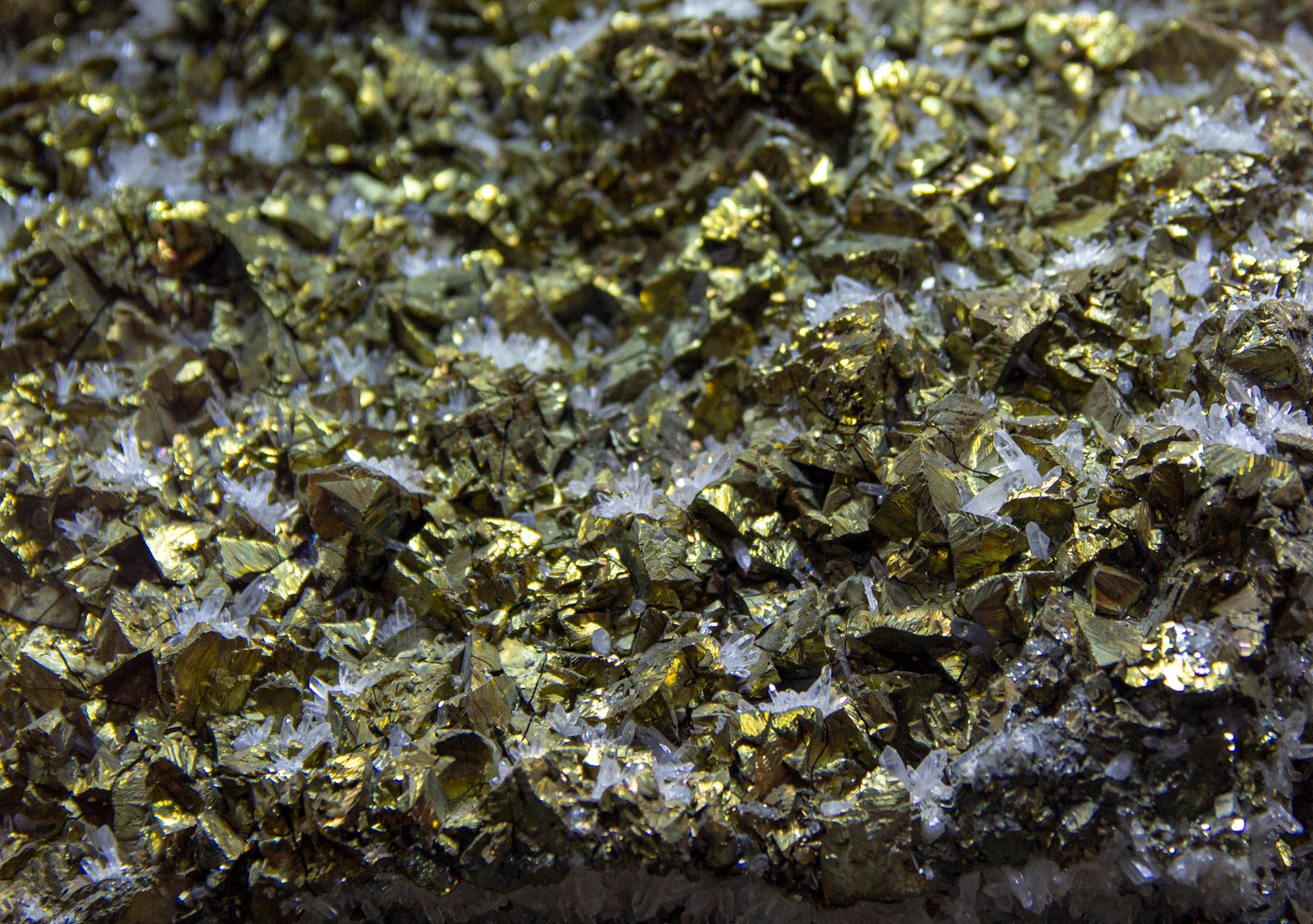
The gold in wedding bands, dental crowns and bullion is older than Earth. Much of it was probably made through rapid neutron capture during neutron-star mergers, scattered into interstellar space and eventually incorporated into the cloud that formed the solar system about 4.6 billion years ago.
That is the strongest version of the story that current evidence supports. Neutron-star mergers are confirmed sites of heavy-element production, and they may be a dominant source of the galaxy’s gold. Scientists cannot yet say that every gold atom came from them.
A review of r-process nucleosynthesis describes neutron-star mergers alongside other possible sites, including collapsars and magnetorotational supernovae. The proportions remain an open question.

Where ordinary stellar fusion reaches its limit
Stars are element factories, but ordinary fusion only takes them so far. The Sun converts hydrogen into helium. More massive stars can proceed through successive stages of burning that produce carbon, oxygen, silicon and elements around iron.
At the iron group, fusion stops providing the net energy that supports a star. Heavier nuclei therefore require other processes.
One is neutron capture. During the slow neutron-capture process, or s-process, nuclei absorb neutrons gradually inside certain stars. The rapid neutron-capture process, or r-process, requires such an intense neutron flux that nuclei capture additional neutrons faster than they can decay.
Gold’s single stable isotope is thought to be produced mainly by the r-process. For decades, the unanswered question was where the required conditions existed in nature.
Recommended watch:
The 2017 event that transformed the argument
On 17 August 2017, the Advanced LIGO and Advanced Virgo detectors recorded GW170817, a gravitational-wave signal from the inspiral of two neutron stars. The event was associated with an electromagnetic counterpart in NGC 4993, at a distance of roughly 40 megaparsecs, or about 130 million light-years.
Observatories around the world followed the resulting kilonova. Its changing light and infrared emission matched models in which freshly synthesised radioactive nuclei heated the expanding debris.
The first robust identification of an individual neutron-capture element came from a later reanalysis. A 2019 Nature paper identified strontium in the GW170817 spectra.
Gold and platinum were not individually detected in those spectra. Estimates that the event produced several Earth-masses of such elements came from models of the ejecta, not from a direct measurement of gold atoms.
GW170817 nevertheless confirmed that neutron-star mergers can host the r-process on an enormous scale. The wider gravitational-wave astronomy of neutron stars now gives researchers an observational route into questions once addressed almost entirely through theory.
JWST later supplied a separate piece of evidence. Observations of the kilonova associated with GRB 230307A produced a spectral feature that researchers interpreted as tellurium. That finding should not be folded into the spectrum of GW170817.
What happens during a merger
A neutron star is the collapsed remnant of a massive star. It can contain more mass than the Sun inside a sphere roughly the width of a city. A sugar-cube-sized sample of its material would weigh about as much as a mountain on Earth.
When two neutron stars share an orbit, they lose energy through gravitational waves and spiral closer together. Their orbital speed increases until they collide.
During and after the merger, neutron-rich material can be expelled at tremendous speed. Atomic nuclei in that debris capture neutrons rapidly, producing unstable heavy isotopes that decay toward elements including gold, platinum and uranium.
Recent NASA Goddard supercomputer simulations focused on the last several orbits before contact. They followed magnetic field lines connecting, breaking and reconnecting around the stars, with the goal of predicting possible precursor X-ray and gamma-ray signals.
Relativistic jets can arise in the aftermath of some mergers and power short gamma-ray bursts. That related process should not be presented as something the recent pre-merger magnetosphere simulation directly demonstrated.

How ancient gold became part of Earth
The Sun formed from a cloud of gas and dust that had already been enriched by earlier generations of stars and stellar explosions. Whatever mixture of events produced the solar system’s gold, those events occurred before the Sun and planets existed.
Some of those atoms entered the protoplanetary disk and became part of Earth. Because gold strongly associates with metal, much of Earth’s original inventory was drawn toward the core while the young planet differentiated.
The presence of gold and other iron-loving elements in the mantle is often explained partly through later accretion. A Nature Geoscience overview of the late-veneer evidence describes iron-loving material being added to Earth after core formation.
The exact timing, composition and scale of that delivery remain debated. It is safer to describe broadly chondritic impactors than to claim the gold arrived specifically in the metal-rich cores of asteroids during one defined bombardment episode.
Geological processes later concentrated small portions of that gold into deposits that could eventually be mined. The atom in a ring is therefore older than the planet, even if its path through the early Earth cannot be reconstructed.
The source question is still open
Neutron-star mergers can produce heavy r-process elements, and several models find that they could account for a large or dominant share of the Milky Way’s inventory. Other models require contributions from rare stellar explosions.
One proposed source is a collapsar, in which the core of a rapidly rotating massive star collapses into a black hole surrounded by an accretion disk. Magnetorotational supernovae are another candidate. Researchers compare event rates, theoretical yields, stellar abundances and radioactive isotopes to estimate how much each channel contributes.
Compact-object formation itself is also proving less uniform than once assumed. A recent result, reported by teams at Birmingham, the Autonomous University of Madrid, and the Max Planck Institute for Gravitational Physics, found strong evidence that the black-hole-neutron-star event GW200105 retained an eccentric orbit shortly before merger.
That result challenges simple assumptions about how these binaries form. It may eventually affect estimates of merger populations, but it does not by itself determine what fraction of solar-system gold came from each r-process source.
Reading the evidence preserved in meteorites
Meteorites preserve a chemical record of the material from which the solar system formed. Presolar grains contain isotopic patterns associated with particular kinds of stellar environments, while the daughter products of extinct short-lived radioisotopes act as clocks.
Those records can reveal whether an r-process event occurred relatively close to the solar system’s birth and how long its ejecta took to mix into the surrounding material. They cannot identify the individual catastrophe that made each surviving gold atom.
The meteorite record, stellar abundance measurements and kilonova observations must ultimately describe the same nuclear processes. They increasingly support the same broad picture, although they do not yet yield one unique accounting of every source.
What the evidence supports
The firm claim is that naturally occurring gold was forged before the Sun existed and that the r-process produced most of it. Neutron-star mergers are now directly confirmed as environments where neutron-capture elements are made.
The unresolved claim concerns proportion. Mergers may have supplied most of the galaxy’s heavy r-process material, but collapsars, magnetorotational supernovae or other rare events may also have contributed.
The r-process story accelerated dramatically in 2017. Decades of nuclear theory and isotope measurements were joined by gravitational waves and a kilonova from the same cosmic collision. Later spectroscopy identified specific elements and added stronger observational anchors.
A wedding ring can therefore be described as material from catastrophes that occurred before Earth formed. Its gold travelled through interstellar space, entered the solar nebula, became part of a planet and was eventually concentrated into mineable rock.
It has orbited the Sun since Earth assembled. Before there was a Sun, it moved through the Milky Way as interstellar material, carrying a history that astronomy can now outline even if it cannot yet trace every atom to one kind of explosion.