

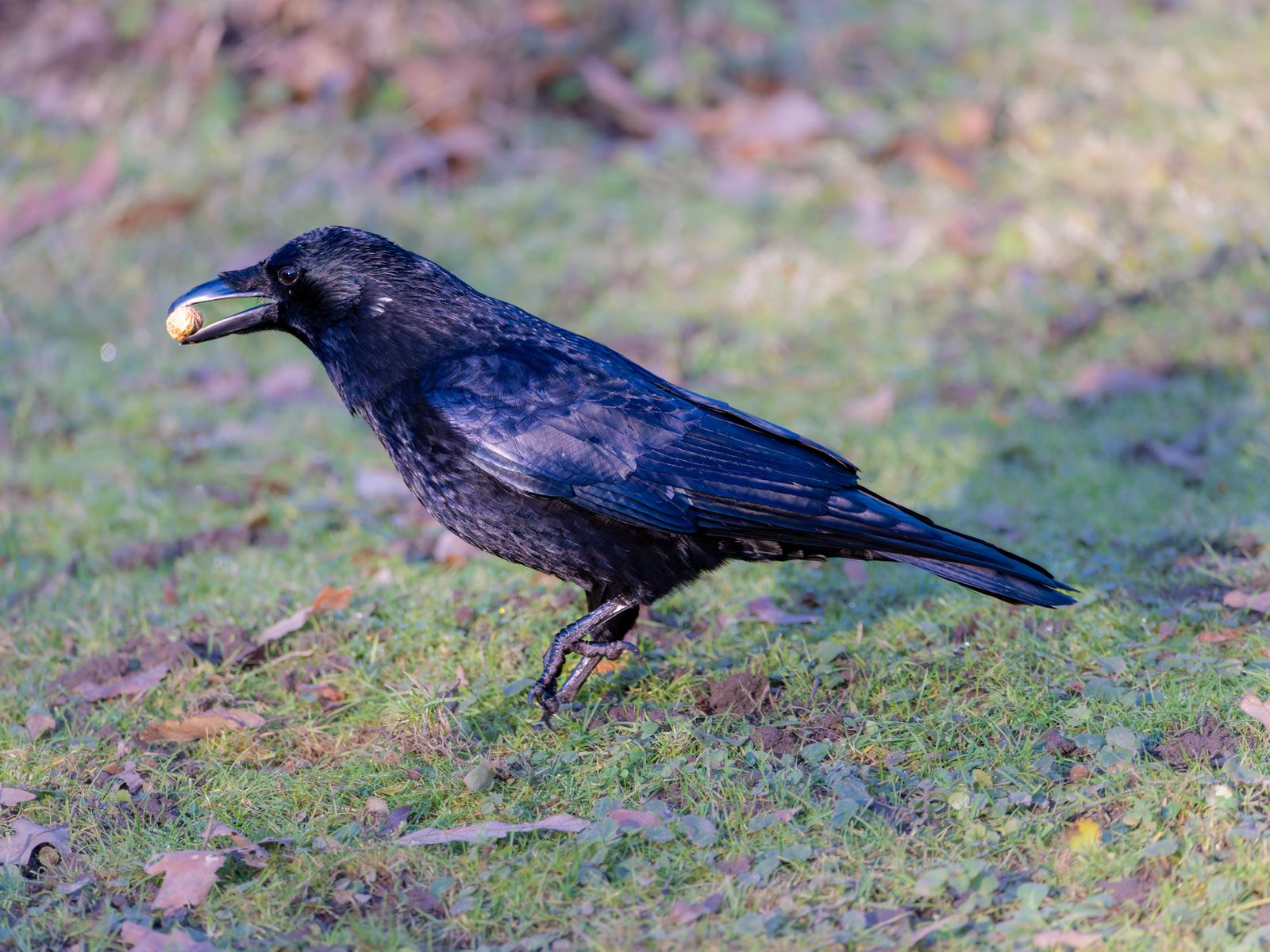
On the South Pacific island of New Caledonia, a black crow the size of a jackdaw picks up a forked twig, snips it with its beak, trims the side branch to a stub, and works the stub into a small hook. The bird then pushes the hook into a crevice in a rotting log and drags out a grub. The tool is not improvised. It follows a design the bird has been refining since it was a fledgling, and one that its parents were making before it hatched.
The species is Corvus moneduloides, the New Caledonian crow, and it is the only non-human animal known to craft hooked tools in the wild. That claim comes from the University of St Andrews group led by Christian Rutz, which has spent the better part of two decades watching these birds in the forests of Grande Terre and running controlled experiments with wild-caught individuals in temporary aviaries.
What the St Andrews work has slowly established is not that crows use sticks. Plenty of animals poke things with sticks. What the work has established is that these crows manufacture tools to a design, that the design varies by region, and that the birds appear to treat some of their tools as more valuable than others.
What the birds actually make
There are two main tool types in the New Caledonian crow’s repertoire. The first is a straight stick, pulled from leaf litter or snapped from a branch, used as a simple probe. The second is the hooked stick tool, and it is the one that has drawn most of the attention.
To make a hooked tool, a bird selects a forked twig, usually from the shrub Desmanthus virgatus, detaches it from the plant, and then works one arm of the fork into a small curved barb. The manufacturing sequence, as described in a 2017 Current Biology paper from Rutz’s group, involves detaching the branch, sculpting the hook from the nodal joint, and often trimming length, bending the shaft, or stripping bark. The Sci.News writeup of that study lays out the stages in order.
The second tool type, the pandanus tool, is different again. Crows tear tapered strips from the barbed edges of Pandanus leaves, producing probes with tiny backward-pointing serrations along one side. The shape of these strips, wide, narrow, or stepped, varies systematically between populations in different parts of the island.
That geographic variation is what pushes the story past clever foraging and toward something closer to tradition.
Why hooks are worth the trouble
A hooked tool takes longer to make than a straight one. It requires a specific plant, a specific technique, and a bird patient enough to shape the barb rather than yank the twig free. So the obvious question is whether the extra effort pays off.
James St Clair, also at St Andrews, led a study published in Nature Ecology & Evolution that put numbers on this. Working with wild-caught crows and baited wooden logs, the team measured how quickly birds could extract food using hooked versus non-hooked tools. According to VOA’s summary of the paper, the hooked tools let birds extract prey several times faster, regardless of what the tool was made from or what the target was. A separate Sci.News piece on the same work puts the same conclusion in plainer terms: hooks are faster.
The 2017 Current Biology paper went one step further. Rutz and colleagues measured hook depth across many tools and found that deeper hooks worked faster in the log experiments. What determined depth was two things: the plant material, and the technique the bird used to detach the twig. Birds that made a clean cut with their bill left more wood at the tip to sculpt from. Birds that simply pulled the branch off ended up with shallower hooks.
Adult crows, the ones with the most experience, did not always make the deepest hooks. They often used the quicker, sloppier pulling method. Rutz’s reading, in the same paper, was that very deep hooks may not be worth the manufacturing time in the wild, and may even break more easily when jammed into narrow crevices. Skill, in other words, includes knowing when not to bother.
The birds appear to value the tools they made
A separate strand of the St Andrews work has looked at what the birds do with their tools between uses. Barbara Klump, then at St Andrews and now at the Max Planck Institute of Animal Behavior, led a study published in eLife in which 17 wild-caught crows were given a mix of straight sticks, forked D. virgatus twigs they could turn into hooks, and pre-made tools of both kinds.
The researchers watched what happened to a tool once a bird had used it. Did the crow drop it? Tuck it under a foot? Wedge it into a nook in the bark?
In the Inside Science account of the study, Klump and Rutz report that crows safely stored their hooked tools 95 percent of the time, compared with 87 percent for straight sticks they had picked up from leaf litter. The birds seemed to treat the more effortful, more effective tool as worth safeguarding. Rutz’s comparison, quoted in the same piece, is to a person putting a treasured pen back in a penholder rather than leaving it on the desk.
That difference, 95 versus 87, is not enormous. But it is consistent, and it fits with a pattern the St Andrews group has documented in other experiments, described in ScienceAlert’s coverage of the same work: crows foraging higher off the ground are more careful with their tools than crows working near the forest floor, presumably because a dropped stick is harder to recover from a canopy branch than from the ground beneath it.
Regional traditions, not universal instincts
The word tradition is loaded, and it should be used carefully. What the field data show is that pandanus tool designs cluster geographically. Birds in one valley consistently produce one shape. Birds a ridge over consistently produce another. The shapes are stable enough over time, and specific enough to place, that researchers have described them as the product of social transmission, young birds learning from parents and other adults, with small variations passed on and accumulated.
That is a claim about cultural inheritance in an animal that last shared an ancestor with us more than 300 million years ago. It is a strong claim, and it rests on a body of observational work, not a single experiment. Wild studies that follow known individuals across years, of the sort the BBC has covered as the St Andrews field program has matured, are what let researchers say the variation is stable and heritable in a social sense rather than a genetic one.
What the data do not show, and what the St Andrews group has been careful not to claim, is that the crows understand what they are doing in the way a human toolmaker does. The birds may be assembling tools through a mix of inherited preference, individual practice, and observation of others, without anything like a mental blueprint. Working out which of those is doing the heavy lifting is exactly the kind of question a new generation of studies is trying to address, and it connects to a wider debate about how to study animal consciousness without projecting human categories onto it.
What the crows are not
It is easy, reading this literature, to slide into calling the birds little engineers. The St Andrews group tends not to. Their papers describe behavior, measure outcomes, and hedge on interpretation. The hook is faster. The birds guard it more carefully. The regional shapes are stable. Whatever the birds are doing cognitively, it produces those results.
What the work has done is knock over the older assumption that toolmaking, in the sense of shaping a raw material to a design, was a human monopoly, or at most a great-ape one. Hooked fishhooks in the human archaeological record appear only about 90,000 years ago, a point the Current Biology paper draws out explicitly. A crow on a Pacific island has been making a functional equivalent, in wood, on a scale of months to years, and passing the design on.
The birds are also part of a broader picture of intelligence in the corvid family and beyond, one that keeps expanding as researchers pay closer attention to species that were previously waved past. That widening includes odd corners like the deep primate history of fermented fruit consumption, and it runs through decades of work on tool use in chimpanzees, capuchins, dolphins, and octopuses.
What would sharpen the picture
Several things would help. Longer pedigrees, following identified birds and their offspring across generations, would tighten the case for social transmission of specific designs. More cross-fostering, where possible in the wild or in aviaries, would help separate what a young crow inherits genetically from what it picks up by watching. And more work on the neural side, still early, would begin to say something about how a bird brain the size of a walnut supports the sequence of decisions a hooked tool requires.
For now, the fact stands on the field notes. Somewhere on Grande Terre this morning, a crow is picking through a shrub, choosing a twig with the right fork, and starting to work it into a shape its grandparents would have recognized.