

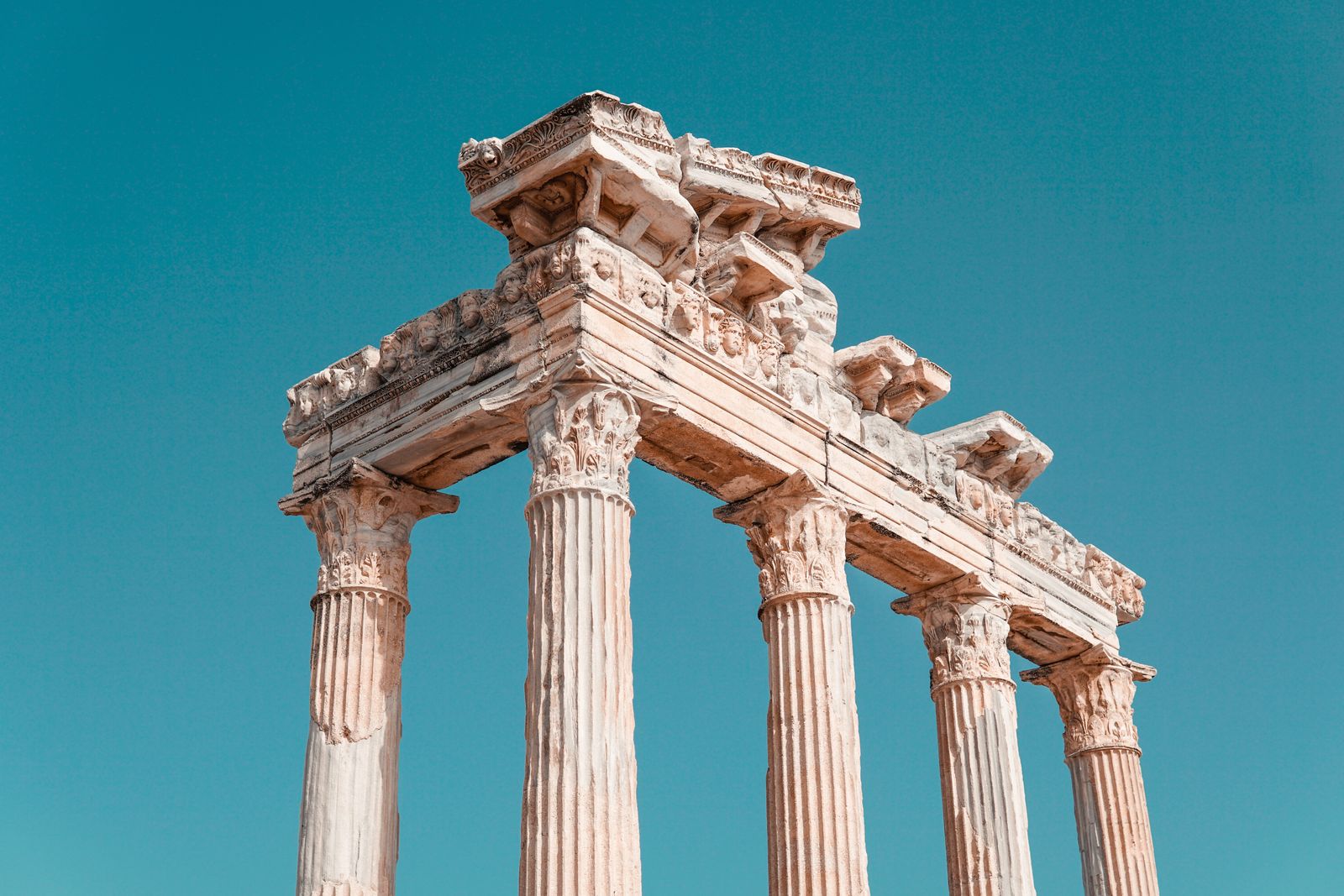
Two thousand years after Roman engineers dumped a slurry of volcanic ash, lime, and seawater into wooden forms along the Tyrrhenian coast, the piers they built are still standing. The concrete inside them is not merely surviving. It is chemically active, growing crystals that thread through old cracks and lock the structure tighter. Modern reinforced concrete in marine environments often begins failing within fifty years.
The mechanism was pinned down by a team led by geologist Marie Jackson at the University of Utah, working with X-ray beamlines at Lawrence Berkeley National Laboratory. They found that seawater seeping into the ancient mortar dissolves reactive components in the volcanic ash and precipitates a rare layered mineral called aluminous tobermorite, along with a zeolite called phillipsite. The crystals grow inside the pore spaces, refining the fabric of the concrete from within.
The result is a marine structure that treats saltwater as a construction material rather than a corrosive agent.
What the Romans actually poured
The recipe was not elaborate. Lime, chunks of volcanic tuff, and a specific volcanic ash from the Bay of Naples region called pozzolana, mixed with seawater and packed into wooden forms lowered into the shallows. Vitruvius wrote down the proportions in the first century BC. Pliny the Elder described how the ash turned rocklike in the sea.
Neither knew about crystals. They knew what worked.
The ash from the Campi Flegrei supervolcano is not inert filler. Its reactive glass and feldspar particles participate directly in the chemistry, binding with lime in what chemists now call a pozzolanic reaction. That initial set gives the concrete its early strength. The interesting part starts later, once seawater begins moving through the hardened pores.
How the crystals grow
Jackson’s team examined cores drilled from harbor structures at Portus Cosanus, Portus Neronis, and Baiae. Under X-ray microdiffraction, they watched aluminous tobermorite plates growing inside pumice fragments and phillipsite crystals filling the matrix around them. The story, described in the journal American Mineralogist, is essentially chemical slow food. Seawater dissolves silicon, aluminum, and calcium out of the ash. Those elements recombine, over centuries, into new minerals that were never in the original mix.
Phillipsite in the volcanic rock reacts with the saltwater to seed aluminous tobermorite. The tobermorite grows in plates. The plates knit across gaps. Where a modern concrete crack would widen under chloride attack, the Roman crack becomes a scaffold for new mineral growth.
Researcher Marie Jackson documented finding tobermorite crystals growing throughout the Roman concrete samples, often appearing alongside phillipsite minerals, as reported in the Berkeley Lab work.
Stronger is the wrong word. Resilient is closer
The popular version of this story often gets stated as: Roman concrete gets stronger every year. Jackson has pushed back on that framing. Jackson has clarified that the concrete doesn’t necessarily increase in compressive strength over time. Rather, the concrete develops greater resilience through its self-healing properties.
The distinction matters. Compressive strength, the number engineers use to rate a bridge deck, is not necessarily rising in a two-thousand-year-old breakwater. What is happening is that cracks that do form struggle to propagate, because the mineral network keeps sealing them. The material stays chemically alive.
That is a different kind of durability than modern engineers usually design for. Portland cement, the binder in almost all contemporary concrete, is formulated to reach its target strength within weeks and then, ideally, not change. Any chemical reaction after that is treated as decay.
Why modern coastal concrete fails
The weakness of modern marine concrete is not really the concrete itself. It is the steel rebar inside it. Chloride ions from seawater migrate through the pores, reach the reinforcing bars, and corrode them. The rust occupies more volume than the original metal, and that internal pressure cracks the surrounding concrete outward. That is why coastal bridges and parking structures need constant patching, and why reporting on Roman marine engineering keeps returning to the same comparison: fifty years versus two thousand.
Roman harbor concrete sidestepped that problem by not containing steel. It also sidestepped a lot of the loads modern concrete is asked to carry. A breakwater sits there. A bridge deck flexes under trucks. The comparison is real, and it is also unequal.
Roman concrete was massive, slow to develop full strength, and weaker in compression than a modern structural mix. It would be a poor choice for a highway overpass. For a seawall meant to last across empires, it is difficult to beat.
The 1,900-year-old latrine, and other clues on land
Not all Roman concrete is marine. On land, other chemistries were doing the maintenance work. A recent study of concrete from a communal latrine at Hadrian’s Villa in Tivoli, published in Science Advances, found calcite networks threading through cracks and pores of the walls. Because the site was never restored, the sample offered a nearly undisturbed record of how the material aged.
The carbonation process there is slower and quieter than the marine tobermorite pathway. Rainwater and groundwater dissolve calcium from unreacted lime clasts, and the calcium precipitates as calcium carbonate inside fine fractures. Over centuries, the concrete becomes denser rather than looser.
Work at an unfinished construction site in Pompeii has also produced direct evidence of hot mixing, in which quicklime was combined with volcanic material before water was added. That process left reactive lime fragments scattered through the mortar, ready to dissolve into any later crack that admitted water. Laboratory replicas have shown the mechanism can seal cracks about half a millimeter wide.
One empire, several self-healing chemistries. The Romans were, in effect, running a distributed materials-science program with feedback measured in generations.
A modern accident that grew tobermorite
Aluminous tobermorite is hard to make in a laboratory, typically requiring elevated temperatures and long reaction times. But the mineral turned up in an unexpected place: the walls of a decommissioned nuclear power plant in Japan.
Researchers examining thick concrete walls that had retained moisture for extended periods at elevated temperatures found aluminous tobermorite growing in them. The concrete had reached substantially higher strength than its design specification, though the study was careful not to credit the crystal alone.
The reactor walls had run a full-scale, slow, wet experiment that no funded research project could have afforded to conduct.
What this means for building today
The temptation is to say we should build seawalls the Roman way. It is not quite that simple. The original recipe depended on ash from specific volcanic sources, gained useful strength slowly, and could not support the tensile loads a modern reinforced structure carries. Construction schedules are measured in months, not centuries.
The transferable idea is different. Engineers can select reactive aggregates, encourage beneficial mineral growth after casting, and design binders that continue to adapt after the pour. There is a climate argument here too. Clinker production, the energy-intensive step in Portland cement, releases substantial amounts of carbon dioxide. A concrete that lasts five times longer is a concrete that needs to be poured one-fifth as often.
We have covered the Roman engineering mind on this beat before, including a look at the Pantheon’s unreinforced concrete dome, which has stood since Hadrian and still holds the record for the largest of its kind. The marine concrete story is the same instinct pointed at the sea. Science Blog has also reported on how the seawater reaction plays out at the harbor scale.

What is happening in the concrete right now
At Portus Cosanus, north of Rome, a block of Roman marine concrete sits below the tideline. Twice a day, seawater fills its pores. Somewhere inside, at a rate too slow to observe, a phillipsite crystal is losing an aluminum atom to solution. That atom will find its way, over a season or a decade, into the growing edge of an aluminous tobermorite plate a few millimeters away.
The plate will thicken. The pore will narrow. The block will stay in place.
Somewhere else along the same coast, a reinforced concrete pier poured in the 1980s is already spalling, its rebar bleeding rust down the seaward face. The two structures share a shoreline and share a solvent. They were designed with very different assumptions about what the ocean is for.