

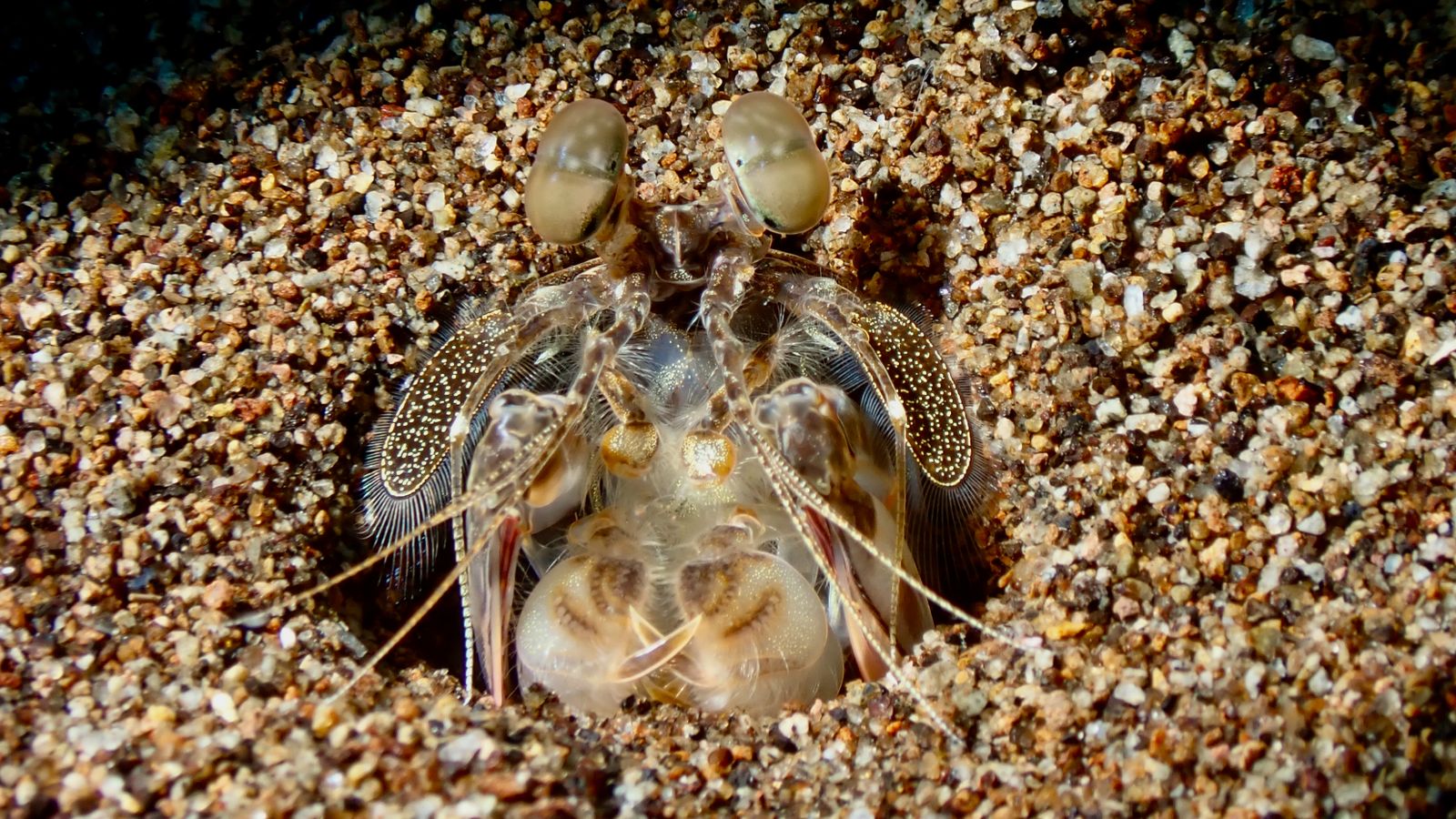
The peacock mantis shrimp throws one of the fastest punches in the ocean. Its dactyl club accelerates at roughly the same rate as a .22 caliber bullet leaving a rifle barrel, on the order of ten thousand times the acceleration of gravity, and it does this through water that is around 800 times denser than air. That comparison is about acceleration, not muzzle velocity: the club itself tops out near 23 metres per second, about 50 miles per hour. The distinction matters, because it is the brutality of the acceleration in a dense medium, not the top speed, that produces the second half of this story. The club gets moving so violently that it leaves a near-vacuum behind it, and that cavity collapses in on itself with a flash of light and heat that briefly reaches temperatures comparable to the surface of the Sun.
The shrimp’s prey, usually a snail or a crab, is being hit twice. Once by the club. Once by the collapsing bubble.
The animal is about the length of a pencil.
How the punch actually works
The peacock mantis shrimp, Odontodactylus scyllarus, is a stomatopod, not a shrimp in the culinary sense. Stomatopods first appear in the fossil record around 400 million years ago, and this particular species hunts in tropical shallow water, where it uses two hammer-shaped appendages called dactyl clubs to break open shells. When Sheila Patek’s group at UC Berkeley first filmed the strike properly in 2004, borrowing a high-speed camera from a BBC crew because their own equipment was too slow, the university’s announcement of the result reported peak club speeds of 23 metres per second and a blow landing with well over a hundred times the animal’s body weight.
The mechanism is not muscle in the ordinary sense. The club is held in a cocked position by a latch, and elastic structures behind it store energy the way a crossbow stores it in a bent limb. When the latch releases, the stored energy releases with it, and the club snaps forward far faster than muscle alone could drive it. A news release from Northwestern’s McCormick School of Engineering describes clubs that store energy in spring-like structures held in place by latch-like tendons, which is the same basic engineering principle behind a mousetrap.
The strike happens in a few thousandths of a second. Fast enough that early high-speed cameras could not resolve it properly, and useful slow-motion footage only became available once frame rates climbed into the tens of thousands per second.
The second punch is a bubble
Water does not compress easily, and it does not get out of the way easily either. When the club accelerates through it, a low-pressure zone opens up in the club’s wake. Dissolved gases and vapor rush into that low-pressure zone and form a bubble. Microseconds later, the surrounding water pressure crushes the bubble back to nothing.
This is cavitation, and it is the same phenomenon that eats away at ship propellers over years of use. In the mantis shrimp’s case, it happens next to a snail.
The collapse is violent. As Horacio Espinosa, the Northwestern engineer who co-led the recent study, put it in the university’s statement, the bubbles collapse to produce shockwaves in the megahertz range, and that secondary shockwave effect, on top of the initial impact force, makes the strike even more devastating. Measurements going back to the mid-2000s have recorded flashes of light from these collapses, a phenomenon called sonoluminescence, and the peak temperatures inside collapsing cavitation bubbles have been estimated in the thousands of kelvin. The Sun’s photosphere is about 5,800 kelvin. The comparison is order-of-magnitude, not identical, and it lasts for a fraction of a millisecond. But for that fraction of a millisecond, a mollusk in the tropical shallows is being hit by something that flashes with the heat of a star.
How the shrimp does not destroy its own fists
This is the part that has puzzled materials scientists for a long time. A bullet-grade acceleration in water, plus a shockwave from a collapsing bubble in the megahertz range, is the kind of load that would shatter most engineered structures within a few strikes. The mantis shrimp molts and grows a new club periodically, but between molts it delivers thousands of these punches without cracking its own fists or scrambling the soft tissue in its arm.
The February 2025 paper in Science, led by Nicolas Alderete in Espinosa’s group at Northwestern in partnership with M. Abi Ghanem at the Institute of Light and Matter in Lyon, offers the clearest mechanical explanation so far. The club is not a solid lump. It is built in layers, and the layers have different jobs. Northwestern’s own summary of the paper describes an outer impact region made of mineralized fibers arranged in a herringbone pattern, and beneath that a periodic region of corkscrew-like fiber bundles known as a Bouligand structure, in which each layer of fibers is rotated slightly relative to the one below it.
The herringbone layer resists cracking. The Bouligand layer does something stranger. It behaves as what the researchers term a phononic shield, filtering out specific frequencies of stress wave the way a noise-cancelling headphone filters out specific frequencies of sound. The high-frequency shear waves that would otherwise travel back into the shrimp’s arm and shred its soft tissue get blocked by the geometry of the layered structure itself.
The Northwestern team confirmed this with two laser-based techniques. A summary of the study on Science Daily describes the first, transient grating spectroscopy, as a method for analysing how stress waves propagate through a material, and the second, picosecond laser ultrasonics, as a way of reading the microstructure of the armor. Both let the team watch how stress waves actually moved through the material rather than modelling it from first principles.
What the study does and does not show
The paper is a materials-science result. It explains how the club survives its own strike. It does not claim to have solved every question about mantis shrimp mechanics, and Espinosa himself flagged the main limitation in the university release: the analysis relied on 2D simulations of how the waves behave inside the club, and 3D simulations, along with underwater experiments using better instruments, are still to come.
The idea itself was not new in 2025, only the evidence. As Smithsonian’s coverage of the paper notes, researchers proposed in 2015 that the Bouligand layer could filter high-frequency shockwaves out of the strike, but nobody had demonstrated it in a lab until now. That 2015 work, by a Purdue and UC Riverside team writing in Acta Biomaterialia, was a modelling result. The 2025 paper is the measurement.
There is also a translation problem worth naming. The phrase “phononic shield” sounds futuristic, and coverage of the paper has sometimes framed the shrimp as carrying a piece of engineered technology inside its arm. It carries a biological structure that behaves, when you measure it with lasers, the way certain engineered metamaterials behave. That is not quite the same claim, and the difference matters for anyone reading press coverage that promises the shrimp will directly inspire the next generation of body armor. Smithsonian quotes materials scientists outside the study who see potential in the structure for impact-resistant coatings and protective gear, which is a statement about promise rather than about a finished design.
Where this fits with what came before
The mantis shrimp has been a favorite of biomechanics researchers for at least two decades. Patek’s group published the first proper high-speed footage of the strike in 2004, and the .22 caliber comparison has been repeated in the literature ever since. What has shifted over the years is the level of resolution. Early work focused on the raw speed and force of the punch. Middle-period work focused on the toughness of the club as a composite material. The most recent work, including the Northwestern paper, focuses on how vibration itself is managed inside the structure, which is a subtler and in some ways more useful question.
Popular Science’s coverage of high-speed camera work on mantis shrimp fights gives a sense of how much of this story is only visible with instruments the researchers of a generation ago did not have. Patrick Green at UC Santa Barbara filmed rival shrimp trading blows at 30,000 to 40,000 frames per second, roughly a thousand times faster than an ordinary camera, in order to work out how much energy their tail plates absorb. The strike itself has not changed. The tools looking at it have.
Animals treated as instruments is a recurring subject on this desk. The story about belugas trained by the US Navy to retrieve test torpedoes from the deep cold sits in a similar register: a living animal doing something that engineered systems could not match at the time, and that engineers then spent years trying to reverse-engineer.
Why the plasma flash is not the whole story
The cavitation-bubble collapse is the vivid part of the fact, and it deserves the attention. But the mechanical punch is doing most of the work of breaking a shell. Force traces of a strike show two peaks rather than one: the club landing, and then the bubble imploding a beat later. The second insult is sharper and briefer than the first, and both are arriving at the same patch of shell.
For the prey, the difference is academic. A snail that has been hit once by a hammer accelerating like a bullet and then again by a flash of hot vapor within about a millisecond is not making fine distinctions about which of the two blows opened the shell.
The shrimp, meanwhile, is already resetting the latch.
A peacock mantis shrimp in a home aquarium can, and sometimes does, crack the glass. Aquarists who keep them use acrylic, or thick tempered panels, and they check the seams. The animal is about the length of a pencil. It punches with the acceleration of a bullet, boils water for a fraction of a millisecond, and does it again the next day.