

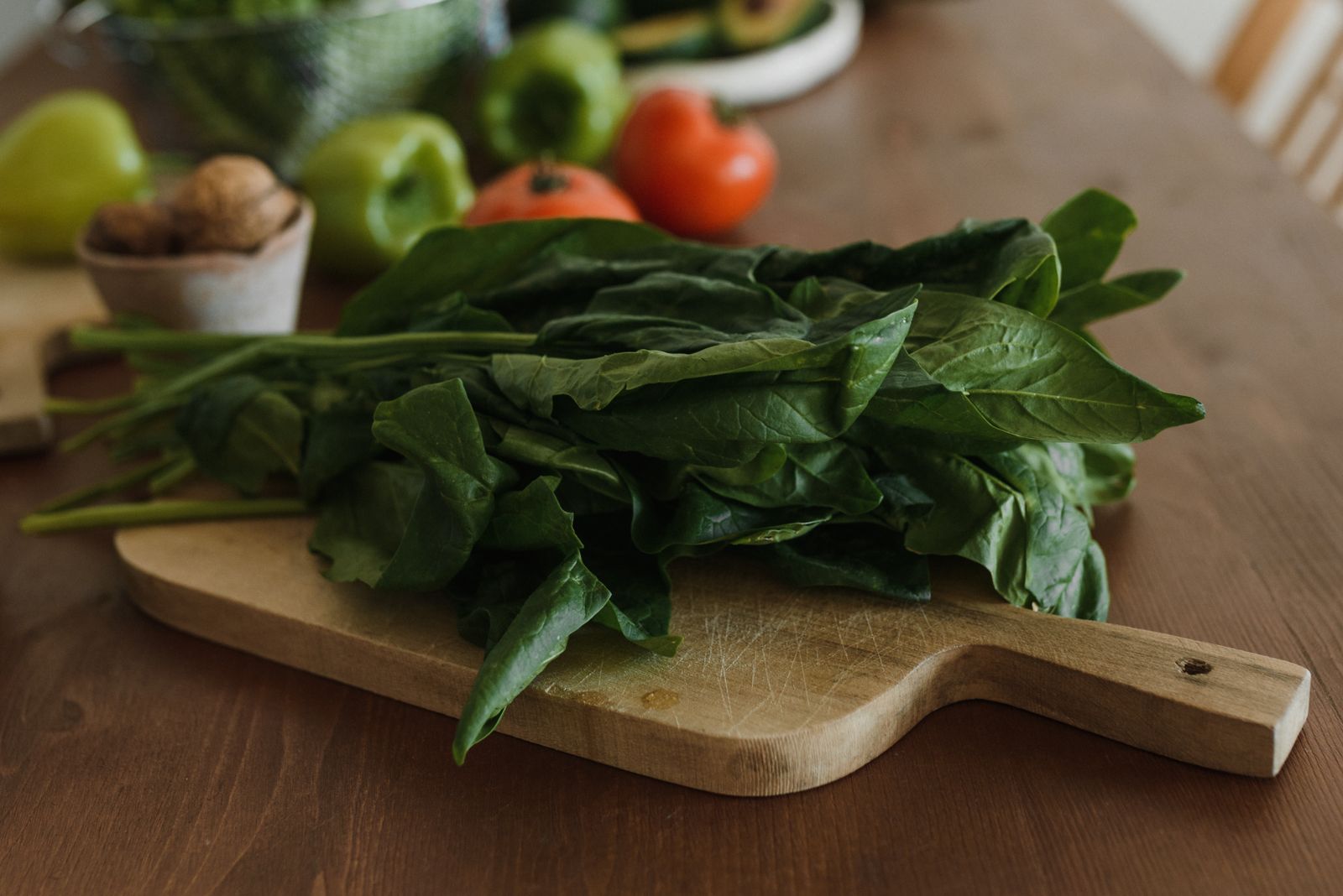
Spinach contains oxalic acid, a plant defence compound. Most dietary oxalate binds calcium in the gut and is excreted; some can be absorbed and later contribute to calcium-oxalate kidney stones in susceptible people, particularly with high intake, juicing, dehydration or an underlying risk factor.
Spinach is not trying to nourish you. It is trying to be inedible. The chemistry is old, patient, and remarkably effective.
Oxalic acid, or its ionised form oxalate, is one of the most widely distributed plant defense compounds on Earth. It sits inside spinach leaves as needle-shaped raphide crystals, packed into specialised cells that rupture when chewed. In a caterpillar’s mouth, that release is a mild disaster. In yours, it is the reason a raw spinach smoothie tastes faintly of chalk and metal.

The oxalate content
Raw spinach ranks near the top of dietary oxalate tables published for clinical use, alongside rhubarb stalks, almonds, and cocoa. Kidney-stone dietitians treat it as a red-flag food for a reason: urologists routinely list spinach, nuts, beets, chocolate, and brewed tea as the highest-yield targets when a patient’s urine chemistry shows elevated oxalate.
Oxalic acid is a small, symmetrical molecule — two carboxyl groups stuck together, formula H₂C₂O₄. It is the simplest dicarboxylic acid in nature, and one of the strongest organic acids that plants make. In leaf tissue, it usually exists bound to calcium as calcium oxalate, forming the tiny mineral needles that give raw spinach its faint sandy mouthfeel.
What happens when you swallow it
Once in the gut, some of that oxalate stays bound to calcium and passes straight through, harmlessly, in stool. This is the part nutritionists like: dietary oxalate can actually reduce calcium absorption from the same meal, because the two lock together in the intestine and neither gets across the gut wall.
The rest is the problem. Free oxalate — unbound, dissolved — is absorbed across the intestinal lining, enters the bloodstream, and is filtered by the kidneys. The kidneys cannot metabolise it. Their only option is to concentrate it in urine and flush it out.
Inside the renal tubules, oxalate meets calcium again. This time the reunion happens in a hot, concentrated, slightly acidic fluid moving through microscopic channels. Calcium oxalate is spectacularly insoluble in that environment. It crystallises. Researchers studying the effect of urine pH on calcium oxalate crystal formation have shown that even small shifts in acidity change how those crystals grow, how they stick to tubule cells, and whether they get internalised by kidney tissue rather than washed out.
Calcium-oxalate crystals can aggregate into stones. Passing a stone through the urinary tract can cause severe pain, but an ordinary serving of spinach does not itself “shred” the ureter.
The most common kidney stone on Earth
Calcium oxalate is the most common kidney stone composition worldwide. Urologists interviewed by USA Today in 2025 put the lifetime prevalence at about 11 percent of men and 9 percent of women in the United States. Kidney stones can range from grit to structures that fill an entire kidney, and any stone that blocks kidney drainage can cause severe pain. Some patients describe the sensation as worse than childbirth. The pain is not the stone forming; it is the stone moving, scraping down a tube about 3 millimeters wide.
High oxalate concentration in urine — hyperoxaluria — is one of the main triggers. It can be genetic, or driven by dehydration and obesity, or, in the case that concerns spinach eaters, driven by eating large amounts of high-oxalate food. Kidney stones are also linked to higher long-term risks of chronic kidney disease, hypertension, and cardiovascular disease.

Why spinach in particular
Spinach is not the only oxalate factory in the produce aisle, but it is unusually concentrated. Beet greens, Swiss chard, and amaranth also load their leaves with oxalate crystals as an anti-herbivore strategy. The needles are physically abrasive to insects and grazing mammals. In cattle, high-oxalate forage can cause both acute poisoning and long-term kidney damage.
Humans get a partial pass because most people eat spinach in modest amounts and often with a calcium source — cheese, yoghurt, dressing — that binds oxalate in the gut before it can be absorbed. Cooking helps too. Boiling spinach and discarding the water can remove a substantial portion of soluble oxalate, because the compound leaches out with the cooking liquid. Sautéing does much less; steaming falls somewhere in between.
The green juice craze is where the arithmetic gets uncomfortable. A single glass of raw spinach juice can concentrate the oxalate of several cups of leaves into a fast-absorbing liquid with almost no calcium to buffer it. Cases of acute oxalate nephropathy — kidney failure triggered by a sudden oxalate load — have occurred in otherwise healthy people following this pattern. The problem tends to arise in patients who think they are eating exceptionally healthy — snacking on nuts and granola, juicing with spinach, piling on beans and avocados. It is all about moderation.
The gut microbes that eat oxalate for you
Human biology has a surprising ally against oxalate: bacteria. A species called Oxalobacter formigenes lives in the colons of many people and uses oxalate as its sole energy source. It literally eats the compound before your body can absorb it. People colonised with healthy populations of this microbe excrete measurably less urinary oxalate than people without it.
That is one reason antibiotics, inflammatory bowel disease, and gastric bypass surgery all raise kidney-stone risk — they disrupt the gut communities that would otherwise degrade dietary oxalate before it enters the bloodstream. A 2025 review in Frontiers in Microbiology on the gut-kidney axis in urolithiasis traced how microbiota, their metabolites, and bile acid signalling all shape whether oxalate ends up in a stone or in a stool.
Which means the question of whether a cup of spinach becomes a health food or a kidney problem depends partly on what species of bacteria happen to be living six feet of intestine downstream from your mouth.
Crystals, cells, and the modern picture
Stone formation is not just chemistry. It is biology. When calcium oxalate crystals form in the renal tubules, they can adhere to the surface of tubule cells, get internalised, and set off inflammation. A 2026 review in Frontiers on interleukin and chemokine signalling in calcium oxalate nephrolithiasis mapped how immune messengers recruit inflammatory cells to sites of crystal deposition, effectively turning a mineral problem into an immunological one. Repeated inflammation scars the tissue and makes the next stone more likely.
Vitamin D adds another layer. It boosts calcium absorption from the gut, which for most people is desirable — but in stone formers can raise urinary calcium and, combined with oxalate, tip the balance toward crystallisation. A 2025 paper on the complex relationship between vitamin D and kidney stones laid out how the same hormone can be protective at one dose and stone-promoting at another.
Researchers have even tried to design molecules that jam the crystallisation machinery itself. A study published in Nature Structural Biology on bio-inspired disruptors of calcium oxalate crystallisation described compounds modelled on urinary proteins that naturally interfere with stone growth — an attempt to copy what healthy kidneys already do to keep small crystals from getting large.
Why the plant makes it anyway
Spinach did not evolve oxalic acid to hurt humans. The compound has jobs. It regulates calcium inside plant cells, sequesters heavy metals like aluminium, and forms the sharp crystals that make leaves physically unpleasant to chew. In arid conditions it may also help with osmotic balance.
The plant is running a chemistry experiment that started 500 million years ago, back when the first land plants faced hungry arthropods and no legs to run on. Every leaf is a compromise between photosynthesising efficiently and not being eaten to death. Oxalate is one line in that ledger.
The human negotiation with these compounds is more recent and much messier. Most plant defense chemicals, at low doses, act as mild irritants that nudge the body’s own repair pathways awake — a phenomenon nutrition researchers call hormesis. The bitter compounds in kale, the astringents in green tea, the sulphur chemistry in a raw radish: at typical dietary levels they seem to help. At extreme levels, or in vulnerable people, they harm.
Oxalate sits squarely in that ambiguous middle. Spinach remains one of the densest sources of folate, magnesium, vitamin K, and lutein in the human diet, and cohort studies consistently link leafy-green consumption to lower cardiovascular and metabolic disease risk. Science Blog has covered how exercise itself appears to protect kidney function in people with obesity, and the story of oxalate risk is inseparable from that broader picture of hydration, weight, and metabolic health.
The practical arithmetic
For a person with no history of stones, no family history of hyperoxaluria, and normal kidney function, a cup of raw spinach in a salad is not a threat. It is a nutrient-dense mouthful of leaves whose oxalate load will mostly get bound to calcium in the gut, partly degraded by microbes, and mostly excreted without incident.
For a person who has already passed one calcium oxalate stone, the calculus is different. Recurrence rates run above 50 percent within a decade. Doctors no longer recommend eliminating oxalate entirely — the diet is too restrictive and many high-oxalate foods carry other benefits — but they do recommend not treating spinach as a free food. Blend it into a daily smoothie for a year and the urinary oxalate numbers will tell.
Rhubarb leaves, worth noting, are on a different planet. They contain enough oxalic acid to cause fatal poisoning at high doses, which is why cooks eat the stalks and compost the leaves. The stalks themselves are relatively safe. The plant sorted its defenses by tissue.
Spinach never went that far. It kept the chemistry mild enough that humans still eat it by the truckload, and sharp enough that the crystals inside every leaf remain, in a real biochemical sense, working. Chew a raw leaf slowly and the faint gritty tingle at the back of the tongue is the raphides bursting — 500 million years of plant strategy, delivered in a salad.
Correction, September 20, 2026: The headline and opening were revised to distinguish oxalate binding in the gut from kidney-stone formation in susceptible people, and to remove an overstated description of stone passage.