

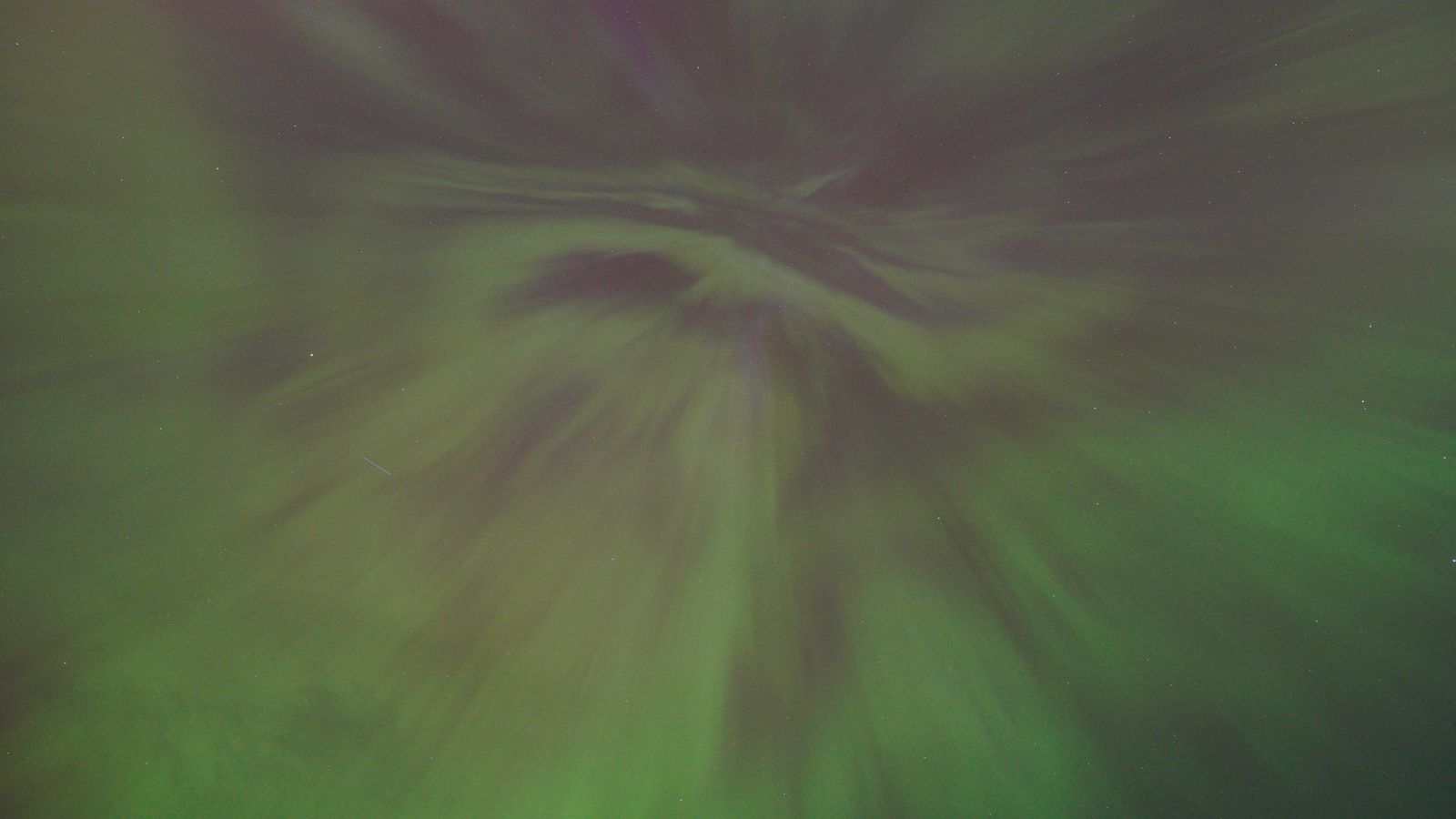
A coronal mass ejection can tear roughly a trillion kilograms of charged plasma away from the Sun and send it racing through the solar system. Most take days to reach Earth’s orbit, and most are not aimed directly at us. The most extreme clouds, however, can cross the roughly 150-million-kilometre gap in less than 18 hours.
Light covers that distance in about 8 minutes and 20 seconds. A CME travelling at 3,000 kilometres per second would be moving at roughly 1% of light speed — slow beside a photon, but extraordinary for a vast cloud of matter carrying its own magnetic field.

What actually leaves the Sun
A CME is not a beam of radiation. It is an expanding cloud of plasma made largely from electrons and ionised hydrogen and helium, threaded by magnetic fields carried out of the Sun’s corona.
Many CMEs develop a coherent, twisted magnetic structure known as a flux rope. A solar-physics explainer on interacting CMEs describes them as long, twisted structures resembling ropes. They do not remain rigid as they travel: the clouds expand enormously, interact with the surrounding solar wind and can collide or merge with other ejections.
Mass estimates vary widely from event to event, but about a trillion kilograms — one billion tonnes — is a commonly used order-of-magnitude figure. That is roughly the combined mass of several million fully loaded jumbo jets, lifted out of the Sun’s atmosphere during an eruption lasting minutes or hours.
The rate also changes with the Sun’s approximately 11-year activity cycle. Near solar minimum, observers may see about one CME each week. Near maximum, the average can rise to two or three per day, with more than ten possible during unusually active periods. Research cited in the same explainer estimates that nearly one-third interact with another CME or with the solar wind.
Where the 18-hour figure comes from
The average Sun–Earth distance is about 149.6 million kilometres, or one astronomical unit. At a constant 250 kilometres per second, crossing that distance would take almost seven days. At 400 kilometres per second, it would take a little over four days. Many Earth-directed CMEs arrive within one to three days because they travel faster than that for much of the journey.
At a constant 2,000 kilometres per second, the same calculation gives about 20 hours and 47 minutes. At 3,000 kilometres per second, it gives just under 14 hours. Real CMEs accelerate, decelerate and interact with the solar wind, so their launch speed cannot simply be treated as their average speed all the way to Earth.
One of the most closely studied modern examples erupted in July 2012 and travelled toward NASA’s STEREO-A spacecraft. A peer-reviewed analysis in Nature Communications calculated that it reached the spacecraft in 18.6 hours. It was unusually fast because an earlier eruption had cleared and altered the solar wind ahead of it, reducing the deceleration it experienced.
The July 2012 storm did not strike Earth. Historical evidence nevertheless shows that an even shorter transit is possible. A reconstruction published in The Astrophysical Journal revised the transit time associated with the September 1859 Carrington storm to no more than 17.1 hours.
Those are exceptional cases. A June 30, 2026 X1.1 flare, for example, launched an Earth-directed CME that illustrated the more familiar timescale. In its coverage, Space.com noted that CME clouds typically require one to three days to arrive.
The 1989 blackout happened in less than a minute
At 2:44 a.m. local time on March 13, 1989, violent fluctuations in Earth’s magnetic field overwhelmed the Hydro-Québec transmission system. According to Hydro-Québec’s official account, the protection system tripped and the blackout occurred in less than a minute. Roughly six million people lost electricity, and much of the province remained dark for more than nine hours.
The danger was not heat from the CME reaching the ground. As the solar storm disturbed Earth’s magnetic field, it generated slowly varying electric fields across the surface. Those fields drove geomagnetically induced currents through long conductive systems, particularly high-voltage transmission lines.
Power transformers are built for alternating current. A strong, slowly changing current entering through grounded transmission equipment can push a transformer core toward magnetic saturation, producing excessive reactive power demand, distorted currents and damaging heat.
The Carrington Event of September 1859 remains the historical benchmark. British astronomers Richard Carrington and Richard Hodgson independently recorded the associated white-light solar flare on September 1. When the geomagnetic storm arrived, telegraph equipment sparked, some operators disconnected their batteries, and induced current in the lines was reportedly strong enough to continue carrying messages.

Why solar activity remains important after maximum
Solar Cycle 25 entered its maximum period in 2024, with high activity continuing through 2025. Solar maximum is not a single day, and major eruptions can continue during the uneven declining phase that follows.
On May 10, 2024, multiple Earth-directed CMEs that had erupted over the preceding days merged into a complex structure before reaching Earth. The result was the first G5, or extreme, geomagnetic storm since 2003, with aurora visible far beyond its usual latitudes.
Interacting ejections are particularly difficult to forecast. A faster CME can catch a slower one, compressing the plasma and magnetic fields between them. The structures may merge, reconnect or arrive as a complicated sequence rather than as two neat, separate clouds. Research on interacting CMEs has found that they are about twice as likely to produce a geomagnetic storm as an isolated ejection.
Scientists now watch these eruptions from several positions around the solar system. India’s Aditya-L1 observatory was placed in a halo orbit around the Sun–Earth L1 point in January 2024. The Indian Space Research Organisation later reported that Aditya-L1’s Visible Emission Line Coronagraph observed a July 2024 CME and measured changes in the corona as material escaped.
It joins a wider fleet that includes NASA’s Parker Solar Probe, ESA’s Solar Orbiter and the long-running NASA–ESA SOHO mission. These spacecraft do not all sit at L1 or perform the same job, but together they provide views of the corona, solar wind and magnetic environment that no single observatory could supply.
What the warning time actually buys
X-rays and ultraviolet radiation from a solar flare reach Earth at the speed of light, so they arrive about eight minutes after leaving the Sun. There is effectively no advance warning of that first electromagnetic burst.
The accompanying CME travels far more slowly. Coronagraphs can reveal a cloud moving away from the Sun, allowing forecasters to estimate its direction, width and likely arrival time. That can provide hours or days of notice, although forecasts remain uncertain because the cloud may accelerate, decelerate, rotate or interact with other solar-wind structures.
Spacecraft near L1 sit roughly 1.5 million kilometres upstream of Earth. When the CME reaches them, their instruments can directly measure the density, speed and magnetic orientation of the incoming plasma. Depending on its speed, those measurements may provide only around 15 to 60 minutes before the disturbance reaches Earth.
That window is still useful. Grid operators can reduce transfers or postpone vulnerable switching operations. Satellite controllers can place spacecraft into safer configurations. Aviation authorities can alter polar operations when radiation and communications conditions warrant it.
The limits of that protection are why European Space Agency emergency planners have conducted Carrington-scale exercises. The aim is not to prevent the solar eruption, but to recognise what is coming quickly enough to protect vulnerable systems and limit the damage.
The Sun is not the only star that does this
For decades, astronomers inferred that other stars should produce CMEs, but proving that plasma had actually escaped a distant star was difficult. In 2025, astronomers reported the first confirmed CME from a star other than the Sun.
The eruption came from StKM 1-1262, a red dwarf about 130 light-years away. Researchers using the Low Frequency Array detected a type II radio burst, a signal associated with a shock moving outward through a star’s atmosphere. Follow-up observations helped establish that material had escaped into space rather than merely moving around within the stellar corona.
The event was estimated to be fast and dense enough to severely erode the atmosphere of a nearby Earth-like planet. That matters because red dwarfs are among the galaxy’s most common stars, and their habitable zones lie close to the star, where planets can face frequent and intense stellar activity.
The mechanics of impact
When a fast CME reaches Earth, its leading shock can compress the magnetosphere. During an extreme event, the boundary on the dayside can be pushed inward far enough to leave some normally protected satellites exposed to harsher solar-wind conditions.
The orientation of the CME’s magnetic field then becomes crucial. If it carries a strong southward component, opposite to Earth’s field at the dayside boundary, magnetic reconnection can efficiently transfer energy into the magnetosphere. That process drives auroral activity and can inject energetic particles into near-Earth space.
Finally, rapid changes in the magnetic field drive geomagnetically induced currents through the ground and connected infrastructure. Long transmission lines are vulnerable because voltage can accumulate over large distances. Those currents can then enter transformers through their grounded connections and disrupt grid operation.
What a trillion kilograms looks like
A fully loaded Boeing 747 has a maximum takeoff mass of roughly 400 tonnes. A billion-tonne CME therefore contains as much mass as about 2.5 million jumbo jets. The Great Pyramid of Giza is commonly estimated to weigh around 6 million tonnes, making the same CME equivalent to roughly 170 pyramids.
At 2,000 kilometres per second, a trillion-kilogram cloud would carry approximately 2 × 1024 joules of kinetic energy. Only a small fraction of the full structure intersects Earth’s magnetosphere, and only part of that energy is transferred into the near-Earth environment.
Most CMEs miss Earth entirely. Even a direct hit is not automatically disastrous: the speed, density and embedded magnetic-field direction all affect how strongly the cloud couples to the magnetosphere. Many impacts produce little more than elevated auroral activity and a tense shift for space-weather forecasters.
Occasionally, the geometry is less forgiving. Québec’s grid experienced that coupling in March 1989. Telegraph operators saw its nineteenth-century equivalent in 1859. The solar physics has not changed, but the amount of technology exposed to it has.
Modern civilisation has stretched long conductors across continents, placed satellites throughout near-Earth space and made power, navigation and communications increasingly interdependent. That does not make every CME a catastrophe. It means that an unusually fast, dense and magnetically aligned one now has more ways to disturb daily life.
Somewhere above an active region on the Sun, another magnetic structure is tightening and reorganising. If it erupts toward Earth, it may take several days to arrive. If it belongs to the extreme sub-18-hour class, tomorrow’s dinner could be on the table before the cloud reaches the planet.