

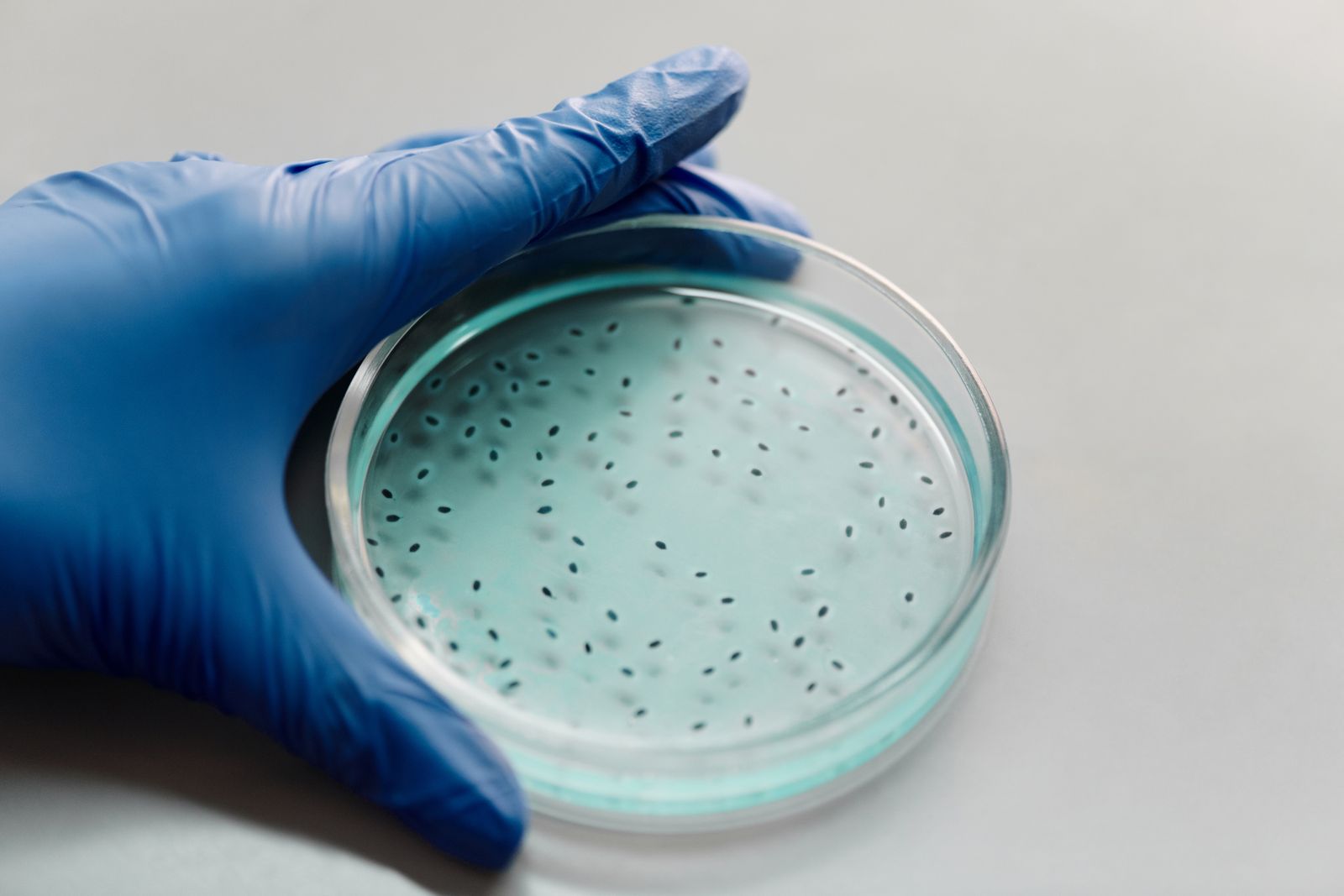
Every molecule of vitamin B12 on Earth, in every cow’s liver and every jar of nutritional yeast and every pink sub-lingual tablet sold at the pharmacy, was originally assembled by a single-celled organism. Not a plant. Not an animal. A bacterium or an archaeon, working through a chain of roughly 30 enzymatic steps to build a cobalt-cored ring so chemically baroque that industrial chemists gave up trying to synthesise it economically and now farm it out to vats of Pseudomonas denitrificans instead.
B12 is the only vitamin no plant can make. It is also the only vitamin no animal can make. The whole biosphere leans on microbes for it.

The molecule almost nothing can build
Cobalamin, the chemical name for vitamin B12, is the largest and most structurally complex of all the vitamins. At its centre sits an atom of cobalt, held inside a corrin ring that looks, to a chemist’s eye, like a slightly warped cousin of the heme in your blood and the chlorophyll in a leaf. Getting that cobalt into position requires a biosynthetic pathway with around 30 steps, encoded across a suite of genes that appears only in bacteria and archaea.
Plants do not carry those genes. Neither do fungi. Neither do animals, including humans. A 2025 study of Propionibacterium freudenreichii, one of the bacterial workhorses used in industrial B12 production and in Swiss cheese fermentation, showed that oxygen availability alone decides whether the bacterium bothers to make cobalamin at all.
The chemistry is so demanding that when Robert Burns Woodward and Albert Eschenmoser completed a total synthesis of vitamin B12 in the lab, it required more than 100 researchers working collaboratively over the course of a decade. Industry never adopted the route. It was easier to grow bacteria.
Why the plant kingdom draws a blank
Ask a botanist to find B12 in a plant and they will come back empty-handed. Spinach doesn’t make it. Neither does kale, wheat, quinoa, soy, or any of the algae marketed as “plant-based B12 sources.”
The reason is evolutionary. Plants build their own amino acids, their own sugars, their own fatty acids, and a long list of vitamins from scratch using sunlight and soil minerals. But they never evolved the cobalt-chemistry toolkit. They didn’t need to. Plants use a different enzyme, one that doesn’t require B12, to handle the biochemical reactions that in animals depend on it.
Animals took the other path. Somewhere deep in evolutionary history, animal lineages committed to B12-dependent enzymes for two critical jobs: rearranging a fatty-acid breakdown product called methylmalonyl-CoA, and recycling the amino acid homocysteine into methionine. Both reactions are non-negotiable. Skip them for long enough and nerves demyelinate, red blood cells swell into fragile megaloblasts, and the tongue turns beefy and smooth.
Cows, termites, and the microbes doing the work
A cow eats grass and produces meat rich in B12. It looks, on the surface, like the cow is manufacturing the vitamin. It isn’t. The cow’s rumen is a four-chambered fermentation tank housing trillions of anaerobic bacteria and archaea, and it’s those microbes, feeding on the plant fibre, that synthesise the B12. The cow then absorbs the vitamin further down the gut. Same story for sheep, goats, deer, and giraffes.
Termites do a version of the same trick. So do rabbits, which practise coprophagy — eating a specific type of soft faecal pellet — to recover B12 produced by microbes in their hindgut, which sits too far downstream for direct absorption. The rabbit isn’t being disgusting. It’s being biochemically sensible.
Humans host B12-producing bacteria too, mostly in the colon. The problem is location. B12 absorption happens in the ileum, in the small intestine, well upstream of where the microbes make it. A 2022 in vitro study of the healthy adult gut microbiota found that colonic bacteria can indeed produce enough B12 to meet their own community’s needs — but that supply stays in the colon and mostly leaves the body in stool. The human gut is, in effect, a factory built downstream of its own warehouse.
The ocean’s hidden vitamin economy
Zoom out to the sea and the microbial monopoly on B12 becomes even more visible. Many algal species can’t survive without cobalamin — and yet, like plants on land, algae can’t make it. They depend entirely on marine bacteria and archaea.
This dependence structures whole ecosystems. A Nature Index survey of marine B-vitamin dynamics (drawing on multi-year metagenomic time series such as Beauvais et al. 2023) describes a seasonal handover in coastal waters: archaeal communities carry the anaerobic cobalamin pathway and dominate B12 production in winter, while Alphaproteobacteria and cyanobacteria take over in spring and summer with aerobic routes. The vitamin supply never quite fails, because different microbes step in as conditions shift.
The transactions between these microbes are startlingly intricate. In 2024, research published in Nature described two North Sea bacteria, one from the genus Roseovarius and one from Colwellia, that only synthesise B12 in cooperation with each other. Colwellia builds the smaller building block and releases it. Roseovarius builds the larger corrin ring and combines the two. But Roseovarius doesn’t hand the finished vitamin over freely.
Instead, Colwellia triggers a virus lying dormant in the Roseovarius genome. The virus replicates, bursts the Roseovarius cell open, and spills B12 into the water alongside a fresh wave of viral particles. According to the research, this marked the first demonstration of two bacterial species that only produce B12 through cooperative interaction. The researchers noted that this type of complex bacterial cooperation had not been previously documented.
Even among microbes that can make B12, most keep it. Many marine prototrophic bacteria — those genetically capable of B12 synthesis — do not release the vitamin to their surroundings under normal conditions. The supply reaching the wider ecosystem often depends on cell death, viral lysis, or grazing, which is another way of saying: B12 tends to leak out when something dies.
The scale of dependency
Genomic surveys have quantified just how lopsided this microbial economy is. Analyses of ocean bacterioplankton suggest that the majority of species are auxotrophs for at least one B vitamin, meaning they cannot synthesise it themselves. For B12 specifically, the producers are a minority underwriting the metabolism of almost everything else in the water column.
Cobalamin has been flagged as a limiting nutrient in some regions, on par with iron or nitrogen. When B12 production falters, phytoplankton growth stalls. When phytoplankton stall, the base of the marine food web wobbles.
The same logic applies in symbiotic pairings. Studies of the marine dinoflagellate Lingulodinium polyedrum have confirmed that the alga’s B1 and B12 requirements can be met entirely by its associated bacterial community in culture — no external vitamin supplementation needed, as long as the right microbial partners are present.
Where dietary B12 actually comes from
Trace any B12 in a supermarket back to its source and it ends in a fermentation tank. Beef liver, one of the densest natural sources, contains B12 produced by rumen microbes and stockpiled in the animal’s liver. Sardines and clams carry B12 that started in marine bacteria and worked its way up through plankton and small fish. Eggs contain B12 that hens absorbed from their feed, which is typically fortified with B12 grown in industrial bacterial cultures.
The B12 in fortified breakfast cereal, in nutritional yeast, in the little pink pill, in the injectable ampoule used to treat pernicious anaemia: all of it is grown in bioreactors, usually by Pseudomonas denitrificans or Propionibacterium species, in fermentation runs that can last a week or more. World production runs to tens of tonnes per year, all of it microbial.
This is why the standard nutritional advice for anyone eating a strictly plant-based diet is unambiguous: take a B12 supplement, or eat foods fortified with it. There is no leaf, no seed, no fruit, no fungus that reliably delivers the human-active form. The vitamin has to come, one way or another, from a microbe — either directly, via a supplement grown in a tank, or indirectly, via an animal that hosted the microbes for you.
An older kind of partnership
The dependency is ancient. B12-using enzymes appear in some of the deepest branches of the tree of life, suggesting that cobalamin was already in circulation when the ancestors of animals were still single cells. What evolved alongside those enzymes was a permanent outsourcing arrangement: the eukaryotes that would become plants and animals never picked up the biosynthetic pathway, and never had to, because the microbial world was already producing enough.
The arrangement holds today in every functioning ecosystem on the planet. In a cow’s rumen. In the sediments beneath a mangrove. In the sunlit surface of the North Sea, where a Roseovarius cell waits for a viral trigger before spilling its cobalamin into the water. In the colon of a human, where bacteria dutifully produce B12 that mostly leaves the body unused.
Every steak, every fillet of salmon, every yolk, every pill: the cobalt atom at the centre of the ring was placed there by an organism you cannot see without a microscope. The rest of the biosphere is, on this one molecule, a tenant.