

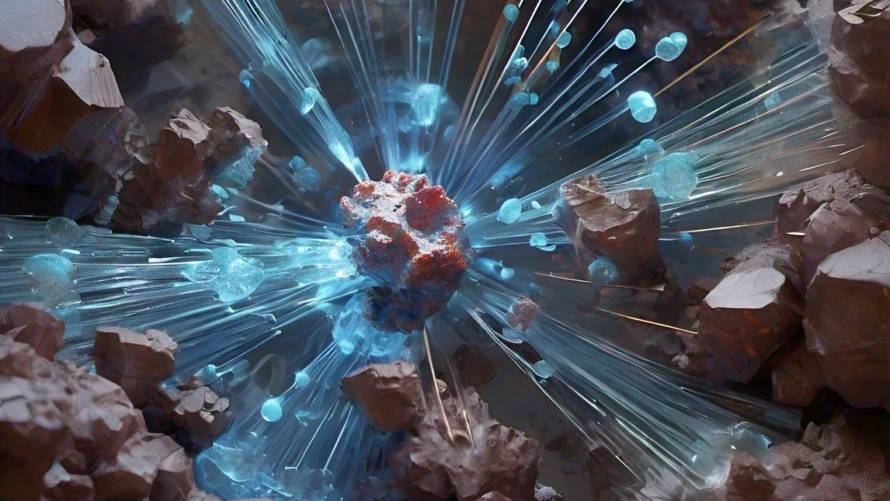
Researchers from Ames National Laboratory have made a groundbreaking discovery by identifying miassite, a mineral found in nature, as the first unconventional superconductor with a naturally occurring chemical composition.
Miassite is one of only four minerals that act as a superconductor when grown in the lab. The team’s findings provide new insights into unconventional superconductivity, which could lead to more sustainable and cost-effective superconductor-based technology in the future.
Superconductivity occurs when a material can conduct electricity without energy loss, making superconductors useful in various applications, such as medical MRI machines, power cables, and quantum computers. While conventional superconductors are well understood, they have low critical temperatures, which is the highest temperature at which a material acts as a superconductor.
Ruslan Prozorov, a scientist at Ames Lab, explained that it is challenging to find superconductors in nature because most superconducting elements and compounds are metals that tend to react with other elements, like oxygen. However, miassite (Rh17S15) stands out due to its complex chemical formula. “Intuitively, you think that this is something which is produced deliberately during a focused search, and it cannot possibly exist in nature,” said Prozorov, “But it turns out it does.”
Paul Canfield, Distinguished Professor of Physics and Astronomy at Iowa State University and a scientist at Ames Lab, synthesized high-quality miassite crystals for the project. The team used advanced techniques to study the superconductivity of miassite at extremely low temperatures, around -460 degrees Fahrenheit.
The researchers conducted three different tests to determine the nature of miassite’s superconductivity, including the “London penetration depth” test and introducing defects into the material. The results showed that miassite behaves as an unconventional superconductor, with properties similar to high-temperature superconductors.
Investigating unconventional superconductors is crucial for understanding how they work, as Prozorov explained, “Uncovering the mechanisms behind unconventional superconductivity is key to economically sound applications of superconductors.”
#UnconventionalSuperconductor #MiassiteMineral #SuperconductivityBreakthrough #SustainableTechnology