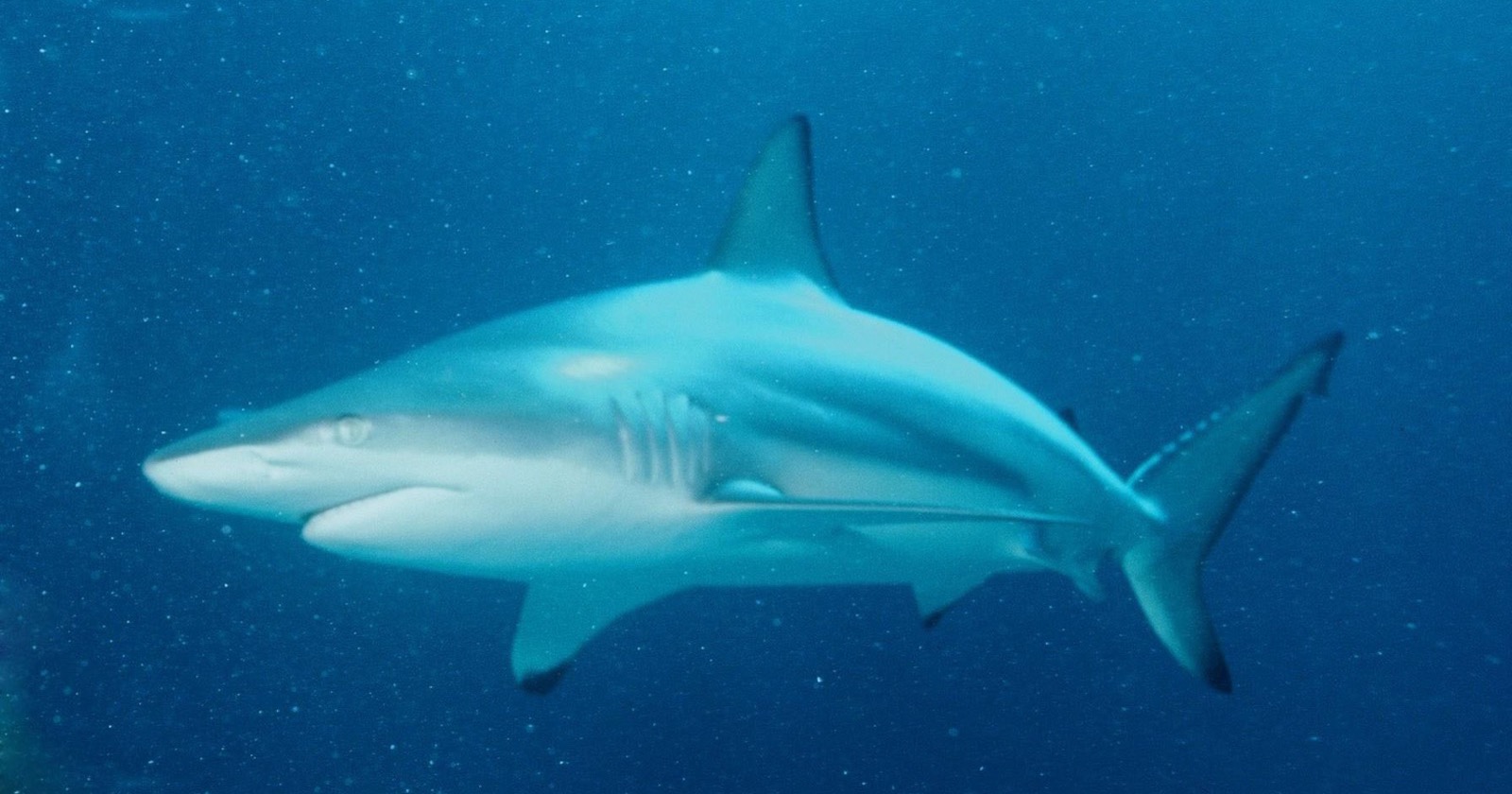
Wild sharks turned away from an underwater speaker from at least 62 metres (about 203 feet) off, more than half the length of a football pitch. The farthest reaction came at 74 metres, nearly 250 feet.
Florida Atlantic University (FAU) calls it the first quantified evidence that free-swimming sharks react to sound from that far out, which makes the study worth knowing about. Its headline went one step further: “Sharks Can Hear Sounds Nearly 250 Feet Away and Find the Source.” The study backs the distance. Whether sharks can pinpoint where a sound comes from is still an open question.
In a study in Integrative Organismal Biology, Caroline Sullivan, Edmund Gerstein and Stephen Kajiura of FAU filmed wild blacktip sharks off Palm Beach County, Florida, with a drone while an underwater speaker played low, pulsing sounds. A 10-kilohertz tone, outside the range at which sharks are known to hear, got no reaction at all.
Sound has long moved sharks
Scientists have known for decades that sound moves sharks. In 1963, Donald Nelson and Samuel Gruber reported in Science that sound could call them in. On reefs off Miami, large sharks came to low, pulsing sounds, mostly 20 to 60 hertz, that resembled struggling fish. Higher pulses and steady low tones did not work. A struggling fish makes noise, and a hungry shark follows it.
The abstract holds a surprise. It says the sharks “apparently detected and oriented to the sounds in the acoustic far field.” So the idea that sharks react from a distance is not new. What was missing was a measurement of how far. The FAU paper’s synopsis still says sharks are “presumed to lack the capacity” to detect such sounds beyond the near field.
Volume changes everything, though. In a 1978 study in the Straits of Florida and the Bahamas, Arthur Myrberg and colleagues watched silky sharks approach a sound source. When the level rose by about 20 decibels, especially suddenly, the sharks withdrew fast. The response faded with repeated tests, and fresh chopped fish weakened it in small sharks.
A study of lemon sharks the next year, as the FAU paper describes it, found withdrawal took a jump of at least 18 decibels above the background. A quiet pulse was a dinner bell. A sudden blast was a car alarm.
Setting off the alarm on purpose
The FAU team chose the alarm. They played 140 decibels, referenced to one micropascal at one metre, about 80 decibels above the quietest background levels at the site. The authors say they “deliberately presented sharks with a repulsive acoustic stimulus designed to evoke an immediate and robust response regardless of motivational state.”
Every winter, blacktips gather in the shallows off Palm Beach County, which makes them easy to watch from above. “Their abundance and accessibility made it possible for us to observe them from above without disturbing their natural behavior,” Kajiura said in FAU’s press release.
The team anchored a boat in 2 to 5 metres of water and let a speaker drift 13 to 19 metres behind it. A drone hovered 40 to 50 metres up. A light on the speaker’s float lit up whenever a sound began, so the video showed exactly when.
Each shark that swam into view got the same routine: five seconds of the 10-kilohertz control tone, five seconds of silence, then one of three low, pulsing sounds. A shark counted as reacting only if it changed course straight after the sound began. Using the boat’s length, 6.73 metres, as a ruler, the researchers measured how far the shark was from the speaker just before it turned.
Near and far, in plain terms
Here is the idea behind the whole study. Stand right next to a loud speaker and you feel the air shove you. Across the room, you only hear music. Underwater, scientists call the first zone the near field and the second the far field. It ends three wavelengths from the source.
Fish with a gas-filled swim bladder can pick up the far-field sound. Sharks have no swim bladder, so the usual assumption is that they notice sound only in the near field, close to the source. (The speaker comparison is ours, not the paper’s.)
Where the near field ends depends on pitch. Wavelength is the speed of sound in water, about 1,500 metres a second, divided by the frequency. For a 100-hertz hum that is 15 metres, so the near field stretches 45 metres, a bit under half a football pitch (our sum). The paper puts the far field at 45 metres for the lowest sound, 22.5 for the middle one and 11.3 for the highest.
What the sharks did
The sharks turned away in 165 of 209 tests, about 79% (our sum of the paper’s counts), and never reacted to the control tone in 209 tests.
Most of those reactions, 71.5% or 118 of the 165, came from the far field. The paper’s synopsis says 71.6% of “all responses (n = 209),” but 209 is the number of tests, not responses.
The farthest reactions to the three sounds were at 74.0, 66.1 and 61.8 metres, which is where “at least 62 metres” comes from. Lower sounds worked at lower volume: about 16 decibels above background for the lowest, about 45 for the highest.
What the headline skips
The headline makes two claims. The study supports the first, with some limits. The second is still open.
The study does not show the sharks found the sound. The authors read the turn away from the speaker as a sign they sensed direction, but the video cannot show how well any shark placed the sound.
It does not show how they hear it. “Ideally, particle motion would have been measured as well,” the authors write, “but this was not practical under the field conditions.” Kajiura said in the release that the findings suggest the sharks detect particle motion at a distance. That is not the same as showing it.
The lowest sound is the shakiest evidence. It drew the farthest reactions but has the biggest near field. By the paper’s calculation, only 33.9% of its reactions came from the far field, against 87.2% and 96.6% for the other two. That is roughly 20, 41 and 57 reactions (our sums). The paper notes the lowest sound leaked some energy below 100 hertz, stretching the near field, but argues the 400 to 800 hertz reactions cannot be explained that way.
The 74 metres is a record, not a limit. The drone’s frame stretched only about 75 to 94 metres at its longest, and sharks outside it went unfilmed. So 74 metres is the farthest reaction seen, not the edge of shark hearing.
It also covers one species on one stretch of coast, and says nothing about whether sound can keep sharks away from swimmers. The 1978 silky sharks got used to the noise, and in a 2019 study in Scientific Reports, white sharks showed no significant change with orca calls. Its authors concluded sound alone was not an effective deterrent.
How do they do it?
So how might a shark with no swim bladder notice a sound from 60 metres away? The authors point to the macula neglecta, a patch of sensitive hair cells in the inner ear. Close relatives of the blacktip have far more of these cells than other sharks, but nobody has counted them in blacktips yet.
That is the next job. “The next question is how their sensory system allows them to pick up and interpret these distant sounds,” Kajiura said in the release.
Sullivan, who did the work for her master’s degree, said this kind of work belongs in the ocean with wild sharks. In a tank, she said, sound bounces off the walls and produces “complex and confusing signals.” It is, she said, “like being in a house of mirrors.”
For now, the sharks have shown how far. They have not yet shown how.