

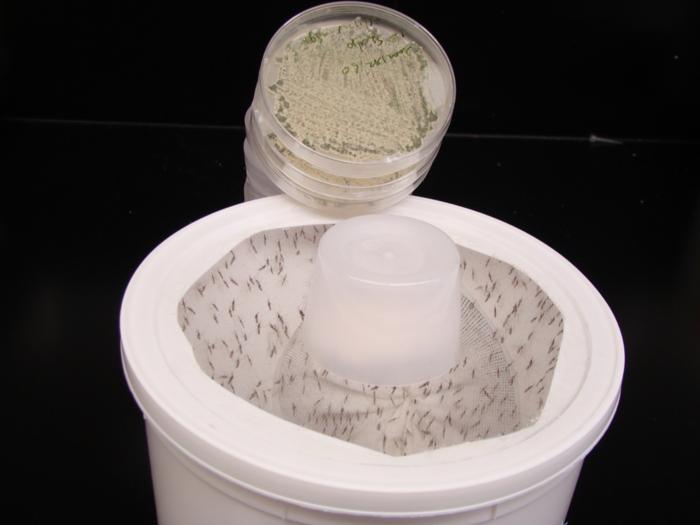
Scientists have turned a fungus into a botanical con artist. The engineered microbe smells like a flower, lures mosquitoes looking for nectar, and kills them within days. It is a surprisingly simple trick that could save thousands of lives.
The approach takes advantage of a basic mosquito vulnerability: their need for flowers. While female mosquitoes are famous for drinking blood, both sexes rely on floral nectar as their primary food source. An international research team realized that if they could make a deadly fungus smell like dinner, mosquitoes would come willingly to their doom.
The researchers, led by Raymond St. Leger at the University of Maryland, built their trap around a strain of Metarhizium fungus. After observing that some wild fungi naturally emit a sweet-smelling compound called longifolene to attract insect prey, they engineered their fungus to crank up production of the same chemical. The result, published October 24 in Nature Microbiology, is essentially a perfume that mosquitoes cannot resist.
“After observing that some types of fungi could trick mosquitoes into thinking they were flowers, we realized we could turbo-charge the attraction by engineering fungi to produce more longifolene, a sweet-smelling compound that’s already very common in nature.”
What makes the strategy particularly clever is that longifolene was not previously known to attract mosquitoes. The team let nature provide the hint, then amplified it through genetic engineering. Once the fungal spores are placed in a container, indoors or outdoors, they release longifolene continuously for months. Mosquitoes encounter the fungus, become infected, and die within days.
Better Than Pesticides
In laboratory tests, the scented fungus killed 90 to 100% of mosquitoes, even when competing against the smell of real flowers and humans in a large room. The performance is impressive, but the safety profile may be even more striking. Longifolene is already a common ingredient in commercial perfumes and has a long track record of human safety. The fungus poses no threat to people, only to mosquitoes.
Chemical pesticides, by contrast, have become increasingly problematic. Many mosquito populations have evolved resistance to standard treatments, rendering them nearly useless in some regions. The fungal approach may sidestep that problem entirely. If mosquitoes evolve to avoid longifolene, they would simultaneously lose their attraction to the flowers they need for food. It is an evolutionary trap with no obvious escape route.
St. Leger noted that the team has backup options if needed. They could engineer the fungus to produce additional floral scents, giving mosquitoes multiple targets to avoid. But he suspects that will not be necessary. The fundamental dependency on flowers makes resistance unlikely.
Cheap, Simple, and Scalable
One of the most promising aspects of the technology is its practicality. Metarhizium fungi are already cultivated around the world on agricultural waste: chicken droppings, rice husks, wheat scraps. The production costs are minimal, and the application requires no special training. Place the container, let the fungus do its work, and replace it every few months.
“It’s not as if you’re going to necessarily find a silver bullet to control mosquitoes everywhere, but we’re trying to develop a very diverse and flexible set of tools that people in different parts of the world can use and choose from.”
The affordability could prove critical in regions where mosquito-borne diseases hit hardest. Malaria alone kills hundreds of thousands of people annually, most of them in sub-Saharan Africa. Dengue, yellow fever, and Zika add to the toll. Traditional control methods, from bed nets to insecticide spraying, have made progress but remain expensive and labor-intensive.
St. Leger and his colleagues are now planning larger outdoor trials to gather data for regulatory approval. The immediate target markets are Africa, Asia, and South America. But he warns that mosquito-borne diseases may not stay confined to the tropics much longer. Rising temperatures and erratic weather patterns are pushing disease-carrying mosquito species into new territories, including parts of the United States that have never dealt with them before.
The floral-scented fungus is one tool among many, St. Leger emphasized. Different regions will need different approaches depending on local mosquito species, environmental conditions, and available resources. The goal is not to find a single perfect solution, but to give communities options. And in this case, the option is a fungus that smells nice and kills efficiently.