

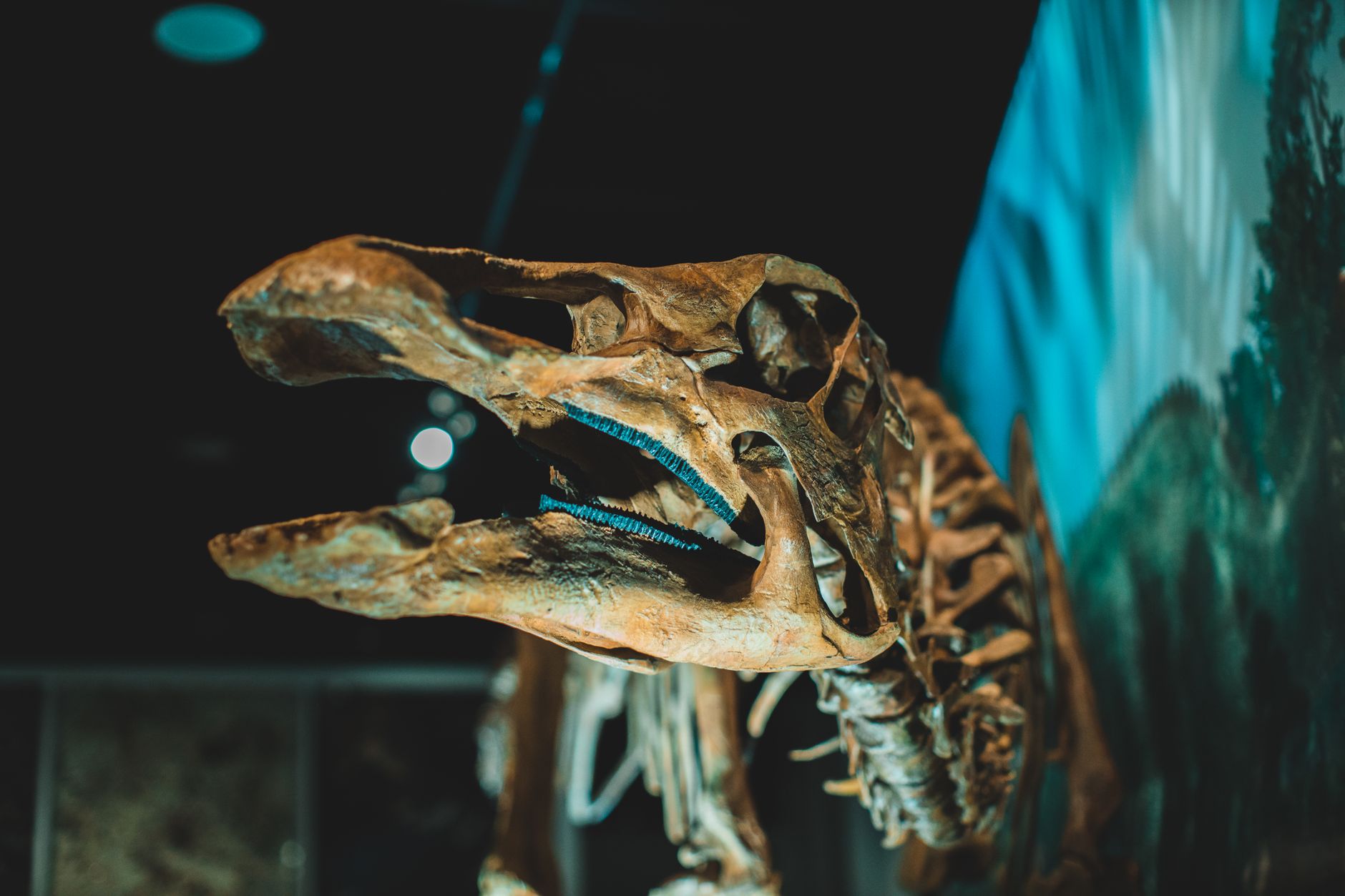
The fossil is easy to oversell, because the real version is already strange enough.
In a paper published in Nature Ecology & Evolution, Jiandong Huang and colleagues describe Haolong dongi, a new iguanodontian dinosaur from the Early Cretaceous Yixian Formation of Liaoning, China. The animal lived about 125 million years ago. The specimen is a young individual, preserved as a near-complete articulated skeleton, with skin structures still visible at a level most dinosaur fossils never approach.
The headline detail is not just that skin survived. It is that the skin includes hollow, spike-like structures preserved finely enough for the team to examine cellular architecture, including keratinocyte-like cells and nuclear-level detail. These were not feathers, and they were not ordinary reptile scales. The authors interpret them as a previously undocumented kind of dinosaur skin structure.
That makes Haolong a useful reminder of how incomplete our picture of dinosaur bodies still is. Skeletons dominate museum halls because bones fossilize far more readily than skin. But living animals are not skeletons with labels attached. Their outer surfaces do work: protection, insulation, display, touch, camouflage, heat exchange. When soft tissue is preserved, it can change the animal from a familiar outline into something less expected.
A small plant-eater with unfamiliar skin
Haolong dongi belonged to Iguanodontia, the broad group that includes Iguanodon and later duck-billed dinosaur relatives. It was not a giant adult. The described fossil is a juvenile about 2.45 meters long, preserved in the fine-grained deposits that have made the Yixian Formation famous for exceptional fossils.
The Yixian Formation is part of the Jehol Biota, a northeastern Chinese fossil assemblage that has repeatedly complicated the public image of dinosaurs. It has yielded feathered theropods, early birds, mammals, plants, insects and other organisms preserved in unusual detail. Fine volcanic ash, lake sediments and rapid burial helped produce conditions in which delicate biological structures could sometimes survive as fossils.
Even against that background, the Haolong specimen stands out. The paper reports a combination of scales and spikes across parts of the body. Along the tail, the animal carried large overlapping scales. Elsewhere, the researchers describe small and medium spikes, along with larger hollow spikes that could reach several centimeters in length.
The paper’s key claim is anatomical, not theatrical: these spikes do not match known dinosaur feathers, known protofeathers, or the spiny scales of living squamates such as many lizards. The team argues that they represent a distinct cutaneous structure, meaning a structure of the skin.
What “skin cells” means in a fossil
When a fossil is described as preserving cells, that does not mean fresh biological tissue has survived unchanged for 125 million years. The original organic material has been altered, replaced, compressed or chemically transformed during fossilization. What can remain is microscopic structure: cell outlines, layers, textures and mineralized traces of once-living tissue.
Huang and colleagues studied the fossil with imaging and histological techniques, including sections of the preserved integument. They report a multilayered epidermal structure and cellular details inside the spikes. In plain English, the fossil preserved not only the shape of the skin from the outside, but some of the internal organization of the skin itself.
That is why the finding matters. Many dinosaur skin impressions show surface texture: scales, bumps, or the outlines of soft tissue pressed into sediment. Haolong appears to preserve a more detailed record of how one unusual skin structure was built. It gives paleontologists something closer to a tissue-level view of a non-avian dinosaur’s outer covering.
The phrase “porcupine-like” is a comparison of form and possible function, not a claim of close relationship. Porcupines are mammals. Haolong was a dinosaur. The point is that stiff projecting spikes can make an animal harder or less appealing to bite, and the authors consider predator deterrence one possible explanation.
What were the spikes for?
The honest answer is that no one knows for certain. The paper discusses several possibilities: protection against small predators, temperature regulation, sensory function, or some combination of roles. The fossil cannot show behavior directly. It can show structure, placement and comparison with living animals and other fossils.
The defensive idea is plausible because the fossil is a juvenile herbivore from an ecosystem that included small carnivorous dinosaurs. A young plant-eater with stiff backward-facing spikes would not need to defeat a predator. It would only need to be awkward enough to handle that a predator chose a different target.
But the authors do not reduce the spikes to a single confirmed purpose. Skin structures often do more than one thing. Feathers, for example, are involved in insulation, display, waterproofing and flight depending on the animal and the structure. Scales can protect, shed water, reduce abrasion or help regulate heat. A fossil can suggest function, but function is harder to prove than shape.
There is also a developmental caveat. The known specimen is juvenile. The paper cannot yet say whether adult Haolong carried the same spikes, whether the structures changed with age, or whether juveniles were especially spiny because they were more vulnerable. That is the sort of question that usually waits for another fossil.
Why one fossil can still matter
A single specimen should not be treated as a complete portrait of a species, let alone a whole group of dinosaurs. But a single specimen can establish that a structure existed. Before Haolong, paleontologists already knew dinosaurs could have scales, feathers, filaments, bristles and armor-like skin structures. This fossil adds another form to that inventory.
It also pushes against a tidy division often made in popular accounts: some dinosaurs had feathers, others had scales. Real skin evolution is messier. Different lineages carried different combinations of coverings, and some animals may have had several kinds of skin structures on the same body.
That matters because skin is not decoration. It is part of how an animal lives. A dinosaur with overlapping tail scales and hollow spikes was interacting with its environment differently from one with smooth skin or filament-like coverings. It may have faced different risks, used different signals, or solved the same biological problems in a different way.
The result is not that dinosaurs suddenly became stranger. They were always strange. The result is that one more piece of their biology has moved from silhouette to detail.
Sources
- Huang et al., “Cellular-level preservation of cutaneous spikes in an Early Cretaceous iguanodontian dinosaur,” Nature Ecology & Evolution
- Zhong et al., high-precision geochronological constraints on the Yixian Formation, National Science Review
- Benton et al., review of the Jehol Biota, Proceedings of the Geologists’ Association
- Godefroit et al., a Jurassic ornithischian dinosaur with both feathers and scales, Science