

The Amazon rainforest produces oxygen continuously in daylight. So do microscopic organisms across the sunlit ocean. The error in the familiar “lungs of the Earth” story is not that photosynthesis occurs. It is that gross oxygen production is treated as though it were a permanent net deposit into the atmosphere.
Photosynthesis fixes carbon into organic matter and releases oxygen. Respiration and decomposition run much of that chemistry in reverse: organisms use oxygen while returning carbon dioxide. In a mature ecosystem whose carbon inventory is roughly stable, production and consumption approach one another.
This article is a synthesis of ecosystem and geochemical evidence, not a new experimental result. It also deals with different timescales: the daily exchange of gases, the yearly carbon balance of a forest or ocean, and the geological processes that built the atmosphere humans breathe today.
The missing word in the Amazon claim is “net”
Leaves take in carbon dioxide, use water and sunlight to make organic compounds, and release molecular oxygen. That is gross production. Trees also respire to power their cells, including when they are not photosynthesizing. Roots, fungi, animals and soil microbes consume additional oxygen as organic matter moves through the food web or decays.
Yadvinder Malhi’s review of tropical-forest productivity and metabolism describes the large flows behind that balance. In measured mature Amazon forests, a substantial majority of carbon captured in gross photosynthesis is returned quickly through plant respiration. Much of the remainder becomes leaves, wood and roots, but litter and dead tissue eventually feed heterotrophic respiration by decomposers.
That is why the Amazon can produce a great deal of oxygen gross while adding little oxygen net over the long run. A National Geographic examination of the claim, drawing on ecosystem scientists, concluded that the forest’s net oxygen contribution likely hovers around zero. The often repeated claim that it supplies 20 percent of atmospheric oxygen confuses a share of biological activity with a lasting addition to the atmosphere.
“Close to zero” describes a mature balance, not every year
No real forest is a perfectly sealed steady-state box. A young or recovering forest that adds wood and soil carbon is storing some of the product of photosynthesis. It can therefore be a net carbon sink and, through the same accounting, a small net oxygen source. An old forest can also continue storing carbon slowly.
The balance changes with drought, heat, tree mortality, fire, logging and land clearing. A disturbed forest may release carbon accumulated over decades or centuries, consuming oxygen through combustion and later decomposition. Rivers can export dissolved and particulate carbon beyond the location where it was fixed. Measuring all of these terms across the Amazon basin is much harder than measuring photosynthesis in a leaf.
This is why a mature forest’s near-zero oxygen balance should not be carelessly substituted for the present carbon balance of the entire Amazon. NASA has reported that the capacity of tropical forests to absorb carbon dioxide is weakening, with strong regional differences. A forest can be nearly neutral in long-run oxygen bookkeeping while its carbon storage, disturbance and climate influence remain urgent.
The Amazon matters because it stores carbon, recycles water into the atmosphere, shapes rainfall, moderates regional climate and supports extraordinary biological and cultural diversity. Correcting an oxygen myth removes a weak argument for protection; it does not remove the powerful ones.
Phytoplankton perform about half of oxygen-producing photosynthesis
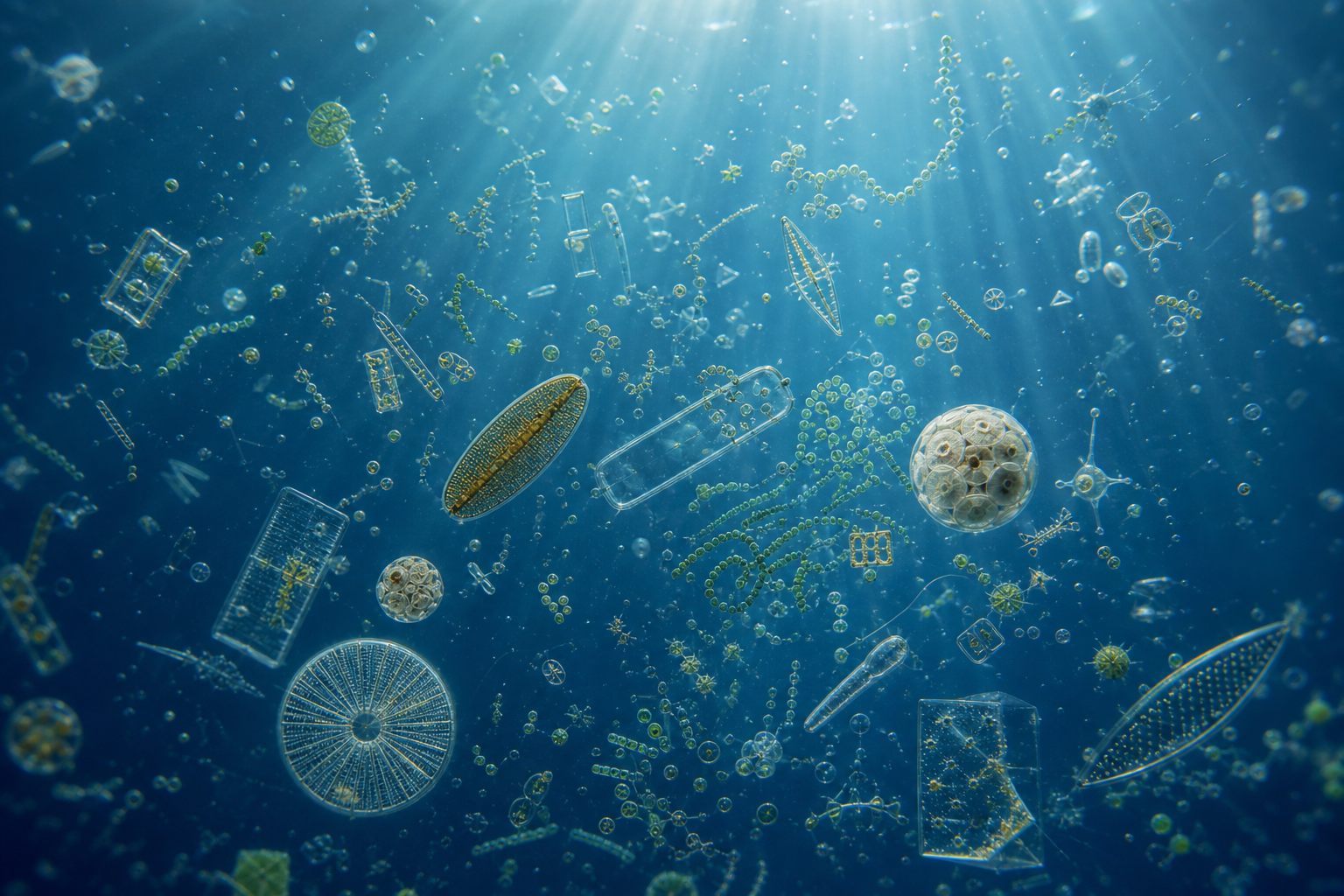
Ocean phytoplankton include algae and photosynthetic bacteria drifting in surface waters. Their individual lives may be brief, but their collective productivity is enormous. NOAA estimates that roughly half of oxygen production on Earth comes from the ocean, mostly from plankton.
That figure describes a production flux, not the origin of half the oxygen molecules currently stored in the atmosphere. Phytoplankton respire. They are eaten by zooplankton and other organisms that respire. When cells and waste die or sink, bacteria use oxygen while decomposing much of the material. NOAA’s summary puts the two sides together: the ocean produces about half of Earth’s oxygen, and marine life consumes about the same amount.
ScienceBlog previously explained how microscopic ocean organisms account for roughly half of oxygen-producing photosynthesis. The important refinement is that turnover can be fast without changing the atmospheric reservoir very much. A molecule released this morning may be taken up in respiration later; gross throughput and net accumulation answer different questions.
Most sinking carbon is recycled before burial
Some phytoplankton-derived organic matter escapes immediate consumption near the surface. Dead cells, aggregates and fecal particles sink, carrying carbon into deeper water in the biological carbon pump. That export is important for ocean chemistry and climate, but export below the sunlit layer is not the same as permanent burial.
Microbes and animals consume much of the falling material in the water column. More is remineralized after reaching the seafloor, converting organic carbon back into dissolved inorganic carbon and consuming oxygen or other oxidants. A review of subseafloor life and biogeochemistry estimated that only a minority of the organic carbon reaching marine sediments is ultimately buried. Coastal and continental-shelf sediments account for much of that long-term preservation.
The distinction explains why the sea can dominate global photosynthetic oxygen production without continuously swelling the atmosphere. Most production is paired with carbon that returns to an oxidized form. The oxygen is then used again somewhere in the system.
Burial is how photosynthetic oxygen escapes cancellation
The simplest bookkeeping starts with one carbon atom. Photosynthesis reduces carbon from carbon dioxide into organic matter and releases oxygen. If respiration later oxidizes that carbon back to carbon dioxide, it consumes the corresponding oxygen and largely closes the loop.
If the organic carbon is buried in sediment and protected from decomposition, that reversal is postponed for geological timescales. The oxygen produced alongside it can remain in the ocean-atmosphere system. A 2023 Nature Geoscience study of mineral-assisted organic-carbon preservation begins from this established principle: maintaining an oxidized atmosphere over geological time requires some photosynthetic carbon to evade reoxidation.
Even this is a deliberately simplified account. Atmospheric oxygen changes when all sources and sinks fail to balance. Burial of organic carbon is the canonical biological source of net oxygen, but burial and weathering of sulfur minerals, oxidation of old organic matter, reactions with reduced volcanic gases and rocks, and the escape of hydrogen to space also enter Earth’s redox budget. Carbon burial is not the only control; it is the key reason oxygenic photosynthesis can leave a long-lived surplus rather than being canceled by respiration.
Earth’s oxygen reservoir is a geological inheritance
The atmosphere contains a vast stock of oxygen accumulated over hundreds of millions of years. People do not rely on this year’s Amazon photosynthesis or this year’s plankton bloom in the way a building relies on a ventilation fan. Annual biological production and consumption are large, but they cycle against a reservoir built by small long-term imbalances.
That does not make damage to forests or oceans harmless. Deforestation releases stored carbon, weakens habitat, changes rainfall and reduces resilience. Ocean warming, stratification and nutrient changes can reorganize plankton communities and worsen regional deoxygenation. Those are serious consequences without claiming that oxygen for human breathing will suddenly disappear.
“Lungs” is also an awkward metaphor because animal lungs consume oxygen and release carbon dioxide. Forests and oceans are better understood as active carbon-and-oxygen cycling systems. They produce oxygen, consume it, move carbon among organisms and environments, and occasionally preserve a small fraction beyond the reach of decomposition.
The durable lesson is about accounting. The Amazon’s value does not rest on a false percentage. Phytoplankton deserve credit for roughly half of gross oxygen-producing photosynthesis, but not for a permanent annual gift of half the air. The oxygen surrounding us is the result of life, geology and time, with burial turning a tiny uncanceled fraction of photosynthesis into a planetary atmosphere.