
The most memorable result in the “awe walk” study was written across people’s faces.
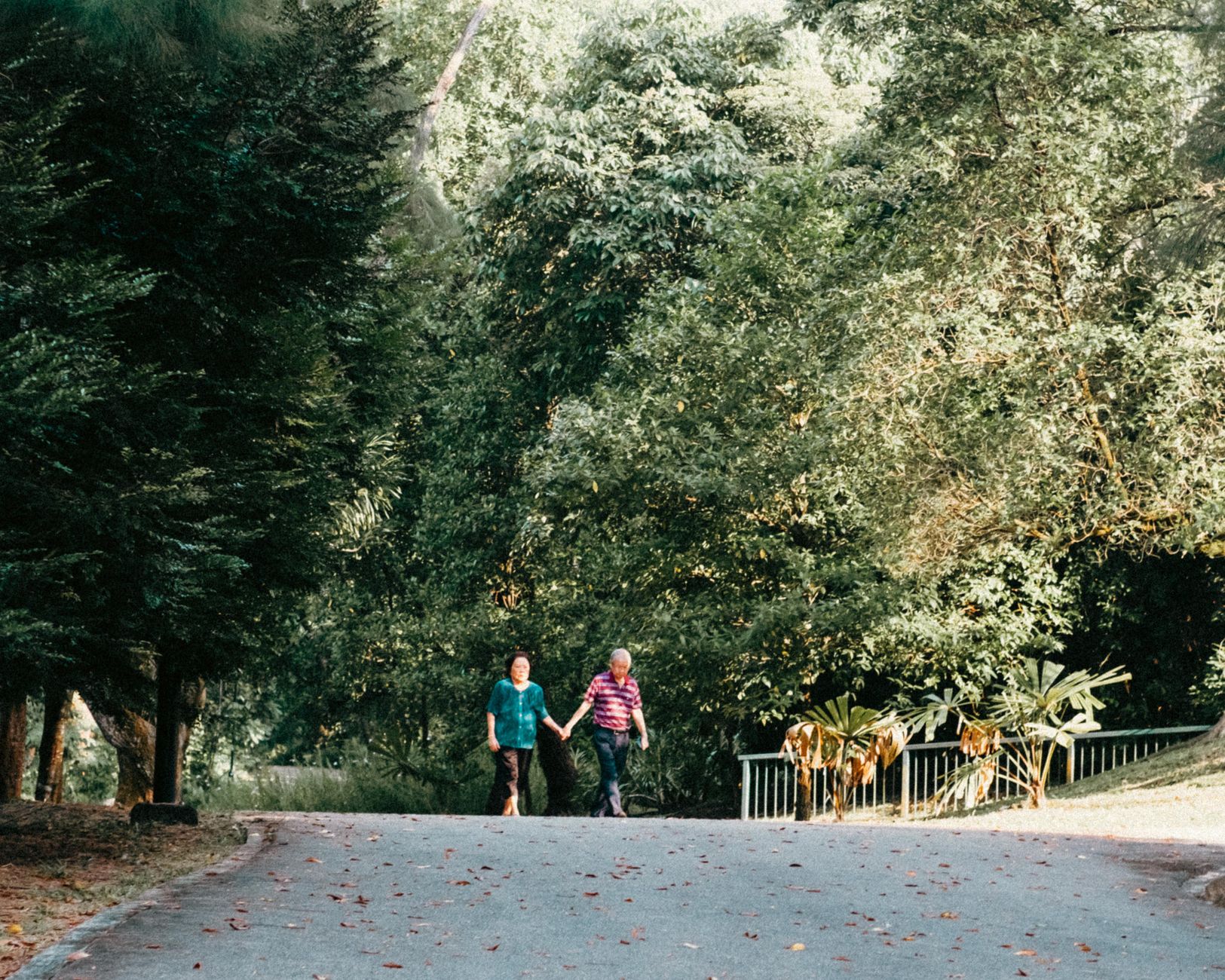
Older adults were asked to take short outdoor walks and photograph themselves along the way. Over eight weeks, the people told to look for awe came to occupy less of each frame. The landscape took up more space, while their smiles became more intense.
The effect was not simply an impression drawn from two charming before-and-after pictures. Trained facial-action coders, blinded to the study’s aims, design and group assignments, rated the smiles across more than a thousand photographs.
The trial also found changes in daily emotion, although it did not show improvement on standard measures of depression, anxiety or life satisfaction. That distinction turns a shareable experiment into a more interesting piece of science.
This article discusses a small study of healthy older adults, not a treatment recommendation. Walking ability and health needs vary, and the results should not be generalised to people who could not safely follow the protocol.
Sixty people were assigned two kinds of walk
Virginia Sturm of the University of California, San Francisco, and colleagues recruited 60 cognitively and physically healthy adults between 60 and 90 years old. The median age among participants included in the final analyses was 75.
Everyone was asked to take at least one 15-minute outdoor walk each week for eight weeks. Participants were randomly placed in an awe-walk group or a control-walk group.
The control group received no special instruction about what to notice. The awe group was introduced to awe as a feeling produced by encountering something vast that is difficult to fit into one’s existing understanding. They were encouraged to tap into a sense of wonder and, where possible, choose unfamiliar places.
Awe did not require a mountain or a famous monument. Participants could attend to patterns of light, an expansive view, trees, architecture or other details available on an ordinary route.
The randomised trial, published in the journal Emotion, analysed 52 participants who met the study’s inclusion criteria after enrolment. They supplied 2,341 daily surveys, 691 walk surveys and 1,184 photographs.
The selfies measured a “small self”
During each walk, participants photographed themselves at the beginning, middle and end. The researchers used two features of these images as behavioural measures.
First, they outlined each participant’s silhouette and calculated how much of the picture was occupied by the person rather than the surrounding scene. The researchers called this “self-size”. It was intended to capture the small-self aspect of awe: a shift in attention away from one’s own concerns and towards something larger.
Self-size decreased across the study in the awe group. Their bodies and faces gradually took up less of the image, leaving more room for the environment. The control group moved in the other direction, with self-size increasing over time.
Second, coders certified in the Facial Action Coding System rated smile intensity. They did not know the hypotheses, study design or participant assignments. Smile intensity increased over time in the awe group relative to the control group.
The paper shows photographs from one participant in each group at weeks one and eight. Those examples make the change easy to see, but they are illustrations, not the analysis itself. The statistical result came from repeated images across the group. Thirty-five photographs were excluded from the smile analysis because their quality was insufficient.
The emotional changes were specific
On their walks, awe-group participants reported more awe, joy and prosocial positive emotions, a cluster that included compassion, admiration and appreciation. Their photographs mirrored the self-reports through stronger smiles.
Outside the walk setting, daily surveys showed a different pattern. Prosocial positive emotions increased more over time in the awe group, while daily distress decreased more. Within that distress cluster, sadness and fear fell more in the awe group, but anger, anxiety and annoyance did not.
Daily awe and joy did not show the same enduring group difference outside the walks. The intervention appeared to change particular emotions and social feelings rather than lifting mood in every possible way.
Standard questionnaires made the boundary clearer. From baseline to week eight, the groups did not differ in changes to anxiety, depression or life satisfaction. Scores were already low for anxiety and depression, which left little room for improvement, but the null result still matters.
The study therefore supports “measurable mood gains” only if that phrase refers to the repeated daily emotion ratings and in-walk experiences. It did not demonstrate a reduction in clinical symptoms or a broad increase in life satisfaction.
The control group actually walked more
An unexpected detail makes the comparison intriguing. Control participants recorded significantly more walks than awe participants, averaging 18.9 compared with 7.5. The groups reported similar walking speed, beauty, strenuousness and urban character, while the control walks tended to be somewhat longer and farther.
That makes a simple exercise explanation less convincing. The people who walked more did not show the same emotional trajectory. The orientation of attention, rather than walking volume alone, appears to have contributed.
It also introduces uncertainty. The researchers could not know why the control group logged more walks. They suggested those participants may have assumed the study was about exercise and counted more casual walks, while awe participants may have reserved the label for occasions when they deliberately followed the instruction.
Awe is more than scenery
The trial grew from earlier research linking awe with reduced self-focus and greater social orientation. Awe can be pleasant, unsettling or mixed, but it commonly involves a sense that the world exceeds one’s usual frame.
In a separate 2018 study of veterans, underserved youth and college students, awe experienced during nature activities predicted later changes in wellbeing and stress-related symptoms. That work was not an awe-walk trial and relied partly on observational associations, but it helped motivate a more controlled test.
A later review of awe and health research argued that awe may influence wellbeing through shifts in attention, social connection and physiological responses. The field remains young, and a plausible pathway is not the same as a confirmed treatment mechanism.
A small trial with an unusually visible outcome
The awe-walk study has real limitations. It was small, most participants were white and highly educated, and everyone was healthy enough to walk outdoors. The researchers did not test whether effects lasted beyond eight weeks. Daily distress also began somewhat higher in the awe group, so regression towards the mean could explain part of its decline.
Still, the design did more than ask whether people liked an inspirational stroll. Random assignment, a walking control group, repeated daily reports and blinded facial coding all strengthened the result.
The faces are what make the study linger. Over eight weeks, participants taught to look outward placed themselves more lightly in the frame and smiled more intensely. The photographs did not prove a transformation in mental health. They captured a smaller, more immediate shift: ordinary walks became occasions to notice a world larger than the walker.