

The important thing about iceberg A-84 is not only that it was large. Its departure opened a temporary route to a stretch of Antarctic seafloor that had been concealed by a floating ice shelf and unreachable by any previous research team.
A-84 calved from the southern end of the George VI Ice Shelf on January 13, 2025. Schmidt Ocean Institute put its area at about 510 square kilometres, or 209 square miles, while NASA measured it at roughly 30 kilometres long and 17 kilometres wide. Both organisations compared its footprint with Chicago.
Scientists aboard the research vessel Falkor (too) were already working in the Bellingshausen Sea. They changed their expedition plan and reached the newly exposed area on January 25, twelve days after the calving. The timing was fortunate, but the account still needs care. This was an expedition report, not a completed peer-reviewed species inventory, and the ages of the animals were inferred rather than directly measured.
The iceberg moved, but the ecosystem was already there
The calving did not suddenly create life on the seabed. It removed the ice above it and allowed a ship and a remotely operated vehicle to approach. According to the Schmidt Ocean Institute expedition release, the team became the first to investigate that particular area after the ice moved away.
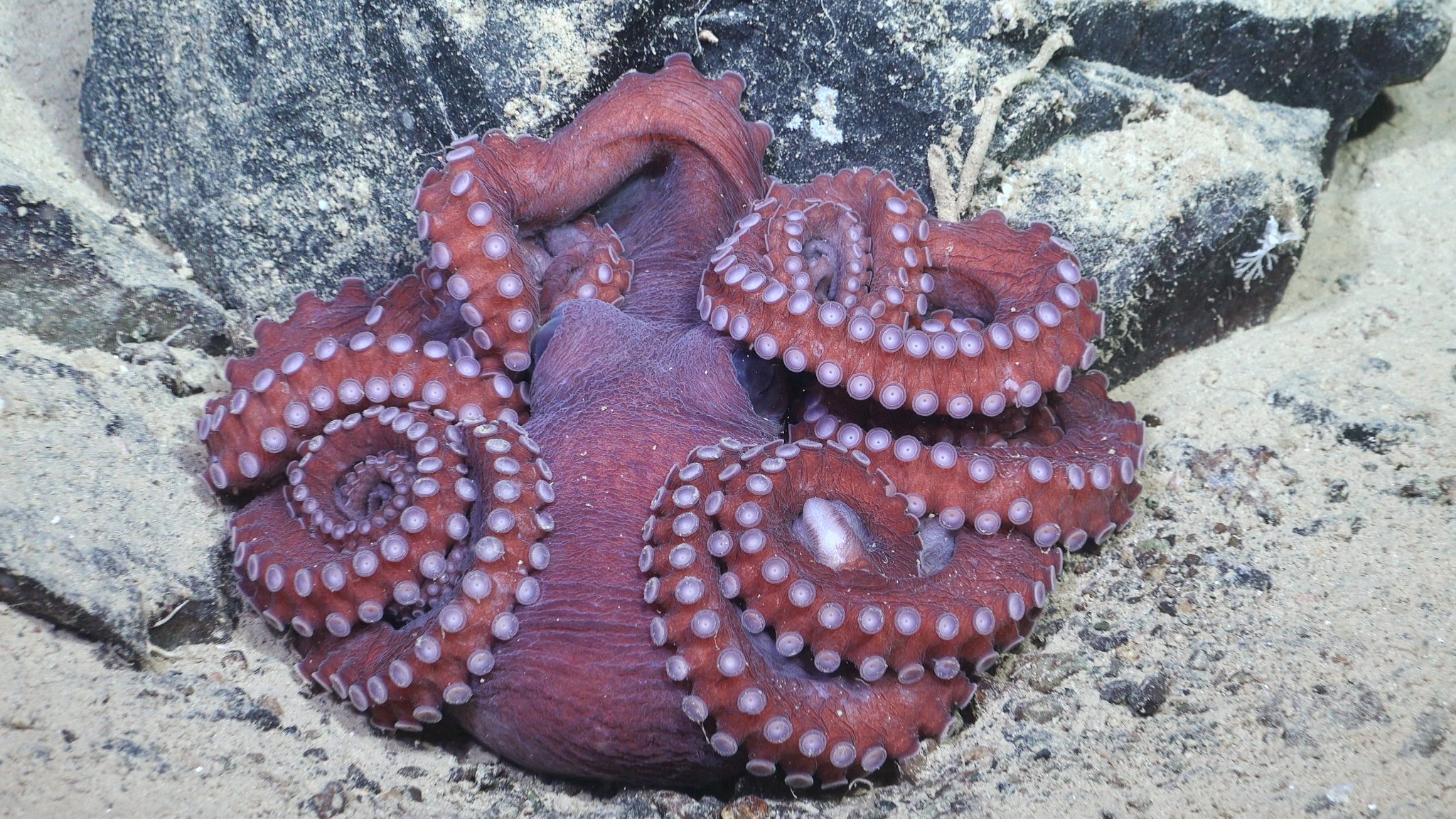
ROV SuBastian surveyed the seafloor for eight days at depths reaching 1,300 metres. Its cameras showed large corals and sponges supporting a range of mobile animals, including octopuses, icefish and giant sea spiders. The vehicle could cross wide areas, take high-resolution video and collect biological and geological samples for work after the cruise.
That makes “found” an observational claim. Researchers encountered and documented an existing community that had previously been inaccessible to direct study. The animals had not spent centuries inside the detached iceberg, nor were they released from the ice. They lived on the seafloor below the floating shelf from which A-84 broke.
“The size of Chicago” describes area, not thickness
NASA tracked A-84 as seasonal sea ice cleared and coastal currents carried it away. A NASA Earth Observatory analysis reported that the iceberg travelled about 250 kilometres between mid-January and mid-February 2025. Its quick departure is what made the newly uncovered water accessible while a capable research ship happened to be nearby.
The iceberg came from the George VI Ice Shelf, a floating extension of Antarctic land ice held between the Antarctic Peninsula and Alexander Island. An ice shelf remains connected to the land-based ice system; an iceberg is a piece that has calved and begun to drift. The 510-square-kilometre comparison concerns surface area. It does not imply that the berg had Chicago’s shape, and city-area comparisons can vary depending on which municipal boundary is used.
Calving is a normal way for an ice shelf to lose mass. NASA also notes that warming air and ocean water, along with reduced protective sea ice, can accelerate calving or contribute to collapse. A-84 by itself is not a controlled climate experiment. Its scientific value came from the sudden access it provided and from the measurements the expedition could make at the boundary between ice, ocean and seafloor.
A forest built by animals
The seafloor was not covered with plants. Large sponges and corals are animals, but their upright bodies add three-dimensional structure much as trees do on land. Anemones, worms, brittle stars and other organisms can occupy the surfaces and spaces around them. Mobile predators and scavengers move through that structure.
This helps explain why the images looked richer than an isolated octopus or fish crossing bare sediment. Habitat-forming animals provide attachment points, feeding surfaces, shelter and changes in local water flow. A sponge or coral can become physical infrastructure for many smaller lives that are easy to miss in a wide camera view.
“Thriving” in the expedition announcement referred to the biomass, variety and physical scale of the observed community. It was not a formal demographic result showing that every population was growing. The team suspected that several organisms could belong to undescribed species, but specimen analysis and taxonomic comparison were still under way.
The age claim comes from slow growth
Expedition co-chief scientist Patricia Esquete said the size of the animals indicated that the communities had existed for decades, perhaps hundreds of years. Schmidt Ocean Institute noted that sponges can grow very slowly, sometimes by less than two centimetres a year. A large specimen at nearly 230 metres depth was one reason the site did not look newly colonised.
That is the basis for the headline’s careful word “potentially”. The expedition release did not report a direct age for every sponge, coral, octopus or sea spider. Growth varies by species, food supply, temperature and body form. Some organisms can also survive for long periods with very low growth.
A large, slow-growing sponge can indicate that suitable habitat persisted for a long time. It does not prove that every neighbouring animal is equally old. Octopuses and fish are mobile, larvae can arrive on currents, and a community assembled over centuries will contain organisms of many ages. The strongest statement is that the ecosystem itself may be old, not that all animals photographed had lived there for hundreds of years.
Total darkness does not mean a sealed ecosystem
The British Antarctic Survey account described about 150 metres, or almost 500 feet, of ice above the ecosystem before A-84 moved away. That roof blocked sunlight and prevented photosynthesis in the water directly overhead. It also interrupted the ordinary vertical rain of freshly produced surface material that feeds many deep-sea communities.
Yet the cavity beneath an ice shelf is connected to the surrounding ocean. Currents can carry oxygen, larvae and organic particles laterally beneath the ice. The expedition team suggested water movement as a possible food-delivery mechanism, and preliminary measurements indicated strong meltwater flow. The exact source and route sustaining the animals remained unresolved.
“Total darkness” therefore describes the absence of sunlight, not complete isolation. The organisms did not need local plants growing above them, but most may still have depended on photosynthetic energy produced in distant open water and transported under the shelf. Chemosynthetic microbes could contribute in some settings, yet the A-84 release did not establish an entire food web powered independently of sunlight.
Earlier boreholes had already challenged the empty-seafloor idea
The A-84 survey was unprecedented in scale, not the first evidence of life under Antarctic ice. In 2021, researchers reported stationary animals attached to a boulder beneath the Filchner-Ronne Ice Shelf, 260 kilometres from open water. The peer-reviewed study in Frontiers in Marine Science described likely filter feeders in a place where conventional expectations favoured only sparse mobile predators and scavengers.
Other work beneath the Ekström Ice Shelf found richer communities and evidence of long persistence. ScienceBlog covered those results in a 2021 report on collected under-ice animals. Together, those boreholes showed that permanent darkness did not make the Antarctic continental shelf biologically empty.
The A-84 opportunity added something those narrow windows could not. SuBastian could travel across sweeping landscapes, approach individual organisms, document relationships among habitats and collect targeted samples. The difference is comparable to viewing a room through a drilled hole and then entering it with a mobile camera.
What the expedition had not yet established
The March 2025 announcement came while much of the analytical work remained ahead. The team suspected new species, but naming one requires detailed comparison with known organisms, often including anatomy, genetics and museum specimens. The number of candidates is not the same as a final number of formally described species.
The food web also remained an open problem. Currents are plausible delivery routes, but researchers still need to connect measurements of water flow and organic matter with the diets and growth of particular animals. A decades-old sponge and a newly arrived fish may use the same habitat while recording very different parts of its history.
Nor did the expedition directly date the duration of ice cover at every surveyed point. The phrase “for centuries” described the long-covered setting reported by the team. Reconstructing exactly when each patch became covered, how water circulated beneath it and when organisms colonised it requires geological, oceanographic and biological evidence to be brought together.
A rare baseline after the roof moved
A previous ScienceBlog account of the A-84 discovery described the hidden seafloor and the puzzle of feeding it. The next scientific value lies in the baseline created by the 2025 survey. Once open water replaces an ice shelf overhead, light, particle supply, mixing and disturbance can all change.
Repeated surveys could show which long-established sponges and corals persist, which newcomers arrive and how quickly the community reorganises. That matters because newly exposed seafloor is not simply empty ground ready for colonisation. It may begin with an old ecosystem already in place.
A-84 revealed more than a list of striking creatures. It exposed a community with a history at the moment the conditions shaping that history began to change. The iceberg made the seafloor visible. The octopuses, sea spiders, icefish, corals and sponges showed that darkness had never made it vacant.