

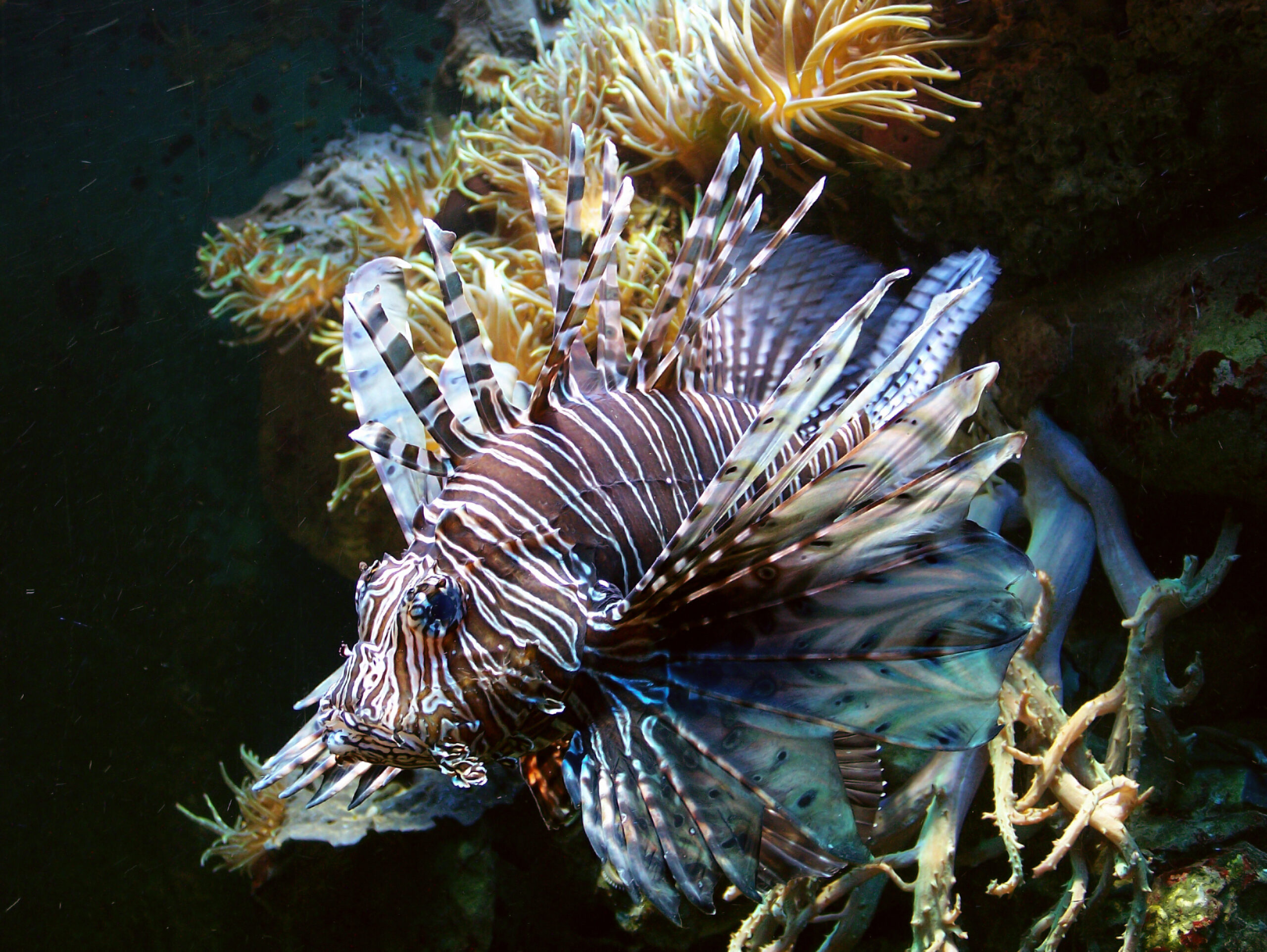
A fish prized for its striped body and extravagant fins became one of the fastest marine invaders on record after people probably released aquarium animals into Atlantic water.
Red lionfish, Pterois volitans, and a smaller number of devil firefish, Pterois miles, are native to the Indo-Pacific. In the western Atlantic they found warm water, abundant unfamiliar prey and little population-level control from predators. By 2013, researchers estimated that the invasion occupied a geographic footprint of 7.3 million square kilometres across the western Atlantic and Caribbean. The first confirmed Atlantic record was in 1985, making the spread a less-than-three-decade transformation.
Each part of that summary needs a boundary. Nobody documented the founding release. The 7.3-million-square-kilometre number describes an invasion range, not reef surface carpeted continuously with lionfish. A female can produce roughly two million eggs in a year, but almost all will not survive. And groupers, sharks and eels sometimes eat lionfish, even though natural predation has not controlled their abundance across the invaded region.
The invasion did not begin with a hurricane
A durable origin story says Hurricane Andrew destroyed a waterfront aquarium in 1992 and released six lionfish into Biscayne Bay. Fish may have escaped in that event, but it cannot explain the beginning. A lionfish had already been collected off Dania, Florida, in 1985, seven years before the hurricane.
The broader aquarium pathway remains the leading explanation. Lionfish were imported and sold as ornamental pets, early records clustered around south Florida, and the invading population carried signs of a small founder pool. Those clues fit intentional disposal or accidental escape of aquarium fish much better than natural movement across oceans from the Indo-Pacific.
The route was not unique to lionfish. A 2004 ScienceBlog report described 16 non-native marine fish species recorded off southeast Florida. Their frequency in the aquarium trade tracked how often divers saw them, while shipping patterns did not support ballast water as the main explanation. Most did not become a lionfish-scale invasion, but every release created another ecological trial.
Aquarium release is therefore a strongly supported pathway, not a witnessed founding moment. It is safer to say releases probably seeded the invasion than to identify one storm, one owner or one tank as its proven source.
Genetics points to more than one introduction
Early reconstructions often treated Florida as the single bridgehead from which all Atlantic lionfish spread. Genetic work made that story less tidy. USGS researchers analysed red lionfish from 14 countries and territories and found distinct northern and southern population patterns separated around the Bahamas.
One rare genetic strain was widespread in the north but appeared in only a few southern samples. Dispersal against prevailing currents might account for that pattern, but the researchers found additional evidence consistent with multiple introductions, including possible releases farther south. The USGS interpretation was not that genetics had identified individual release events. It was that a single Florida origin was no longer the only plausible scenario.
That distinction matters for prevention. If unwanted aquarium fish continued to enter the sea after the first population became established, new releases could add genetic variation and potentially improve the invader’s ability to tolerate different conditions. Stopping releases remains useful even when eradication of the established population is impossible.
What 7.3 million square kilometres measures
The 7.3-million-square-kilometre estimate comes from a 2013 review in Biological Conservation. It drew on the rapidly growing record of catches and sightings from scientists, fishers and recreational divers. The authors described lionfish as occupying that broad western Atlantic and Caribbean region after establishment in the Bahamas in 2004.
The number is a geographic footprint inside the invasion boundary. It does not mean every square kilometre contained reef, suitable temperature or a resident lionfish. Open ocean, deep water and unsuitable habitat sit between documented populations. Range area is useful for showing the scale of expansion, but it should not be mistaken for a fish-density survey.
The review placed the first Florida report in 1985. Comparing that date with the 2013 synthesis produces the “less than three decades” claim in the headline. The paper’s 7.3-million-square-kilometre estimate is consequently a historical benchmark for how far the invasion had advanced by then, not a fresh 2026 remapping of its current limits.
Currents helped convert local establishment into regional spread. Lionfish release floating gelatinous egg masses, and their larvae remain in the water column for weeks. Adults did not have to swim from Florida to every island. Each successful coastal population could launch larvae into moving water and become a source for the next location.
Two million eggs is reproductive capacity, not recruitment
In the Caribbean, lionfish can spawn throughout the year. NOAA research reports reproduction about every four days, maturity in less than one year and more than two million eggs produced by a female annually under favourable conditions. That repeated schedule is more important than one spectacular clutch.
The NOAA figure is an estimate of potential egg output. It is not a count of offspring that reach adulthood. Eggs go unfertilised, larvae are eaten, currents carry them away from suitable habitat and juveniles die. Marine fish routinely produce enormous numbers because survival from egg to breeder is very low.
For an invader, however, frequent batches spread risk. A female is not betting one season on one current. She can release eggs every few days, into changing water movement, across much of the year. Even a minute survival fraction can found or replenish populations when the starting number is large and releases are repeated.
The egg mass itself may also help. It floats near the surface, where currents can transport larvae over long distances. Once juveniles settle, lionfish mature quickly, eat a wide range of fish and crustaceans, tolerate multiple habitats and use venomous spines as defence.
Predators eat lionfish but have not controlled them
The phrase “no natural predators” is memorable and incomplete. Nassau grouper, tiger grouper, nurse sharks, moray eels and other Atlantic animals have been observed eating lionfish, particularly injured, tethered or diver-provided individuals. An isolated meal does not demonstrate biological control.
Control requires predation to reduce survival or reproduction enough to limit the population. A regional analysis examined 71 reefs across three Caribbean biogeographic regions and found no negative relationship between lionfish abundance and the biomass of large groupers or other potential predators. The researchers concluded that managers could not rely on existing native grouper populations to contain the invasion.
Several mechanisms could contribute. Lionfish carry 18 venomous spines, and Atlantic predators did not evolve alongside them. Native predators may not recognise a healthy free-swimming lionfish as ordinary prey. Groupers and other large reef fishes have also been depleted by fishing across much of the Caribbean, reducing the number of animals even physically capable of taking a lionfish.
Predators are not entirely absent; dependable population control is. The headline’s “almost no predators capable of controlling them” refers to that ecological result, not to a claim that no Atlantic animal has ever swallowed one.
Eradication gave way to repeated local suppression
Once lionfish occupied millions of square kilometres, complete removal stopped being a realistic regional objective. They live on coral reefs, rocky bottom, mangroves and seagrass, and they extend below the depth reached by most volunteer divers. A ScienceBlog account of a 2013 submersible expedition found substantial populations around 300 feet deep, including large adults beyond the practical reach of ordinary spearfishing.
Local control still works. Repeated diver removals can lower density on selected reefs, and a food fishery gives people a reason to keep harvesting the invader. The venom is concentrated in the spines rather than the cooked fillet, although local ciguatera guidance still matters. Deep refuges and larvae arriving from elsewhere mean the work has to continue.
Culling also has a scale limit. Protecting a tourism reef, nursery habitat or marine reserve is different from emptying the western Atlantic. Managers choose sites where removal effort can be repeated and where reduced predation on native fish has the greatest ecological value.
The invasion began with a pathway small enough to overlook: ornamental fish entering coastal water. Its continental scale came later, multiplied by repeated spawning, drifting larvae, broad habitat tolerance and an invaded food web with no reliable population-level brake. Prevention would have required control at the aquarium door; management now requires returning to the same reefs again and again.