

For decades, one of the most memorable facts about the human microbiome was that bacteria outnumbered our own cells ten to one. It appeared in textbooks, university lectures, popular science books and research announcements. The image was irresistible: a person who was, by cell count, only ten percent human.
There was just one problem. When three researchers at Israel’s Weizmann Institute of Science went back through the arithmetic, the ten-to-one figure largely dissolved.
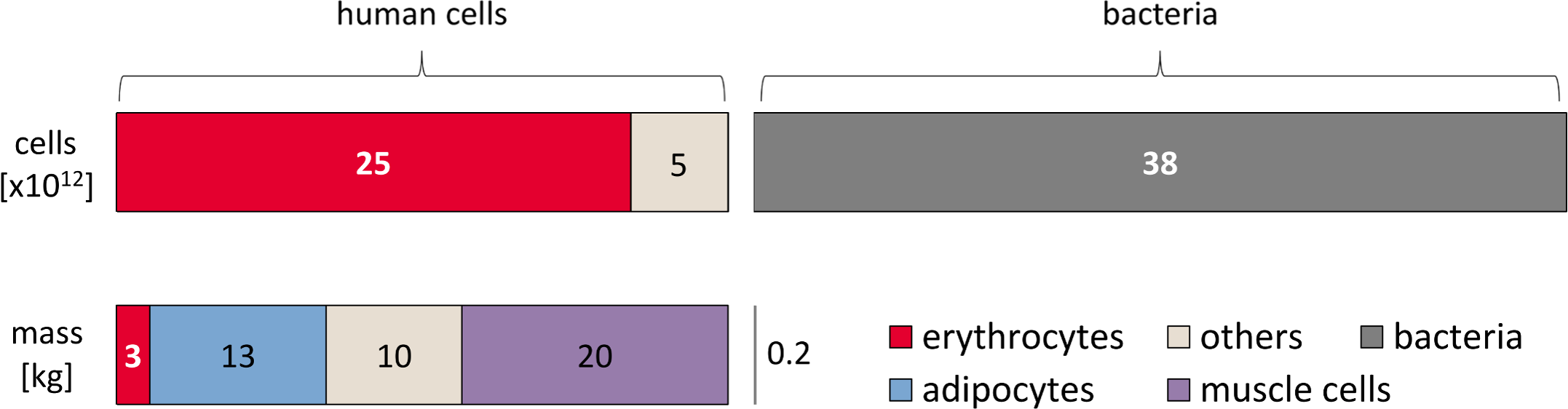
In a 2016 analysis published in PLOS Biology, Ron Sender, Shai Fuchs and Ron Milo estimated that a 70-kilogram “reference man” contains about 38 trillion bacterial cells and 30 trillion human cells. That works out to roughly 1.3 bacteria for every human cell.
This is one model-based recalculation, not a direct whole-body measurement or a universal personal ratio. But it is a wonderfully revealing case study in how a reasonable estimate can be repeated so often that its assumptions disappear.
The famous ratio began with one short calculation
The old number did not come from researchers somehow removing and counting every microbe in a human body. The Weizmann team traced the widely cited estimate of 100 trillion bacteria back to a calculation from the 1970s that was only a sentence long.
Its logic was simple. Take an assumed litre of material in the alimentary tract, treat it as roughly one kilogram, and multiply by a bacterial concentration of about 100 billion cells per gram. The answer is 100 trillion bacteria. Compare that with an often-used estimate of ten trillion human cells, and the celebrated ten-to-one ratio appears.
As rough calculations go, it was not foolish. It put a scale on a problem that was otherwise difficult to picture. The trouble came later, when the assumptions were forgotten and the result became “common knowledge.” A 2010 ScienceBlog report on the Human Microbiome Project, like many scientific sources of the period, repeated the ten-to-one ratio. That old article now offers a neat snapshot of just how settled the claim once seemed.
Most of the bacteria are crowded into the colon
The biggest correction concerned where bacteria actually live. The old arithmetic effectively spread the colon’s exceptionally high bacterial density across an entire litre of digestive contents. Yet the stomach and the upper portions of the small intestine contain far fewer bacteria. The colon overwhelms every other body site in the final count.
Sender and his colleagues therefore narrowed the calculation to the compartment that matters. Drawing on measurements that included MRI studies, they estimated that the reference man’s colon held about 0.4 litres of material. They then reviewed 14 studies of bacterial density in stool and settled on approximately 90 billion bacterial cells per gram of wet content.
Multiply those values and the result is 38 trillion bacterial cells in the colon. The mouth, skin, stomach and other sites add comparatively little. According to the paper, the colon exceeds any other organ’s bacterial population by at least two orders of magnitude.
Even that 38-trillion figure comes with uncertainty. The authors put its standard error at about 25 percent and estimated substantial variation among 70-kilogram men. Stool samples also serve as a proxy for the contents of a large, spatially varied organ. This is a carefully documented estimate, not a microscopic roll call.
The human-cell total needed its own recount
The other side of the ratio was not fixed either. Human cells range enormously in size, so there is no sensible “average cell” that can simply be divided into a person’s body mass. A skeletal-muscle cell can be around a million times larger than a red blood cell. Counting by weight therefore gives a badly distorted picture.
The researchers instead revisited an inventory assembled across 56 cell categories and examined the types that dominate the count. Their revised total came to about 30 trillion human cells.
What fills that census is surprising. Around 25 trillion, or roughly 84 percent, are red blood cells. Add platelets and other blood-forming lineages and close to 90 percent of the human cells counted belong to the hematopoietic system. Mature red blood cells do not even retain a nucleus, yet each still counts as a human cell.
By contrast, the bulky cells of muscle and fat contribute much of our cellular mass while making up only a sliver of the number. This is why “How many cells are there?” and “What is the body made of?” are not interchangeable questions.
Your personal ratio is not permanently 1.3 to one
The reference body in the paper was unusually specific: a man aged 20 to 30, 170 centimetres tall and weighing 70 kilograms. The authors began there because much of the available anatomical data had been collected in men. They also considered how sex, age, body mass and colon volume could change the balance.
Then there is the most human source of variation. The researchers estimated that a bowel movement reduces colon contents by roughly one-quarter to one-third. Because the colon holds almost the entire bacterial side of the ledger, an ordinary trip to the bathroom can shift the ratio enough that human cells temporarily outnumber bacterial cells.
So 1.3 to one is best understood as the centre of a plausible range for one reference model, not a biological constant tattooed inside everyone. A more recent National Institute of General Medical Sciences overview sensibly rounds the message to about one bacterial cell per human cell.
Equal cell numbers do not make us half bacteria
The revised ratio is often translated into another seductive line: half the cells in your body are bacterial. Numerically, that is a fair shorthand. Physically, it can be deeply misleading.
Bacterial cells are much smaller than most human cells. The Weizmann paper estimated that all of the bacteria in the reference body together weighed about 200 grams, only around 0.3 percent of total body mass. The current NIGMS comparison puts that at roughly seven ounces, about the weight of a hamster. You are not half bacterium by weight, volume or anatomy.
The count also concerns bacteria, not every nonhuman biological entity associated with us. Bacteria vastly outnumber the archaea and microbial eukaryotes in the human microbiome, so the researchers treated bacteria as a practical stand-in for microbial cells. Viruses are not part of the one-to-one comparison, and genetic influence is a different calculation again.
None of this makes the microbiome less important. Our microbial communities help process food, interact with the immune system and form dynamic ecosystems that can vary across a day and a year, as other microbiome research covered by ScienceBlog has shown. Biological significance is not awarded by majority vote.
The correction is more interesting than the myth
It is tempting to treat the Weizmann result as a clean debunking: scientists said ten to one, then better scientists proved one to one. The history is messier and more useful. The original number was an explicit back-of-the-envelope estimate. It became misleading only as citation chains and retellings detached it from the conditions that produced it.
The revised figure is also an estimate, but one with its machinery left visible. We can see the assumed body, the colon volume, the stool measurements, the cell categories and the uncertainty. That transparency makes the number easier to challenge when better evidence arrives.
Perhaps the most accurate lesson is not that we are 50 percent microbial or 90 percent human. It is that a human body is an ecosystem whose inhabitants are difficult to count, and that wonderfully tidy scientific facts deserve the occasional recount.