

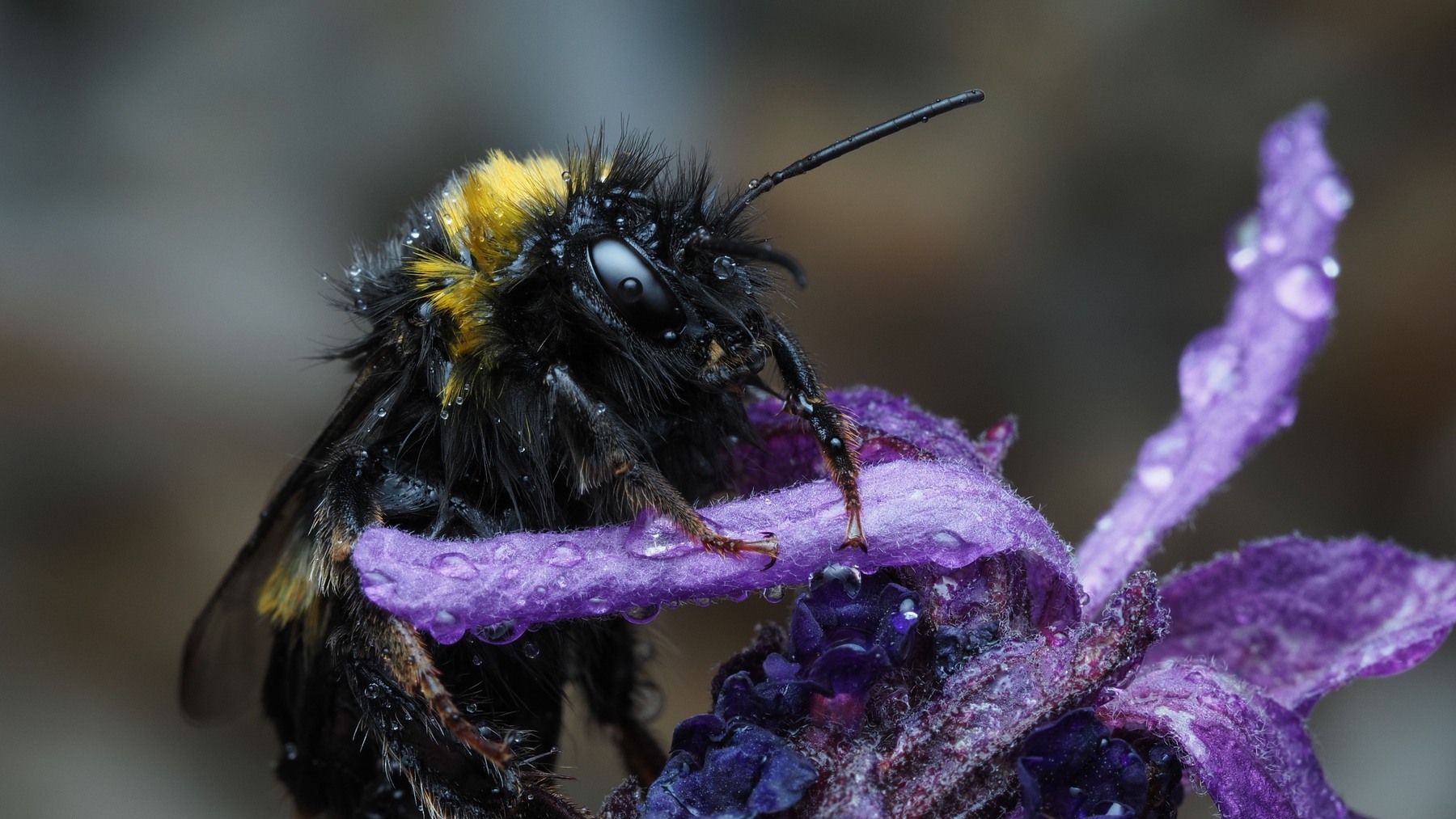
A buff-tailed bumblebee entered a transparent arena where a familiar blue artificial flower had been moved from the floor to the ceiling. It could not stand beneath the flower and reach its sugar reward, and the chamber was too shallow for normal hovering access. A small white foam ball sat below.
The successful insect pushed the ball into position, climbed on top and stretched up to contact the flower. No bee had watched another perform the sequence. No bee had been trained to roll a ball beneath an elevated target and use it as a step.
Even when walls hid the destination, most bees still moved the ball where it needed to go.
A box-and-banana problem built for a bee
The study appeared in Science on June 4, 2026. Akshaye Bhambore and colleagues at the universities of Oulu, Helsinki and Turku tested buff-tailed bumblebees, Bombus terrestris, on an object-manipulation task deliberately unlike their normal foraging problems.
The researchers compared it to Wolfgang Köhler’s century-old box-and-banana experiments. Chimpanzees faced food suspended out of reach and movable boxes that could become platforms. The insects encountered the same problem geometry at a different scale: a reward overhead, a movable object below, and a gap that could be closed only by putting the object in the right place.
The arena floor contained four pits that could steady the Styrofoam ball. Only the pit directly under the ceiling-mounted blue ring turned the ball into a useful step. A test ended when the bee solved the problem or after 15 minutes.
The analogy is structural, not psychological. Rolling one ball does not show that a bee thinks like an ape, imagines a future scene or names the object as a tool. It asks a narrower question: can an insect combine information acquired separately into a new sequence that reaches a goal?
The University of Oulu’s research summary includes video of the task, making the motor demand visible: the bee must grip, redirect and steady an object before its height becomes useful.
Untaught did not mean wholly inexperienced
The strongest bees were not dropped into an unfamiliar box with no history. In the all-information group, they first learned that the blue ring represented a flower containing sucrose. They also encountered a movable ball. In another pretraining phase, the ball covered the rewarding flower, so the bees had to displace it to gain access.
A restricted-information group learned the flower-reward association but had no equivalent ball experience. A true-control group received neither form of preparation. When all three groups met the new ceiling task, bees given all the component information succeeded significantly more often than either comparison group. The restricted and true-control groups did not differ significantly.
That result makes two points at once. Prior knowledge mattered, so the behavior was not an innate ball-under-flower routine. Yet the all-information bees had never practiced the solution itself. Training had not rewarded rolling toward an overhead flower, choosing the correct pit, standing on the ball or joining those actions into one means-to-an-end sequence.
This is a different question from copying. ScienceBlog reported in 2005 that bumblebees can favor flowers after watching other bees visit them. In the 2026 experiment, no demonstrator showed how the ceiling problem worked.
The first hidden-flower test reached 73%
A visible flower leaves a simpler explanation open. Perhaps a bee merely pushes the ball toward an attractive blue ring, receives continuous visual feedback as the distance closes, and happens to climb when the object arrives. That would be flexible, but it would not require maintaining an unseen goal.
Experiment 2a inserted a barrier between the ball’s starting point and the flower. The bee had to move the ball through a small opening, position it beneath the target, climb onto it and touch the flower. Sixteen of 22 bees completed that sequence, or 73%.
This is the clearest source of the “more than 70%” figure, but it was not a perfect removal of visual guidance. The flower was hidden when transport began, yet a bee approaching the opening might glimpse it and use that information during the final phase. The authors acknowledged the limitation.
They next built a three-barrier course intended to suppress perceptual feedback further. Seventy-seven bees took part, 39 with a flower in the final area and 38 in a no-flower control. The treatment group did not outperform the control group significantly. Ball movement alone, including exploration or play, could therefore carry bees through that particular course.
The null result matters because it prevents every pushed ball from being labeled a planned solution.
A stronger test used a remembered location
Experiment 3 replaced the corridor with a choice. The arena had two visually occluded side compartments. During habituation, each bee inspected a flower above one side. For the test, the ball was placed between the compartments while the arena was lit with red light that bees cannot see. From the starting point, the goal itself was hidden.
Success now meant moving the ball into the compartment associated with the previously seen flower rather than the equally available empty side. Twenty-three of 30 bees chose correctly, or 77%. A statistical model estimated the same 0.77 probability, with a 95% confidence interval from 0.59 to 0.88, and performance exceeded the 50% chance expectation.
Sixteen of the 23 successful bees moved the ball directly toward the correct compartment without first heading toward the wrong one. Bees inspected the arena before acting, and success was predicted by the proportion of inspections directed toward the flower side. Other recorded movement variables did not explain the outcome.
The study’s public data and analysis archive contains individual choices, inspection counts, correction movements and tracked trajectories. That transparency is useful because “goal-directed” is an inference from controlled behavior, not a view inside an insect’s mind.
Goal-directed is not the same as humanlike insight
The controls make simple steering toward a visible cue an insufficient explanation for Experiment 3. The remembered side influenced where bees transported the ball. Their movements also drew on separately learned properties: the blue ring predicts sucrose, the ball can move, and displacing it can expose access to a reward.
The evidence supports spontaneous problem-solving in the technical sense used by the authors. The solution was novel and was not shaped step by step through reinforcement. It does not identify the internal computation. The arena was too small for cameras to capture subtle behaviors that might distinguish a sudden “aha” transition from rapid exploration followed by action.
Nor does the result overturn neurobiology. A bumblebee brain has fewer than a million neurons, but brain size alone is a poor scorecard for cognitive capacity. ScienceBlog previously examined why larger brains are not automatically better processors. Compact circuits working with active vision, memory and a maneuverable body can generate behavior that a neuron count would not predict.
The word “tool” deserves similar care. The ball was an external object deliberately repositioned to make an unreachable goal reachable, which satisfies many definitions of tool use. The paper itself centered spontaneous problem-solving, and the experiment does not show wild bumblebees building platforms at flowers. It reveals a laboratory capacity, not a natural tradition.
What changed, and what did not
Bumblebees had rolled balls before this study. Previous experiments showed that trained bees could move balls for rewards and that bees sometimes rolled balls without food, behavior interpreted as play. The 2026 advance was not the motor act. It was recombining familiar elements into an untrained solution, then carrying the ball toward a goal that was no longer visible.
The failed three-barrier comparison keeps the conclusion disciplined. Bees can move balls for reasons unrelated to a flower, and not every complicated route reflects planning. The two-choice experiment is stronger because the behavior was directional: the correct hidden side, rather than mere transport, determined success.
Nothing here proves consciousness, self-awareness or humanlike reasoning. ScienceBlog’s earlier discussion of the search for evidence of bee sentience stressed that learning, flexible cognition and subjective experience are connected research areas, not interchangeable findings.
Future tests could change the object’s shape, color or weight, move the remembered goal after habituation, and ask whether successful bees transfer the relationship to a new arena. Higher-speed video could resolve inspection, grooming and pauses before the first directed movement. More colonies and bee species would show whether the capacity is widespread or depends on particular experience.
The flower disappeared behind a wall. For most of the tested bees, the goal did not.