

Charles Darwin’s working day looks suspiciously convenient when compressed into a modern productivity lesson.
He concentrated for a few hours, walked through the countryside, listened to novels, answered letters, rested and still changed biology. The temptation is to turn the timetable into a formula: four focused hours are better than eight ordinary ones.
His actual routine is more interesting and less transferable.
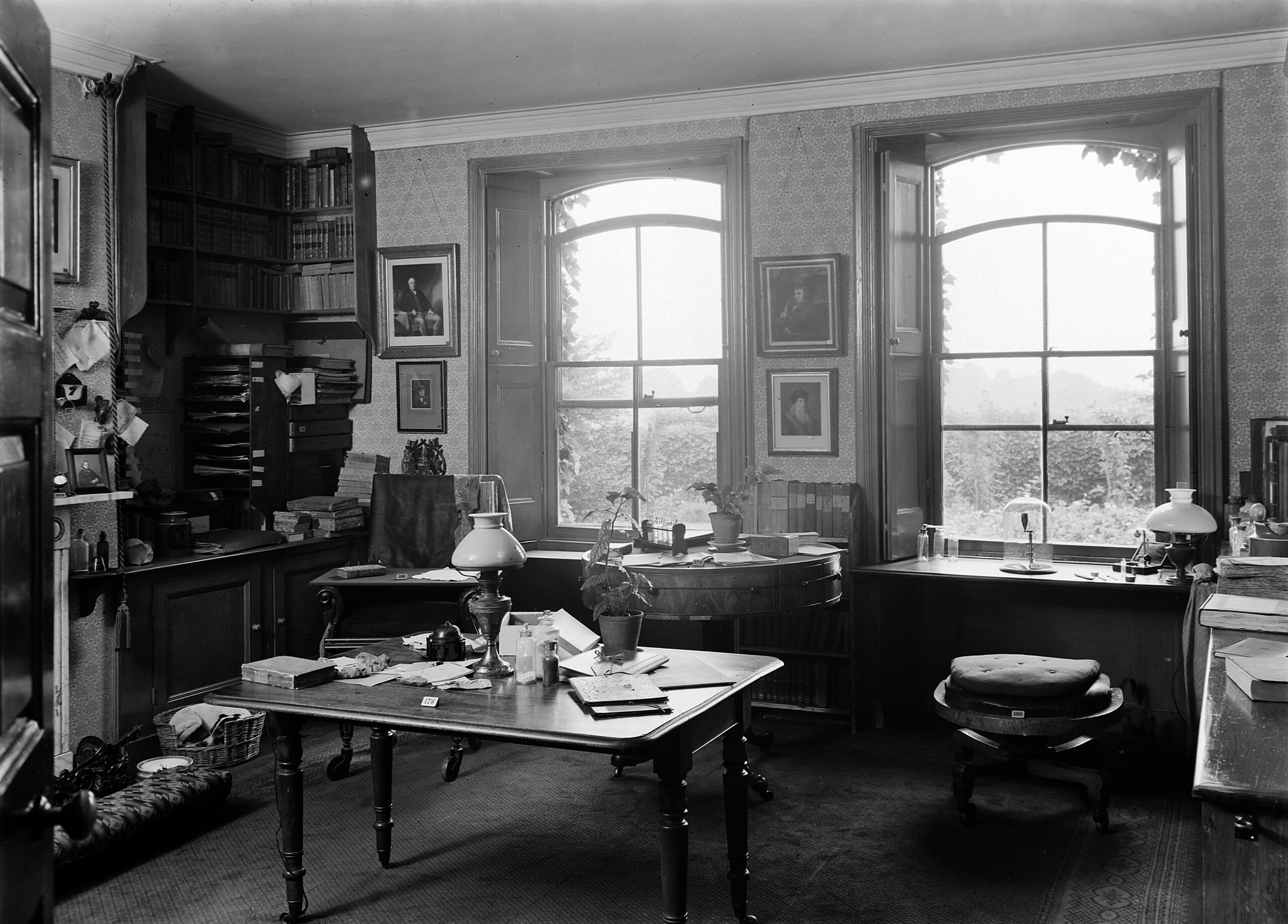
Darwin did reserve roughly four hours for work in his study. He also carried his science into correspondence, reading, greenhouse experiments and walks. His short blocks were shaped partly by years of poor health, and they were sustained by money, domestic support and control over his schedule. The achievement came not from a magical number of daily hours, but from the way intense work, lighter work and recovery accumulated across four decades at Down House.
The timetable comes from Darwin’s son
The principal source is The Life and Letters of Charles Darwin, edited by his son Francis and published in 1887, five years after Charles Darwin died.
Francis included a chapter of recollections about his father’s everyday life. It describes a settled routine at Down House in Kent during Darwin’s middle and later years, when Francis could observe him within the family home.
This makes the schedule better grounded than many stories about the private habits of famous people. It is still a son’s retrospective account, not a continuous time-use diary kept by Darwin. The language is often qualified. Darwin would “often” make his satisfied remark at noon; the routine describes what usually happened, not an inviolable rule followed through travel, illness and every stage of his career.
It also does not describe the five years Darwin spent aboard HMS Beagle, his earlier years in London or every intense period surrounding publication. The famous clock belongs mainly to life at Down, where he settled with his family in 1842 and remained until his death in 1882.
Three study blocks made a little more than four hours
Darwin rose early, partly because he found it difficult to remain in bed. After a brief outdoor turn and breakfast alone at about 7:45, he went straight to his study.
From 8 until 9:30 he completed what Francis called one of his best working periods. At 9:30 he moved to the drawing room for the post. Letters were read, followed by family correspondence and often part of a novel while he lay on a sofa.
At about 10:30, Darwin returned to the study. He worked until noon or 12:15. Francis then recorded the line that has survived every retelling: Darwin considered his day’s work over and would often say, with satisfaction, “I’ve done a good day’s work.”
He went outdoors in almost any weather. The walk usually began with a visit to the greenhouse and continued along the Sandwalk, the gravel loop around a small wood that Darwin used so regularly that it became known within the family as his thinking path.
After lunch, he read the newspaper and dealt with letters. At about 3 he rested in his bedroom, smoking a cigarette while someone read a novel or another non-scientific book aloud. He came down at 4 for another walk, then returned to the study for a third work period from about 4:30 to 5:30.
Those three formal blocks total four hours to four hours and 15 minutes. Later came another rest, a simple evening meal, two games of backgammon with his wife Emma and as much scientific reading as his strength allowed. He generally went to bed around 10:30, although discomfort and persistent thoughts often made his nights difficult.
The Darwin Correspondence Project’s hour-by-hour summary broadly follows this family account. It also makes clear that “work” changes meaning across the day.
The four-hour label leaves out part of the science
Calling only the three study periods work creates a tidy total, but it draws an artificial line through Darwin’s activities.
His letters were not the Victorian equivalent of clearing an inbox. Correspondents sent observations from farms, gardens, ships and distant countries. Breeders supplied information about variation. Botanists checked identifications. Colleagues challenged arguments, commented on manuscripts and helped gather evidence Darwin could never have collected alone.
The post could worry him precisely because it mattered. Reading and answering letters formed part of a distributed research network. Darwin’s surviving correspondence documents thousands of exchanges, many directly connected with the conception, testing and revision of his books.
Going outside could also be scientific labor. The greenhouse contained experiments. Plants, worms, pigeons and other organisms at Down became subjects of observation. His walks combined exercise with reflection, and a difficult question did not necessarily stop developing because he had left the chair.
ScienceBlog previously examined Darwin’s use of the Sandwalk and the modern evidence on walking and idea generation. That evidence does not prove a particular circuit caused a particular insight. It does help explain why separating concentrated analysis from movement need not mean that thought has stopped.
Evening scientific reading belongs in the same grey zone. Four hours is a reasonable estimate of Darwin’s protected study time. It is not a complete measure of the hours during which his scientific work advanced.
Illness made pacing necessary
Darwin experienced recurring illness for much of his adult life. Accounts describe nausea, vomiting, fatigue, headaches, palpitations, skin problems and long periods in which ordinary social activity exhausted him. Historians and doctors have proposed many diagnoses, but no retrospective explanation has settled the matter.
What is clear is that Darwin and his family organised the day around limited stamina. Francis wrote that an extra half-hour of conversation could mean a sleepless night and perhaps the loss of half the next day’s work. Resting on a sofa was not decorative leisure added to an enviable lifestyle. It helped determine whether work would remain possible.
Darwin sometimes complained in letters that illness had shortened his available hours. During one period of water-cure treatment in 1849, he wrote that he had been allowed to work two and a half hours daily and found even that as much as he could manage.
The mature timetable can therefore be read as energy management under constraint. He placed demanding work early, when he felt strongest; alternated it with letters, reading and movement; rested before the final hour; and guarded the next morning from avoidable exhaustion.
This is a different story from a healthy person effortlessly completing world-changing science before lunch. Darwin’s declaration at noon expressed satisfaction with the work his strongest hours had produced. It did not make the remainder of his day empty, and it did not erase the physical limits surrounding those hours.
The output extended far beyond Origin
On the Origin of Species, published in 1859, is the work that dominates Darwin’s reputation. It condensed more than two decades of observation, note-taking, experiments, correspondence and argument into a book that transformed the study of life.
It was only one part of the record. The Darwin Correspondence Project counts more than 20 books, many of which passed through several editions during his lifetime.
Darwin wrote about the voyage of the Beagle, coral reefs and volcanic islands. He spent years producing detailed work on living and fossil barnacles. Later books examined orchids, climbing plants, insect-eating plants, variation under domestication, human descent, emotional expression, cross- and self-fertilisation, different forms of flowers, plant movement and the formation of soil by earthworms.
A bibliography from Christ’s College, Cambridge also credits him with more than 200 articles and queries in journals and newspapers, as well as thousands of letters, diaries and notebooks. Editions complicate any simple book count, but the description “more than 20” is well supported.
This was cumulative output. A morning observation could be tested through correspondence, revisited in the greenhouse, left to mature during a walk and rewritten across several editions. The calendar rewarded continuity more than spectacle.
Rest was not the opposite of discipline
Darwin’s day alternated kinds of demand. A novel offered relief from scientific thought and often sent him to sleep. The Sandwalk provided movement and solitude. Backgammon brought competition and laughter into an evening shaped by fatigue. Letters were lighter than sustained argument, but still useful.
The rests were regular because the work was regular. Francis remembered his father caring about short fragments of available time and being willing to use a few spare minutes rather than dismissing them as too small. That attitude sits awkwardly beside the image of a gentleman casually stopping at noon.
Darwin was not idle for 20 hours and brilliant for four. He was deliberate about when to concentrate, when to change tasks and when to stop before the following day was damaged. The structure allowed the next morning’s best period to recur.
There is no controlled experiment here. We do not know how Darwin’s output would have changed under a different timetable. His routine cannot show that four hours maximises creativity or that every demanding profession should copy it.
A private timetable is not a universal prescription
Darwin possessed advantages unavailable to most workers. Family wealth gave him independence from a salaried job. Down House supplied space for a study, garden, greenhouse and experiments. Emma Darwin, their children, domestic staff, scientific friends and a vast correspondence network all helped sustain the life in which those protected hours were possible.
A teacher, nurse, laboratory technician or parent cannot necessarily redesign the day around three private blocks. Their work includes presence, coordination and care that cannot be postponed until personal energy is ideal. Comparing their hours with Darwin’s can turn privilege and illness into a standard they are then blamed for failing to meet.
The schedule offers a narrower insight. Time spent visibly at a desk is not the same as useful intellectual time. Preparation, correspondence, observation, movement, reading and recovery can support concentrated work even when they do not resemble it.
Darwin’s four-hour day was really a 40-year system. It protected a few demanding hours, surrounded them with other forms of inquiry and repeated the arrangement whenever health allowed. By noon he could truthfully feel that a good day’s work had been done. The shelf of books was built because he returned the next morning.