

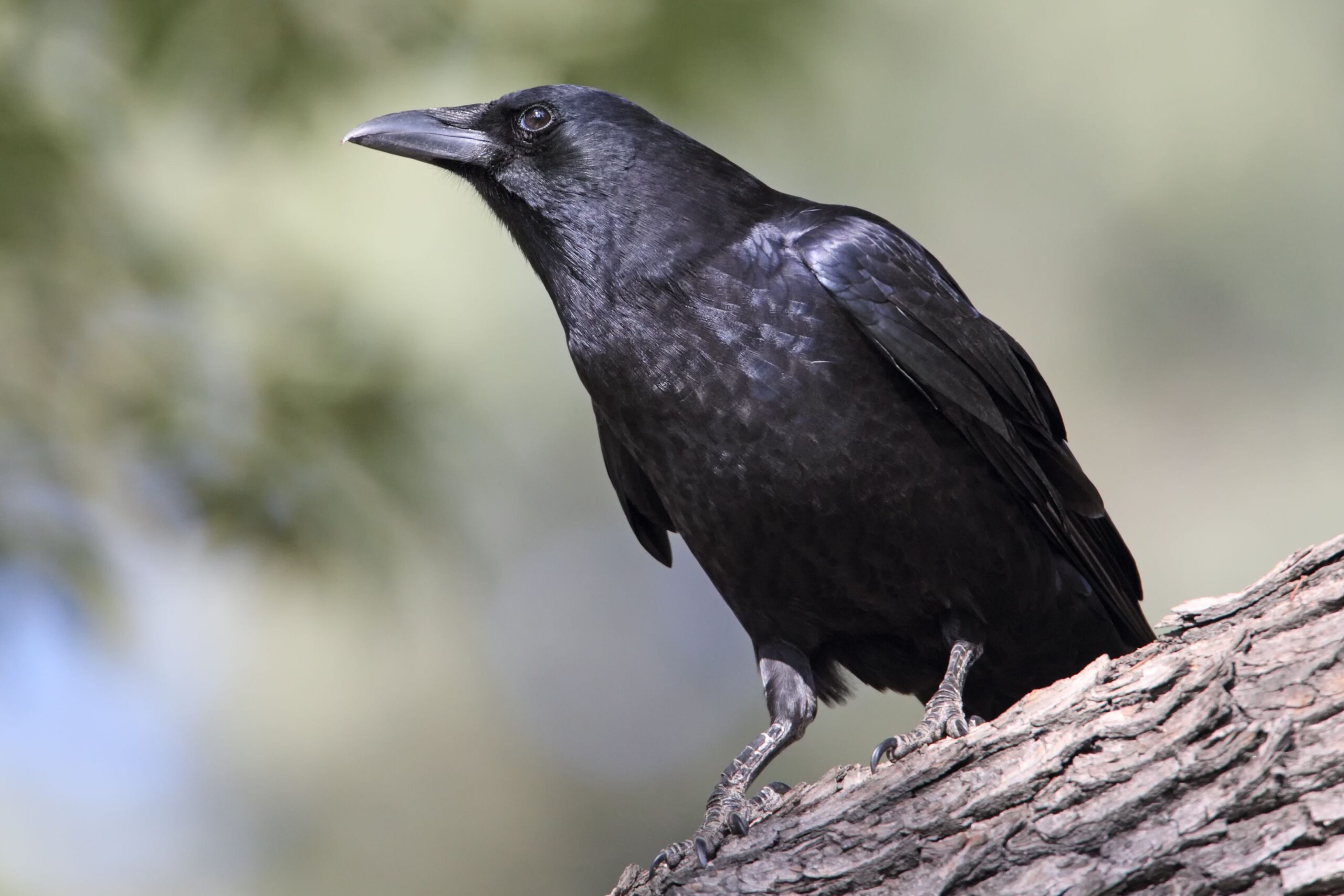
On four February mornings in 2006, a patch of lawn on the University of Washington’s Seattle campus became the centre of an unusually long experiment. A remotely triggered net caught seven American crows at four locations. Researchers fitted each bird with coloured leg bands, handled it for about 15 minutes and let it go.
Throughout the capture and banding, biologist John Marzluff and his team wore the same rubber caveman mask. To any passer-by it was a piece of fancy dress. To the birds involved, it became the face of a dangerous human.
When people later crossed campus wearing that mask, crows scolded them with harsh calls. Some followed or gathered in a mob. Without the mask, the walkers attracted little attention. A different face used as a control was also largely ignored.
The response did not remain confined to the seven banded birds. Other crows learned it, young birds joined in, and the warning spread beyond the places where the trapping had happened. It also persisted through years of turnover in the local population.
Then it ended. In September 2023, about 17 and a half years after the original captures, Marzluff walked the campus in the caveman face once again. No crow scolded him.
The mask was a controlled signal
The famous image of a scientist in a caveman mask can make the study sound almost whimsical. Its value lay in the experimental control. A mask gave the crows a human face that stayed exactly the same while the person wearing it could change.
Before the trapping, the caveman face provoked little reaction. The association formed when the crows were netted and handled. In subsequent walks, the researchers alternated the threatening mask with a neutral condition. One control was a mask made to resemble then US vice-president Dick Cheney. They also walked without a mask.
A University of Washington account published during the experiment noted the crucial contrast: people walking without the threatening mask drew the birds’ ordinary behaviour. It was the learned face, not simply a nearby researcher, that elicited the alarm.
In a broader set of tests around Seattle, different realistic masks exchanged the dangerous and neutral roles between sites. A face associated with capture at one place served as the harmless control elsewhere. That made it harder to argue that the crows simply disliked one set of features.
The crows were responding to history. They had connected a particular face with a particular unpleasant event, then retained that distinction when the face returned in other clothes and on another body.
ScienceBlog covered the early phase of the research in 2008, when the campus warning was only two years old. Even then, the finding was stronger than the familiar claim that crows are clever. These were free-living birds recognising a specific human face outside the immediate context in which they learned it.
Seven captured birds could not explain what followed
The coloured bands let the team distinguish the seven original crows from the rest. That distinction became crucial as unbanded birds began scolding the mask too.
Some of those birds could have watched the trapping. Groups of 10 to 30 crows had circled and called while the seven were being handled, creating an audience for the original event. But the reaction continued to appear in birds that could not have experienced that afternoon for themselves.
A five-year analysis published in Proceedings of the Royal Society B tracked how the knowledge moved. Crows that accompanied a knowledgeable bird during a test could later respond to the mask independently. Young birds from families that scolded also acquired the response, providing evidence for both horizontal learning among peers and vertical learning from parents to offspring.
The geographical footprint widened as well. Crows farther from the capture sites began responding, consistent with a warning moving through overlapping social networks. The researchers were not merely counting the memories of seven long-lived individuals. They were watching information propagate.
The title’s word “taught” needs one qualification. The study demonstrated social learning, not necessarily deliberate instruction in the human sense. A parent did not have to set out to give a lesson. When adults scolded and mobbed a masked walker, a young crow could notice the face, join the group and learn which person the flock treated as dangerous.
Why one warning became a campus tradition
Crow alarms are difficult to keep private. A loud scold draws attention. A mob draws more birds. Each reappearance of the mask therefore gave experienced crows a chance to demonstrate the response to birds that knew nothing about 2006.
This feedback helps explain why the warning first became stronger rather than gradually fading. In Marzluff’s later account of the full experiment, the proportion of birds reacting rose over the first seven years. Through the twelfth year, about four in ten crows encountered during the trials were still scolding the caveman face, roughly twice the response to the control.
The annual walk was not the same as the 2006 trapping. No new crows were netted under the mask. Yet an alarmed flock could renew the association socially. The warning no longer belonged solely to the original birds; it was sustained by repeated public behaviour.
This is one reason the experiment is often discussed in terms of animal culture. Culture, in its broad biological sense, does not require language, schools or conscious storytelling. It requires information or behaviour that is acquired from others and persists through social transmission. The caveman response fits that definition more comfortably than the popular idea of a 17-year personal grudge.
Recognition was more than a reflex
The field experiment showed what the birds did, but not what their brains were doing while they looked at a threatening face. Later work approached that question by presenting captured crows with familiar threatening and caring human faces while measuring brain activity.
As ScienceBlog reported in 2012, threatening faces recruited regions involved in attention, fear, decision-making and learned associations. A familiar caring face produced a different pattern. The results supported the behavioural evidence that crows were not responding indiscriminately to any human head.
Comparisons with human face processing should still be modest. Similar functional labels do not mean a crow experiences danger exactly as a person does. The firmer conclusion is that recognising an individual threat recruits an organised evaluation rather than a simple, universal panic response.
That capacity makes ecological sense. Urban crows encounter thousands of people, nearly all harmless. Treating every pedestrian as an emergency would waste time and energy. Remembering the few individuals linked to capture, aggression or other danger lets a crow be selective.
What the silent walk can and cannot tell us
By September 2023, the experiment had outlived its original participants. Marzluff wrote that the last of the seven banded crows had died about a year earlier. Whatever remained of the warning now depended on birds whose knowledge came through observation and social contact.
The result of the final trial is narrow but meaningful: during that masked walk, no crow scolded. It does not prove that every bird on campus had known the face and then erased it from memory. Nor does it reveal the precise moment when the tradition vanished.
Several processes could produce the silence. Knowledgeable birds may have died or moved away. New generations may have seen too few experienced birds react. Years in which the masked person simply walked past without trapping anyone may also have reduced the value of the alarm. In learning theory, an unrewarded association can weaken, especially once the social demonstrations that sustain it become rare.
The final walk was part of a long-running field record described retrospectively by Marzluff, not a separate peer-reviewed experiment proving a universal maximum for crow memory. Another population, another threat or repeated harmful encounters could produce a different duration.
The numbers in retellings differ slightly for a mundane reason. The birds were trapped between 8 and 12 February 2006, and the silent walk occurred in September 2023. That is roughly 17 years and seven months. Marzluff later described it in round numbers as “after eighteen years.” Both refer to the same final observation.
A memory that became larger than one brain
The deepest part of the story is not that one crow can remember one human for a long time, impressive as that is. It is that a danger learned by seven birds became knowledge available to birds born after the event.
Individual memory and social transmission did different jobs. The first preserved the association inside a bird. The second copied it into a changing flock. Together, they allowed the warning to survive the deaths of some of the animals that had direct evidence for it.
The eventual silence matters for the same reason. Animal traditions are not permanent files stored somewhere above the group. They live in acts of attention and imitation. When too few informed animals remain, or when there is no longer enough reason to repeat a behaviour, knowledge can disappear from a population even if its members remain capable learners.
A strange face, seven brief captures and years of annual walks revealed the full arc. The Seattle crows recognised a threat, spread the warning, carried it across generations and finally let it go.