

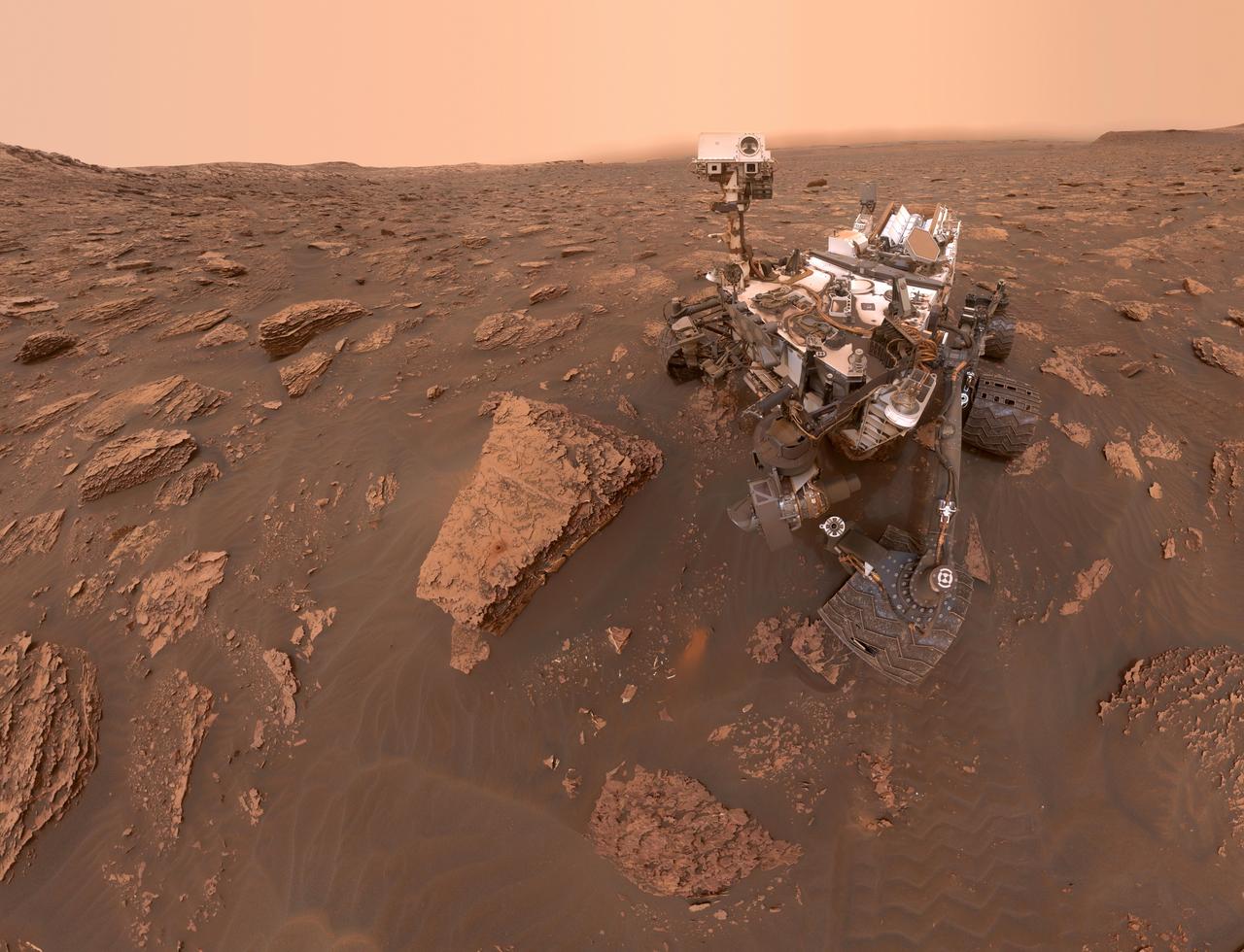
NASA’s Curiosity rover has repeatedly reported methane in the thin air immediately above Gale Crater. Most readings are tiny, but in June 2019 its Sample Analysis at Mars laboratory measured about 21 parts per billion by volume, the largest value the mission had seen.
The European-Russian ExoMars Trace Gas Orbiter has produced the opposite result. Its two atmospheric spectrometer suites have searched broad regions of Mars with exceptionally low detection limits and found no methane signal. That is a non-detection above the instruments’ reported limits, not proof that the atmosphere contains literally zero methane molecules.
The apparent contradiction cannot be reduced to one instrument being “better”. Curiosity and the orbiter sample different places, heights, times of day, and volumes of air. Those differences may explain part of the disagreement. They have not yet explained all of it.
Dozens of measurements do not mean dozens of plumes
Curiosity landed in Gale Crater in August 2012. A tunable laser spectrometer inside its Sample Analysis at Mars suite, usually shortened to SAM-TLS, draws atmospheric gas into a chamber and shines a precisely tuned infrared laser through it. Methane absorbs at characteristic wavelengths, allowing the instrument to estimate its concentration.
SAM-TLS works in two modes. A direct-intake experiment analyses Martian air largely as collected. A more sensitive enrichment procedure removes most of the carbon dioxide, which makes up about 95 percent of the atmosphere, and concentrates the trace gases left behind.
“Dozens of times” refers to individual measurement runs across this record, not dozens of 21-part-per-billion eruptions. Many runs measured a background of only a few tenths of a part per billion. Some found no statistically clear methane, and a smaller number produced elevated values.
On 24 June 2019, NASA announced the mission’s 21-part-per-billion result. A follow-up test soon afterward put the concentration back below one part per billion. Whatever produced the signal, it was brief at the rover’s location.
TGO’s “none” is a stringent upper limit
The Trace Gas Orbiter, or TGO, entered Mars orbit in 2016 and began its main science phase in 2018. Its Atmospheric Chemistry Suite and NOMAD instruments observe sunlight passing through the edge of the Martian atmosphere. Molecules leave narrow absorption patterns in that light, and the long path through the atmosphere amplifies very faint signals.
Oleg Korablev and colleagues reported the mission’s first methane results in a 2019 paper in Nature. They found no methane across observations spanning both hemispheres and placed the upper limit near 0.05 parts per billion by volume. That limit was 10 to 100 times below earlier positive detections.
The “thousand times more sensitive” comparison in the headline comes from the paper’s methods. Based on path length and spectral performance, the authors estimated that TGO’s solar-occultation observations were theoretically more than 1,000 times as sensitive as Curiosity’s direct-intake measurements. Against SAM’s enrichment mode, the stated advantage was more than thirtyfold. Sensitivity also varies with dust, altitude, geometry, and systematic error, so one ratio does not describe every observation.
TGO’s result says that methane was not detected in the atmospheric layers it could probe, at the locations and times observed, above the relevant threshold. “Absolutely none” is fair as a description of the reported detections. It is not a measurement of absolute zero.
A rover at night and an orbiter by day
Curiosity’s inlet is roughly a metre above the ground inside a 154-kilometre-wide crater. Its most sensitive methane runs have usually occurred at night, when fewer rover systems compete for power and the near-surface atmosphere is relatively still. A small local seep could accumulate in a shallow boundary layer around the rover.
TGO’s solar-occultation method requires sunlight. Dust prevents it from seeing all the way to the ground, with the lowest useful altitude often several kilometres above the surface. By day, solar heating creates convection that mixes the lower atmosphere. Methane concentrated near the ground overnight might then be diluted below the orbiter’s limit.
The Curiosity team tested this day-night proposal directly. As NASA reported in 2021, SAM made two daytime enrichment measurements around a nighttime measurement. The daytime values fell effectively to zero, while the nighttime value agreed with the previously measured background.
That result shows how both instruments could correctly describe different parts of a daily cycle. It does not close the case. Conventional photochemistry gives methane a lifetime of roughly 300 years on Mars. Gas released repeatedly near the surface should eventually mix upward and accumulate. TGO should then see at least a small global background unless another process removes or stores methane far faster than expected.
Sources are only half of the problem
Methane attracts attention because organisms make much of Earth’s supply. Biology is not the only route. Water reacting with suitable rock can generate methane without life, ancient gas could be stored underground and later released, and heat or ultraviolet radiation can process carbon-bearing material.
Before any source can be identified, researchers need confidence that the gas is present and a mechanism that explains its distribution. One proposal involves hardened salt layers in the regolith. Laboratory work summarized by NASA’s Jet Propulsion Laboratory in 2024 found that simulated Martian soil containing enough perchlorate could form a crust and trap gas beneath it. Warming or physical cracking could release a short puff.
The experiment used neon as a methane analogue, and seals formed only in samples containing 5 to 10 percent perchlorate, higher than Curiosity has measured in Gale Crater. The team proposed testing sulfate-rich material next. This is a laboratory mechanism that might organize future measurements, not evidence that such a reservoir produced the 2019 spike.
A fast sink is even harder to establish. Dust-driven electrical discharges, reactive surface minerals, and adsorption by soil have all been investigated. Any successful explanation must destroy or sequester methane quickly near the ground while remaining consistent with measurements of other atmospheric chemicals.
Even the Curiosity record remains under scrutiny
The story has already reversed once. In September 2013, Science Blog covered Curiosity’s initial upper limit after six analyses found no methane. Later enrichment measurements established the low background and episodic rises that now define the rover record.
There is some independent support. ESA’s Mars Express orbiter measured 15.5 plus or minus 2.5 parts per billion above Gale Crater on 16 June 2013, one Martian day after one of Curiosity’s early spikes. A 2019 Nature Geoscience paper reported that coincidence. Most other Mars Express observations did not produce comparable detections, however, and the independent event was not the 2019 Curiosity maximum.
In 2025, Sébastien Viscardy and colleagues published a critical reanalysis in the Journal of Geophysical Research: Planets. They questioned whether terrestrial methane retained in parts of SAM-TLS and other instrument systematics had been fully excluded. The paper does not by itself invalidate the Curiosity results, but it makes clear that measurement reliability is still an active scientific dispute rather than a settled premise.
The missing experiment is continuous and coordinated
SAM is a general chemistry laboratory, not a dedicated methane weather station. Its methane experiments are resource-intensive and occur only several times a year. TGO provides wide coverage but cannot continuously sample the first metre of air over Gale Crater. Brief releases can therefore happen between observations, and the spacecraft rarely examine the same parcel of atmosphere.
A stronger test would place dedicated methane sensors at several surface locations, operating through complete day-night and seasonal cycles while an orbiter observes above them. Measurements of wind, pressure, soil temperature, and atmospheric mixing would show whether a spike travels, disappears, or remains trapped. If enough methane were captured, carbon and hydrogen isotope ratios could help discriminate among sources, though isotope interpretation would bring its own uncertainties.
Until then, the strongest conclusion is narrower than either “Mars has methane” or “Mars has none.” Curiosity has reported local near-surface signals. TGO has set very low upper limits higher in the atmosphere. One day-night experiment shows that their sampling differences matter, but the expected centuries-long lifetime of methane says they should not matter enough. The unresolved task is to explain every part of that record before treating the gas as evidence for geology, chemistry, or life.