

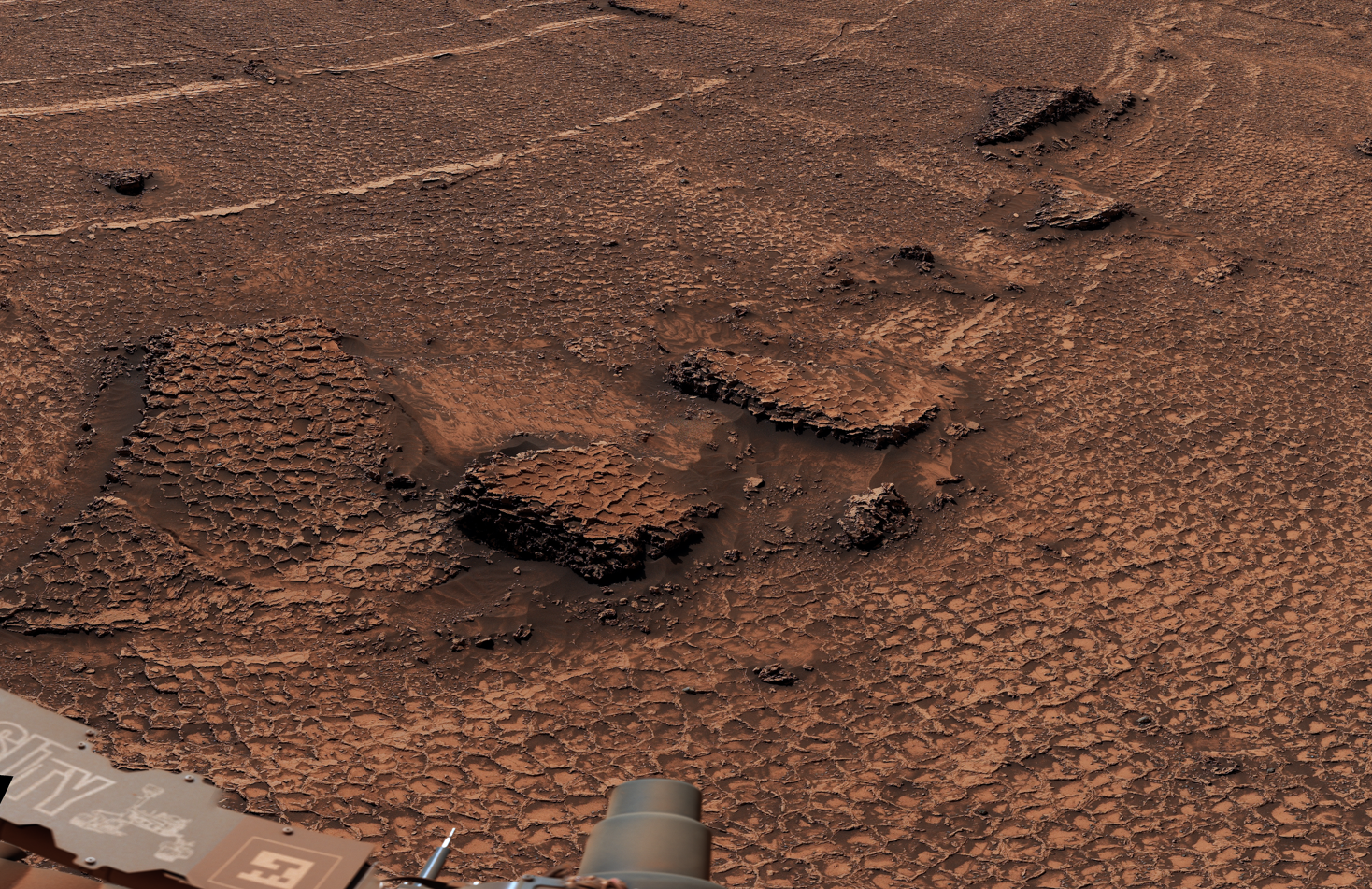
Curiosity had encountered polygonal patterns before, but the view in Valle Grande was different: the small shapes extended across the landscape. In June 2026, approaching the fourteenth anniversary of its Mars landing, the rover photographed a field of honeycomb-like fractures stretching away in every direction.
Its extent set it apart from the smaller patches Curiosity had seen before.
In its July 29 account of the discovery, NASA described individual polygons roughly 4–8 centimeters across. The textures also surrounded a nearby mound called Miraflores. Curiosity had seen smaller patches elsewhere, but NASA said it had not encountered anything comparable to this expanse.
The photographs establish that the pattern is widespread at this location. They do not yet establish which process made it.
A panorama assembled from 340 images
The JPL image catalogue dates the panorama to June 19 and 20, 2026, the rover’s 4,930th and 4,931st Martian days. Its Mastcam captured 340 individual pictures that were stitched together on Earth into a 360-degree view. A published detail, designated Figure A, makes the small polygons easier to pick out.
There is a modest difference between NASA’s published size estimates. The news account gives 4–8 centimeters, while the image caption gives roughly 5–10 centimeters. Both describe centimeter-scale features; readers should treat the range in the headline as approximate, rather than an exact measurement of every cell in the field.
The panorama’s colors were adjusted to approximate how the scene would look to human eyes under lighting on Earth. That means the published image should not be read as an unprocessed record of the color someone standing there would see.
A smooth-looking unit became a textured landscape
The surprise was already apparent in a mission planning update by researcher William Farrand, published July 1. The geological unit had appeared light-toned in orbital images and relatively smooth from earlier rover viewpoints. Driving onto it revealed the polygonal texture that those more distant views had not resolved.
Farrand also described variation within the terrain: farther into the unit, the ridges looked more eroded. That is a useful reminder that the panorama is not simply an enormous repetition of identical shapes. The condition of the boundaries changes across the ground.
The team’s observation plans targeted both the polygon ridges and their centers with close-up imaging and chemical measurements. Comparing those locations gives researchers more information than photographing the outline alone. The planning account describes intended observations, rather than announcing a completed explanation of how the field formed.
One shape can point to several processes
NASA’s discovery account leaves several possibilities open. Some polygonal cracks can develop as wet material dries. Temperature changes can also fracture ground, while compression during burial can squeeze water out of sediment and change its volume. A honeycomb-like outline, by itself, does not select among those histories.
A separate Mars investigation illustrates why the surroundings matter. In 2023, researchers using China’s Zhurong rover reported buried polygonal terrain beneath Utopia Planitia. Their radar analysis identified wedges more than 35 meters underground, which the team interpreted as products of freeze-thaw cycles.
Those buried features occur in a different region and were investigated with a different instrument. They are not confirmation of an origin for the surface textures in Valle Grande. They show why “polygon” is a description of geometry, not a complete geological diagnosis: researchers need the setting and other measurements to work back toward the process.
Earlier Curiosity mud cracks offer a comparison
There is a closer comparison from Curiosity itself. A 2023 Nature paper led by William Rapin described centimeter-scale polygonal ridges that the researchers interpreted as evidence of repeated wetting and drying on early Mars. The case involved more than a resemblance to cracked mud.
The team reported sulfate enrichment and characteristic Y-shaped junctions between ridges. Taken together, the observations supported repeated cycles affecting fresh mud, with a regularity the authors linked to sustained, possibly seasonal conditions.
That finding matters to questions about ancient Martian environments because recurring wet and dry phases are a more specific history than the simple presence of water. The study also discussed their relevance to chemistry that can join small molecules into larger ones.
It remains a study of an earlier exposure. Transferring its conclusion to Valle Grande would skip the very work the rover team is undertaking: checking whether the new terrain carries comparable evidence.
Nearly fourteen years of reading Martian rocks
Curiosity landed in Gale Crater in August 2012 to investigate whether Mars once had conditions capable of supporting microbial life. By the time of this June panorama, nearly fourteen years of exploration had placed the rover in a position to compare a newly encountered texture with features it had examined earlier.
ScienceBlog’s earlier coverage of Curiosity’s preserved organic chemistry draws a related distinction: finding ingredients relevant to life does not demonstrate that organisms were present. A patterned surface likewise needs supporting measurements before it can tell a specific story about ancient conditions.
For Valle Grande, the immediate question is geological. Close views, ridge-to-center comparisons and the field’s relationship to surrounding rocks can help test competing explanations. The panorama supplies an unusually extensive example to investigate; its repeating shapes are the starting evidence, not the finished answer.