

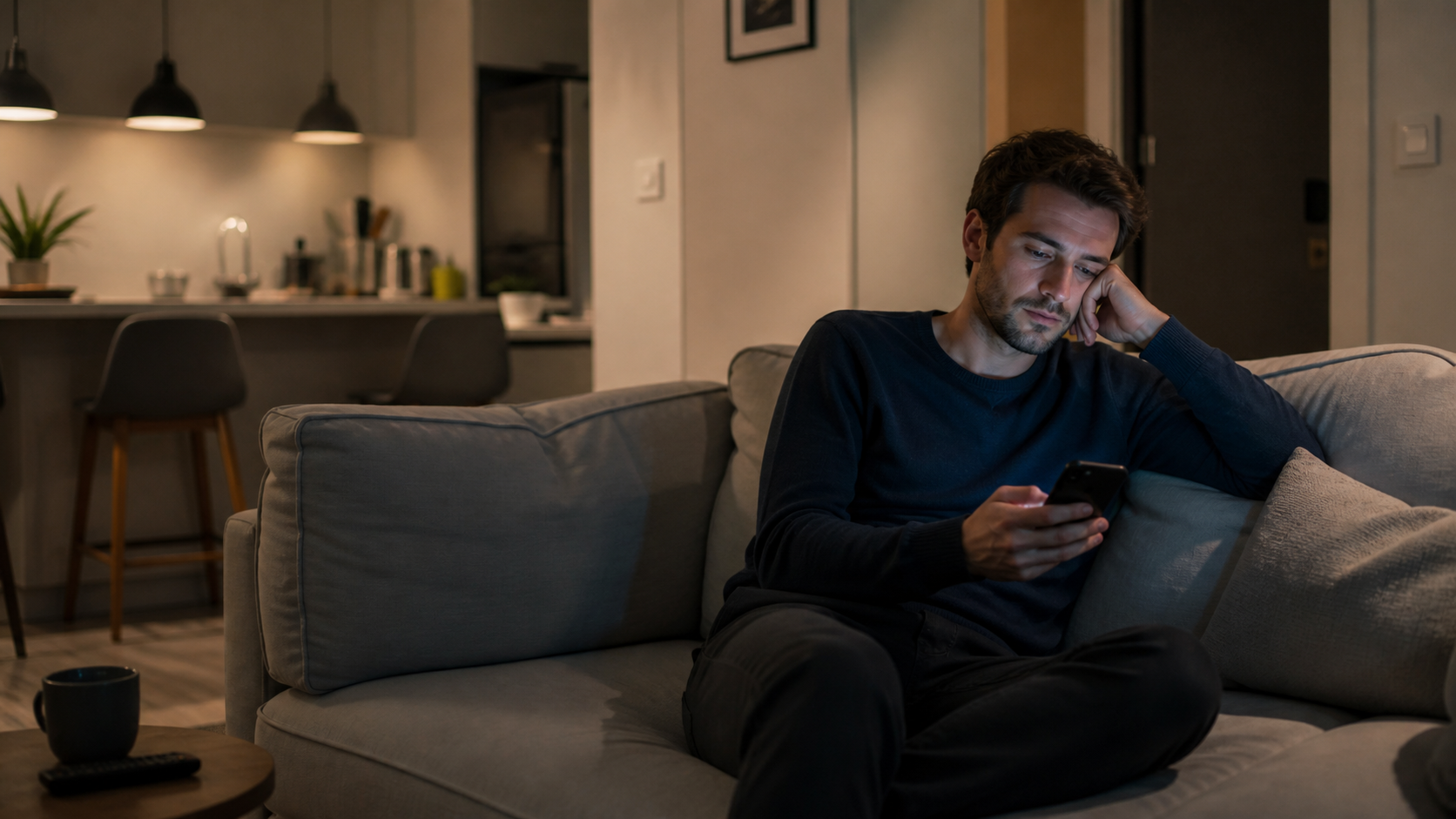
A 2024 online poll of 1,000 American dating-app users found that 78 percent felt emotionally, mentally or physically exhausted by the apps sometimes, often or always. Peer-reviewed research now points in the same general direction: burnout is common, and loneliness is closely entangled with it. But the evidence does not show that dating apps simply cause loneliness.
The 78 percent figure comes from one commercial survey, not settled consensus. More careful studies suggest a two-way problem. People who already feel lonely may be more susceptible to app burnout, while particular ways of using the apps, especially seeking approval through matches and likes, may predict greater loneliness later.
We are writers, not clinicians. What follows is a reading of the research, not mental health advice.
What the 78 percent figure actually measures
Forbes Health commissioned OnePoll to survey 1,000 US adults who had used a dating app in the previous year. Data were collected from March 27 to April 1, 2024, and the reported margin of error was plus or minus 3.1 percentage points.
Respondents were asked how often they felt emotionally, mentally or physically exhausted by dating apps. Combining the answers sometimes, often and always produced 78 percent. The figure was 80 percent among millennials, 79 percent among Gen Z, 78 percent among Gen X and 70 percent among baby boomers. Women reported burnout somewhat more often than men, 80 percent compared with 74 percent.
That is a striking prevalence estimate, but it is also a broad one. Someone who occasionally feels tired after swiping is counted alongside someone who feels exhausted every time they open an app. The survey was commissioned for editorial coverage, not published as a peer-reviewed study, and its public methodology does not provide enough detail to evaluate every possible source of sampling bias.
It tells us that fatigue is familiar. It does not tell us what caused it.
Burnout increased during a 12-week study
Liesel Sharabi of Arizona State University, Paige Von Feldt and Thao Ha followed active single dating-app users across four surveys over 12 weeks. Their study, published in New Media & Society, treated burnout as three related experiences: emotional exhaustion, a sense that using the app was ineffective and growing detachment from other users.
The researchers began with 493 participants and retained 190 through the final wave. Their growth models found that emotional exhaustion and perceived inefficacy increased over time. Loneliness, anxiety and depressive symptoms measured among participants predicted more exhaustion and inefficacy. Problematic app use also predicted greater exhaustion.
The direction matters. In this study, loneliness was a predictor of later burnout. That is different from showing that app use created loneliness. A person who turns to an app because meeting people is already difficult may face more rejection, uncertainty or repetitive interaction, then feel increasingly depleted. The app can become part of a feedback loop without being the original cause.
Attrition is another limit. More than half the initial participants did not complete all four waves. People who formed a relationship, stopped using the apps or became especially discouraged may have been more likely to leave, and each possibility would change the picture.
Loneliness depends on why and how the app is used
A separate short-term panel study, led by Anja Stevic and published in Social Media + Society, helps explain why the relationship does not fit a simple harmful-or-helpful verdict. The researchers surveyed 876 dating-app users in Germany and retained 521 one month later. They measured app-use motives, perceived success, loneliness and life satisfaction.
Using apps to seek social approval at the first survey predicted greater loneliness one month later, with a regression coefficient of 0.17. Using them to pursue a relationship did not predict later loneliness. Frequency of app use itself did not predict loneliness either. Meanwhile, people who initially felt more successful on the apps reported slightly less loneliness and greater life satisfaction at follow-up.
The study’s central result was conditional, not uniformly negative. Matches and conversations may feel connecting when they move someone towards a goal. The same interface may feel evaluative when its feedback is treated as a running score of desirability.
These were self-reports collected only a month apart. The researchers did not have logs of swipes, matches, messages or offline dates, and most participants were heterosexual. The finding is worth taking seriously, but it should not be read as the final word.
The broader evidence finds association, not cause
An earlier systematic review of 70 dating-app studies found a field dominated by cross-sectional surveys and wide variation in the questions researchers asked. Newer syntheses can describe the recurring pattern more clearly, but they inherit many of those design limits.
In 2026, Sharabi and colleagues published a preregistered meta-analysis in Computers in Human Behavior. It combined 23 studies involving 26,068 people and found that dating-app users reported modestly worse psychological health and well-being than non-users across measures that included loneliness, anxiety, depression and distress.
The authors were explicit about the main limitation: much of the underlying literature was cross-sectional. A comparison made at one point in time cannot establish whether app use affects well-being, whether people with lower well-being are more likely to use the apps or whether a third factor influences both. The studies also varied considerably in platform, sample and measurement. The meta-analysis identifies a recurring association, not a universal causal pathway.
A second 2026 meta-analysis of 27 studies and 21,263 participants similarly found small-to-moderate associations with several adverse psychological outcomes. Yet effects for general well-being were small and statistically non-significant, and the authors said longitudinal and mechanistic evidence remains limited.
Even objective measurement has produced mixed results. A one-week pilot study by Gabriel Bonilla-Zorita, Mark Griffiths and Daria Kuss tracked app use and asked 22 participants about mood, self-esteem and craving three times a day. More time on dating apps predicted craving, but notifications were associated with better mood and higher self-esteem. With only 22 people, it was designed to test a method rather than settle the question.
Dating apps also produce relationships
Calling the apps machines for loneliness ignores the people for whom they work. In a nationally recruited 2022 survey of 6,034 US adults, Pew Research Center found that one in ten partnered adults met their current partner online. Among people who had used a dating site or app, 53 percent described their experience as at least somewhat positive and 46 percent as at least somewhat negative.
Those results can coexist with burnout. A service may create many real relationships while imposing repeated evaluation and uncertainty on the larger group still searching. Success is also unevenly distributed. In the Pew survey, recent users reported frequent disappointment, while women and lesbian, gay and bisexual users were more likely to report several forms of unwanted behavior.
The apps are designed to facilitate introductions, not to treat loneliness. Their business incentives generally reward continued engagement, while an individual user’s goal may be to meet someone and leave. That tension is relevant, but the current research cannot reduce every negative experience to product design. Dating markets, safety, local demographics, relationship goals and individual circumstances all travel through the same screen.
What would clarify the feedback loop
The next useful studies need more than another one-time questionnaire. Researchers would need large, diverse samples followed for months, objective app-use logs, measures taken before people begin using an app and records of what happens after conversations move offline. Randomized tests of specific features could help distinguish the effects of endless swiping, visible match counts, notifications and limits on daily choices.
They would also need to separate app failure from app exposure. Receiving few matches, encountering harassment, wanting approval, going on disappointing dates and finding a partner are different experiences. Adding them into a single measure called use can hide the mechanism that matters.
If using an app is contributing to persistent distress or interfering with daily life, a qualified mental health professional can help assess the situation in context.
For now, the evidence supports a narrower conclusion: dating-app burnout is widespread, loneliness can make it worse, and the emotional outcome depends less on the mere presence of an app than on what happens while a person is using it.