

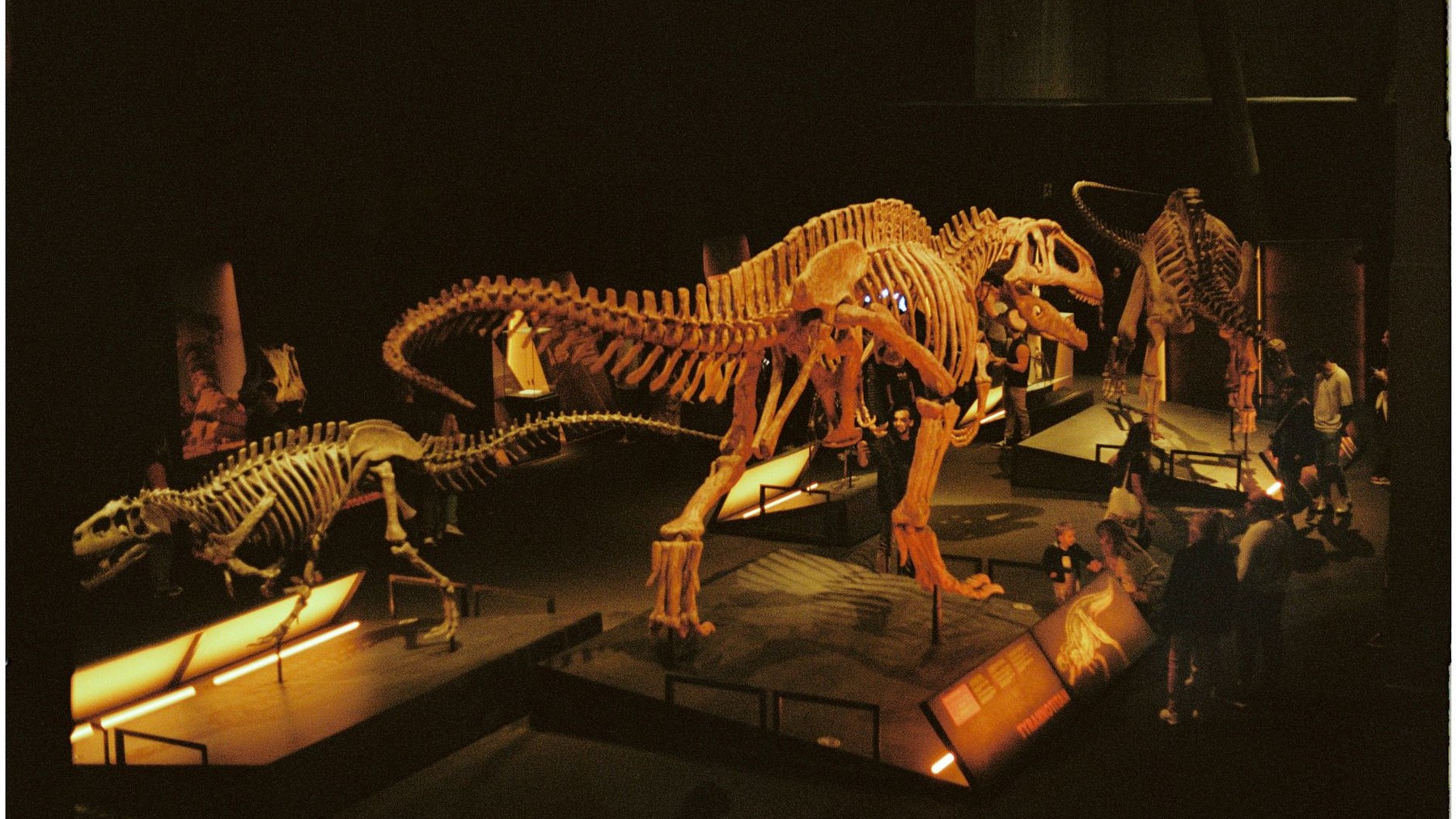
The plastic dinosaur bin has been lying to generations of children. Dimetrodon, with its low body, sharp teeth and enormous back sail, is routinely packed beside Stegosaurus and Tyrannosaurus rex. It certainly looks as if it belongs in the same prehistoric category.
Evolution does not sort animals by toy-aisle resemblance.
The oldest Dimetrodon fossils are about 294 to 295 million years old. The earliest unambiguous dinosaur fossils are roughly 233 million years old, putting about 60 million years between their first appearances in the fossil record. More importantly, Dimetrodon sits on the synapsid side of the amniote family tree, the branch that eventually produced mammals. T. rex sits on the sauropsid side, with reptiles and birds.
That makes Dimetrodon more closely related to humans than to any dinosaur. It does not make it our ancestor, an early mammal or a hairy proto-human. It means humans share a more recent common ancestor with Dimetrodon than either shares with T. rex.
The timeline puts Dimetrodon in a different world
Dimetrodon lived during the Permian Period, long before the Triassic origin of dinosaurs. Fossils assigned to the genus span roughly 294 to 271 million years ago. The Harvard Museum of Natural History describes the earliest known species, Dimetrodon milleri, as living nearly 300 million years ago. It was also among the smallest known species, growing to just under two meters long.
The oldest widely accepted dinosaurs appear around 233 to 230 million years ago. T. rex arrived much later, living near the end of the Cretaceous between about 68 and 66 million years ago. By the time T. rex walked through western North America, Dimetrodon had been gone for more than 200 million years. The time separating the two animals was roughly three times the interval separating T. rex from us.
The word “appeared” needs care. Fossils date the oldest remains found so far, not the exact birth of a lineage. A 2026 phylogenetic analysis estimated that dinosaurs may have originated between 250 and 240 million years ago, before their earliest unambiguous body fossils. That inference would narrow the gap. The title’s roughly 60-million-year comparison refers to first appearances in the accepted fossil record, not to a perfectly known evolutionary birthday.
Dimetrodon also vanished well before dinosaurs. Its youngest fossils are around 271 million years old, leaving roughly another 38 million years before the earliest unambiguous dinosaurs. The animals never met.
Family trees are about branching, not resemblance
Early amniotes split into two great lineages roughly 315 to 320 million years ago. One became Synapsida. The other became Sauropsida.
Humans, dogs, whales, bats and every other mammal are living synapsids. Dimetrodon was a much earlier non-mammalian synapsid. Dinosaurs, crocodilians, lizards and turtles sit on the sauropsid side. Birds are living dinosaurs and therefore sauropsids too.
“More closely related” has a precise meaning in evolutionary biology. Two organisms are more closely related when they share a more recent common ancestor. Dimetrodon and humans remain on the same branch after the synapsid-sauropsid split. To connect either one to T. rex, the family tree must be followed farther back past that split.
This can feel counterintuitive because time and relatedness are different things. Dimetrodon lived far closer in time to the earliest dinosaurs than to us, but evolutionary relationship is not measured by how many years separate two animals. A great-grandparent is more closely related to a descendant than to an unrelated neighbor born in the same year. The relevant question is where their branches join.
The distinction was laid out especially clearly in paleontologist Kenneth Angielczyk’s peer-reviewed paper, “Dimetrodon Is Not a Dinosaur”. The paper uses this persistent misconception to show why reading a tree is more reliable than grouping extinct animals by superficial similarity.
Dimetrodon was a relative, not our ancestor
The human connection is easy to overstate in the opposite direction. Dimetrodon was not a mammal and is not known to be a direct ancestor of mammals. It belonged to an extinct family called the sphenacodontids. Other synapsid branches, particularly therapsids that appeared later, carried the lineage toward true mammals.
The Field Museum calls animals such as Dimetrodon non-mammalian synapsids. That term is more accurate than the older label “mammal-like reptile,” which makes them sound like reptiles acquiring mammal traits. They were already on the mammal side of the deepest split, even though they lacked the defining anatomy of mammals.
“Stem mammal” is another useful term, provided it is not mistaken for “direct ancestor.” A stem group contains extinct members closer to a living group than to any other living group, while sitting outside the living group’s crown. Dimetrodon helps document the broader branch from which mammals emerged, but its own particular branch ended.
Think of it as a distant extinct cousin on the broad synapsid branch, not a missing link marching toward humans.
The skull gives away the relationship
The most useful clue lies behind the eye. Early synapsids had a single temporal opening on each side of the skull, providing space and attachment surfaces for jaw muscles. The name Synapsida refers to the bony arch associated with that opening. The same basic opening can be identified in the heavily remodeled skulls of mammals, including humans.
Sauropsid skulls followed other patterns. Dinosaurs inherited the diapsid condition, with two temporal openings behind the eye, although these openings were extensively altered or fused in many later groups. The skull does not need to look obviously human or birdlike for these structural relationships to remain readable.
Dimetrodon’s name means “two measures of teeth,” referring to teeth of different sizes and shapes rather than a row of nearly identical pegs. Its jaws included large caniniform teeth and smaller cutting teeth, a useful arrangement for a major predator. Differentiated teeth are not uniquely mammalian, but Dimetrodon sits within the fossil sequence that later records increasingly specialized synapsid jaws, teeth and chewing muscles.
That sequence eventually includes one of the more remarkable transformations in vertebrate history. Bones that helped form the jaw joint in early synapsids were progressively reduced and incorporated into the mammalian middle ear. Dimetrodon does not possess the finished mammalian arrangement, but it belongs on the side of the tree where that transformation happened.
The sail is memorable, but its job is uncertain
Dimetrodon’s sail was supported by dramatically lengthened neural spines growing from its vertebrae. It may have helped the animal absorb or shed heat. It may have served as a visual display for attracting mates, recognizing members of the same species or intimidating rivals. The American Museum of Natural History presents temperature regulation, mating display and intimidation as possibilities rather than a settled answer.
The familiar heat-exchanger explanation is appealing, especially if blood vessels ran through the sail. But a large, conspicuous structure can serve several functions, and soft tissues rarely fossilize well enough to settle the question. A thermoregulatory role and a display role are not mutually exclusive.
A sail is not a dinosaur badge. The herbivorous synapsid Edaphosaurus evolved a different sail during the Permian. Spinosaurus, an actual dinosaur, evolved its own tall-backed structure more than 150 million years later. Similar-looking structures can arise independently when unrelated animals face different versions of a physical or social problem.
Dimetrodon was also not one uniform giant. A 2026 study of two small species found different growth strategies in North American D. natalis and German D. teutonis. The familiar large museum restoration represents only part of the genus’s biological range.
Why the dinosaur mistake refuses to die
Dimetrodon has everything popular culture uses as visual shorthand for “dinosaur”: a dramatic silhouette, a large skull, sprawling limbs and an extinct predator’s teeth. It also lived so long ago that the Permian, Triassic, Jurassic and Cretaceous can collapse into one generic prehistoric scene.
Commercial categories reinforce the error. A box labeled “prehistoric synapsids and their evolutionary context” is unlikely to move many toys. A dinosaur set is instantly understood, so Dimetrodon is invited in despite arriving tens of millions of years too early and belonging to the other side of the family tree.
The mistake shows why evolutionary trees matter. Categories such as dinosaur and synapsid are not labels for appearance, size or antiquity. They are branches defined by descent. A pigeon is more closely related to T. rex than Dimetrodon was. A person is more closely related to Dimetrodon than either is to T. rex.
Dimetrodon does not become less interesting when removed from the dinosaurs. It becomes more useful. Its bones preserve an early chapter in the synapsid story, when our side of the amniote family tree included sail-backed predators ruling landscapes tens of millions of years before the first recognizable dinosaurs appeared.
It was not a dinosaur. It belonged to the much longer history that eventually made mammals possible.