

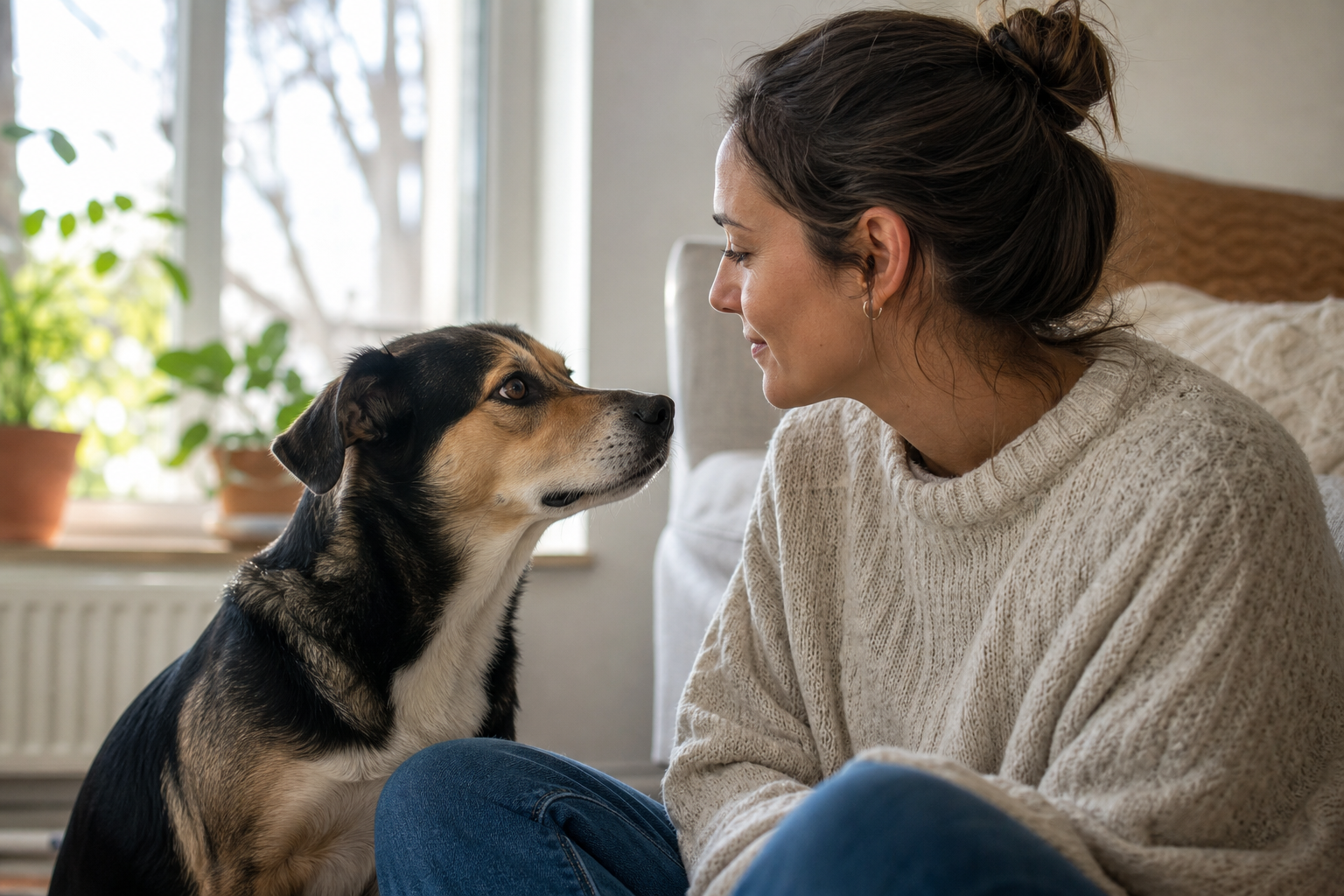
A dog looks at its owner. The owner looks back. In a widely cited experiment, the longer that gaze lasted, the more oxytocin appeared in urine samples from both members of the pair.
Oxytocin is involved in birth, lactation, social recognition and attachment. It also participates in the feedback between human mothers and infants. The dog study therefore offered a striking possibility: domestication may have allowed two species to recruit part of the same bonding system through eye contact.
That is a meaningful result. It is not evidence that a dog experiences love in precisely the same way as a human infant, or that one molecule contains the whole biology of either relationship. The researchers measured urinary oxytocin in small groups of dogs and owners. They did not measure love, and they did not directly measure oxytocin inside the brain.
This is one study, not settled consensus. Later work supports a role for oxytocin in dog-human affiliation, but it also shows that the hormone’s effects depend on sex, breed, prior experience, relationship and social context.
What the 2015 experiment actually did
Miho Nagasawa and colleagues at Azabu University published the central paper in Science in 2015. The study tested an “oxytocin-gaze positive loop” between dogs and their owners in two related experiments.
In the first, 30 dog-owner pairs spent 30 minutes interacting in a room. Owners could talk to and touch their dogs, and the researchers measured how long the dogs gazed at them. Urine samples were collected from both dogs and owners before and after the session.
The researchers divided the dogs according to gaze duration. There were 21 dogs in the long-gaze group and nine in the short-gaze group. Only owners in the long-gaze group showed a statistically significant rise in urinary oxytocin after the interaction. Dogs in that group also showed a larger change than short-gaze dogs.
Longer dog-to-owner gaze predicted more change in both the owner’s and dog’s urinary oxytocin after the researchers included talking and touching in their statistical model. Touch showed a weaker trend. This was an association inside an interaction that included several behaviours, not proof that gaze alone caused every hormonal change.
The team also tested 11 hand-raised wolves with their human caregivers. The wolves rarely gazed into the caregivers’ eyes, and gaze did not predict an oxytocin change. The comparison supported the idea that human-directed mutual gaze became unusually important during dog domestication.
It did not cleanly separate genes from experience. Pet dogs and hand-raised wolves differ in species history, rearing conditions, daily environment and the meaning eye contact carries in their social behaviour. The authors examined early human contact and argued that it did not explain their findings, but 11 wolves cannot settle the evolutionary history of the mechanism.
The second experiment tried to close the loop
An association between gaze and oxytocin could run in either direction. Affectionate interaction might increase oxytocin and make gaze more likely, or gaze might help raise oxytocin and encourage further interaction. The second experiment tried to manipulate one side of that cycle.
The researchers gave 27 dogs either intranasal oxytocin or saline on different occasions. Each dog then entered a room containing its owner and two unfamiliar people. The humans were told not to initiate touching or talking, limiting some of the cues that could blur the effect.
Female dogs given oxytocin gazed longer at their owners than they did after saline. Their owners, who received no oxytocin themselves, subsequently showed increased urinary oxytocin. The same pattern was not found in male dogs. The researchers proposed that sex differences in oxytocin and vasopressin systems, or vigilance towards strangers, might have contributed.
That sex-specific result matters. The experiment did not show that spraying oxytocin makes every dog gaze lovingly at a person. The paper itself described the sample as small and the social effects as complicated by sex and context.
Other experiments have produced related but not identical effects. A 2017 study found that intranasal oxytocin increased owner-directed gaze in ancient Japanese dog breeds, while a 2020 experiment with retrievers tested gaze during a food-learning task and found effects that depended on the measure and condition. Oxytocin is part of the system, not a universal gaze switch.
Why researchers compared dogs with mothers and infants
Mutual gaze is a major cue in early human relationships. A mother sees an infant attending to her, responds with voice, touch and facial expression, and the infant responds in turn. Oxytocin is among the systems that help coordinate maternal behaviour, stress regulation and social reward.
Earlier human work found that maternal oxytocin responses predicted mother-to-infant gaze. Nagasawa’s group did not put mothers, infants, owners and dogs through one matched experiment. They compared the structure suggested by the dog-owner results with a feedback loop already proposed in the parent-infant literature.
The similarity is therefore at the level of a component mechanism. In both relationships, gaze can act as an affiliative signal, social interaction can engage oxytocin, and that chemistry can influence further attention or care. The relationships remain biologically and psychologically different in obvious ways.
A human infant depends on a caregiver for survival and develops through pregnancy, birth, feeding and years of maturation. A dog-owner bond is interspecies, begins under highly variable circumstances and includes learning, food, touch, play, routine and shared environment. Finding oxytocin in both does not collapse them into one relationship.
Oxytocin is not a vial of love
Calling oxytocin the “love hormone” is convenient and misleading. Oxytocin is a peptide made in the hypothalamus. It acts as a hormone in the body and as a signalling molecule in the nervous system. Its effects vary with the brain circuit, receptor distribution, individual and situation.
Modern reviews describe oxytocin as helping regulate the detection, evaluation and reinforcement of social cues. Increased social attention can support affiliation in a familiar, safe interaction. In another setting, the same increased attention may sharpen vigilance, group preference or defensive behaviour.
This is why the presence of oxytocin cannot be translated directly into a feeling. It is involved in maternal care and pair bonding, but also in birth contractions, milk release, stress responses, memory and context-dependent social behaviour. Love is an experience and a relationship, not the concentration of a single chemical.
The measurement also deserves care. Nagasawa’s team measured oxytocin in urine before and after a 30-minute session. Urine offers a practical, non-invasive sample from dogs, but peripheral oxytocin is not a direct reading of moment-to-moment signalling in the brain. A systematic review and meta-analysis of endogenous oxytocin during human social interaction found substantial differences among study designs and measurement methods.
The dog experiment’s result is best read as evidence that an oxytocin-related physiological response accompanied certain owner-dog interactions. “The same brain chemical” is broadly true because the same molecule participates in both species. “The very same biology” is too broad if it implies identical neural activity, attachment or subjective emotion.
Dogs have other ways of showing attachment
Whether dogs love people cannot be decided by oxytocin alone. Behavioural research asks related but more observable questions. Does a dog seek its caregiver when uncertain? Does the person’s presence reduce stress? Does the dog prefer familiar people, return after separation and coordinate attention or action with them?
Dogs often use human faces and gaze in ways that wolves do not, particularly when seeking information or help. Work comparing dogs and wolves in an unsolvable task found that domestication and experience both shape “looking back” towards humans. Eye contact is one part of a learned and evolved communication system.
Touch and broader social interaction also affect the chemistry. A 2014 experiment reported that intranasal oxytocin increased dogs’ affiliation towards owners and dog partners, with further changes in endogenous oxytocin. That result fits a social feedback account extending beyond eye contact alone.
A 2019 review of the dog-owner literature nevertheless urged caution. It noted variation across studies and raised questions about whether oxytocin changes are specific to owners, familiar humans or positive social contact more generally. The review concluded that the dog-owner oxytocin story remained more complex than a single mutual-gaze pathway.
What the shared chemistry does tell us
The 2015 study remains important because it described a plausible route by which domestication could bridge two species. Dogs that comfortably held human gaze may have elicited more attention and care. Humans responsive to those cues may have formed stronger bonds with those dogs. Across generations and within individual relationships, behaviour and physiology could reinforce one another.
That loop need not imitate infancy in every detail to be significant. Evolution commonly reuses existing systems. A pathway involved in attachment within a species can be recruited into a relationship across species when both partners reliably exchange the right cues.
Owners also need not wait for a hormone assay to recognise a dog’s attachment. The animal’s choices, proximity, excitement at reunion, willingness to seek comfort and patterns of shared attention are evidence at the level where relationships actually happen. Oxytocin helps explain how some of those interactions may become rewarding and self-reinforcing.
So the headline contains a real biological insight wrapped in an overstatement. Dog-owner gaze can engage the same oxytocin system that participates in mother-infant bonding. That does not mean every gaze releases it, that the response is identical in every dog, or that canine love has been chemically proved.
What the research supports is subtler: humans and dogs appear able to enter a shared physiological feedback loop through social attention. The molecule is ancient. The interspecies relationship built around it is the unusual part.