
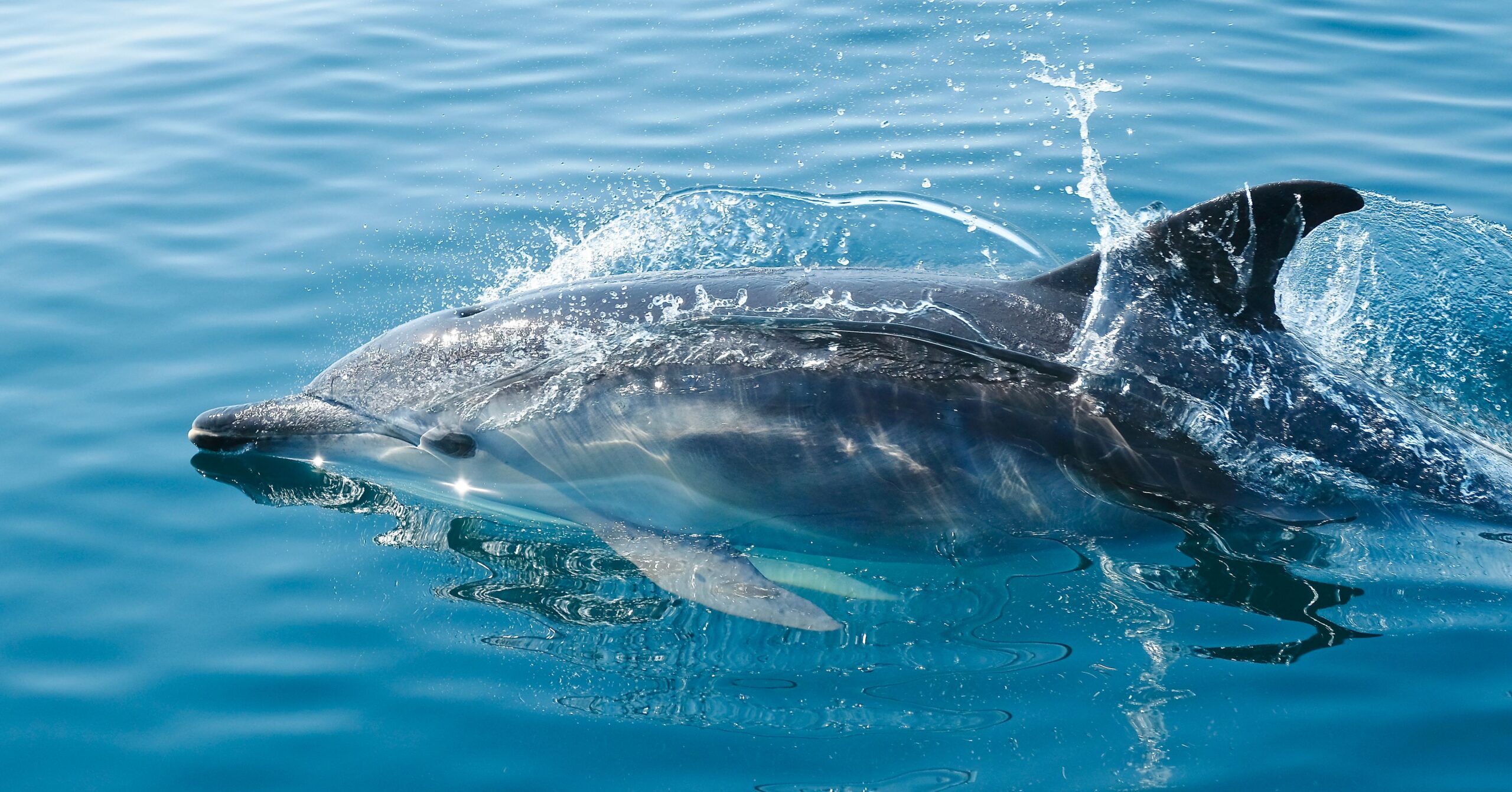
A dolphin can be asleep and awake at the same time. Electrical activity in one cerebral hemisphere slows into the large, synchronized waves associated with deep non-REM sleep, while the other hemisphere remains in a lower-voltage, more responsive state. Later, the two sides trade places.
This is unihemispheric slow-wave sleep, one of the strangest solutions evolution has produced for an air-breathing mammal that lives entirely in water. It allows dolphins to keep swimming, rise for air and retain a degree of vigilance without denying either half of the brain its turn to rest. The discovery began with an eye seen closing in 1964, but it took electrical recordings in the 1970s to show what the brain was actually doing.
Lilly began with an eye, not an EEG
In 1964, the American dolphin researcher John C. Lilly described a resting dolphin that kept one eye open while closing the other. He proposed that the open eye might continue scanning the environment while the opposite side rested. As a detailed review of cetacean sleep research recounts, Lilly had reached the possibility of one-sided sleep through behavior alone.
It was an inspired guess, but an eyelid is not an EEG. An animal may close an eye without sleeping, or sleep without displaying an obvious external sign. Lilly’s observation therefore raised a testable hypothesis rather than proving it. Researchers would need to record the electrical activity of both cerebral hemispheres simultaneously and show that the two sides could enter different states.
The history also complicates a familiar story about dolphins having to remember every breath. In 1969, physiologist James McCormick reported that dolphins sometimes floated with both eyes closed and argued that breathing could have both automatic and cortical control. Lilly had identified a genuine phenomenon, but not every explanation attached to it would survive unchanged.
EEG revealed two different brains at once
Electrophysiology supplied the decisive evidence. In the early 1970s, Soviet researchers Lev Mukhametov and Alexander Supin recorded brain activity from freely moving bottlenose dolphins. Their initial findings were published in 1975, then expanded with Irina Polyakova in a landmark 1977 Brain Research paper titled Interhemispheric asymmetry of the electroencephalographic sleep patterns in dolphins.
One hemisphere produced high-amplitude, low-frequency slow waves, a defining electrical signature of slow-wave sleep. At the same moment, the other showed lower-amplitude, faster activity closer to waking. The asymmetry could be extreme, but it was not fixed. The left and right hemispheres alternated, so neither side served as a permanent night watchman.
That alternating pattern is what makes the phrase “half a brain at a time” accurate. It does not mean half the brain simply switches off, nor that the awake side performs every task at full daytime capacity. A later review of unihemispheric and asymmetric sleep describes a range of intermediate patterns, with one hemisphere sometimes sleeping more deeply than the other rather than a perfect binary split.
Half asleep does not mean half paralysed
A resting dolphin may float quietly, move slowly or swim in a repetitive circle. It can preserve posture, coordinate its tail strokes and return to the surface. The active hemisphere and brainstem networks maintain enough sensorimotor control for life in an environment where losing orientation could be fatal.
This is not simply human sleep made 50 percent lighter. In people, the hemispheres usually move through sleep stages together. During rapid-eye-movement sleep, when vivid dreaming is common, skeletal muscles are strongly inhibited. Adult dolphins have not shown conventional, sustained REM sleep with the same unmistakable combination of cortical activation, rapid eye movements and muscle atonia. Brief twitching episodes have been observed, especially in young cetaceans, but their relationship to mammalian REM remains unsettled.
The difference helps explain how dolphins can rest while moving. Their sleep architecture is organized around continued life at sea, not around lying immobile in a protected place. Movement during unihemispheric sleep is therefore not evidence that the resting hemisphere is secretly awake. The EEG shows that genuine slow-wave sleep is occurring even while the whole animal remains mobile.
Breathing is more complicated than the popular story
Dolphins must surface to breathe, and unihemispheric sleep plainly fits that constraint. Keeping part of the brain responsive supports orientation, locomotion and timely access to air. Yet the common claim that every dolphin breath is fully voluntary, or that the awake hemisphere alone presses a mental breathing button, goes beyond what the experiments establish.
Dolphin respiration can be influenced by higher brain centers, but it also has automatic components. Researchers have observed sleeping dolphins breathing regularly and have not shown that a particular hemisphere individually orders each surfacing breath. It is safer to say that asymmetric sleep preserves the coordinated behavioral state required for breathing in water.
The wording matters because adaptation rarely has one tidy purpose. Unihemispheric sleep may help with breathing, thermoregulation, movement, group cohesion and protection at the same time. It solves a bundle of problems created by sleeping at sea rather than a single on-off respiratory problem.
The open eye can act as a lookout
Later experiments clarified the relationship between eyelids and hemispheres. In dolphins, almost all visual input from an eye crosses to the opposite hemisphere. A review of sleep and eye state in marine mammals reports that the eye opposite the sleeping hemisphere is usually closed, while the eye connected to the more active hemisphere is typically open.
The open eye is not merely decorative. When resting in groups, dolphins often aim it toward a companion, consistent with a sentinel function that helps maintain contact. Scientists have not directly watched that eye detect a predator during a measured sleep episode, so “alert” should not be taken to mean full waking awareness of everything nearby. It means that sensory access and the capacity to respond are preserved to a remarkable degree.
Hearing and echolocation broaden that vigilance. In a 2012 target-detection study, two trained bottlenose dolphins repeatedly used echolocation to monitor their environment during continuous trials lasting five days, and one completed a 15-day session with little loss of accuracy. The researchers did not record EEG simultaneously, so the study cannot assign individual responses to the awake hemisphere. It does show that dolphins can sustain monitoring across timescales that would severely impair a conventionally sleeping mammal.
What dolphin sleep teaches us
Unihemispheric sleep is not unique to dolphins. It occurs in other cetaceans, some seals sleeping in water and many birds, which can use one open eye to watch for danger. Dolphins are nevertheless the clearest mammalian example of a brain distributing sleep across space instead of putting the entire cortex into the same state at once.
Humans cannot learn the dolphin trick. Our two hemispheres may differ slightly in sleep depth, and small brain regions can show local sleep-like activity, but people do not normally keep one cerebral hemisphere awake while the other completes slow-wave sleep. Even unusual human experiments involving communication with lucid dreamers rely on a sleeping brain processing a narrow signal, not one half remaining awake.
The larger lesson is that “asleep” and “awake” are not always whole-animal labels. A dolphin can move, breathe and monitor part of its surroundings while slow waves pass through half its cortex. Lilly saw the behavioral clue in 1964. EEG recordings in the following decade revealed the deeper truth: in this animal, sleep is not a place the entire brain enters together.