

Few ideas in physics have had a stranger career than the cosmological constant. Albert Einstein introduced it in 1917 to hold the universe static, abandoned that motivation after cosmic expansion became accepted, and then watched from history as the same mathematical term became the simplest explanation for accelerating expansion.
A May 2026 analysis from the Dark Energy Survey now adds another turn. Combining several ways of measuring the universe’s expansion and growth, the collaboration found a weak preference for dark energy that changes over time rather than remaining constant. The signal reaches 3.0 standard deviations in its fullest data combination. That is intriguing, but it falls short of the five-sigma convention physicists use for a discovery.
Why Einstein added lambda in 1917
Einstein’s original field equations allowed a universe that changed. Yet the prevailing picture was a cosmos that was eternal and static. In his 1917 cosmology paper, Einstein added a term represented by the Greek letter lambda. Its repulsive effect could counter the attraction of matter and produce a delicately balanced static model.
The balance was unstable, and observations soon favored expansion. Einstein dropped the static model. The familiar story says he later called the cosmological constant his greatest blunder. That may capture his eventual distaste for the added term, but the quotation comes from physicist George Gamow’s later recollection. A historical examination of the phrase found no surviving document in which Einstein used those exact words.
The popular narrative is therefore too tidy. Einstein introduced lambda for a universe that does not describe ours, and he later regarded the independent extra term as ugly. Whether he delivered the immortal one-liner exactly as Gamow remembered it remains unresolved.
Acceleration gave the old term a second life
By the late 1920s, galaxy redshifts and theoretical work had established an expanding universe. Most physicists expected gravity to slow that expansion. Instead, two teams studying distant Type Ia supernovae found in 1997 and 1998 that the expansion had accelerated. Saul Perlmutter, Brian Schmidt and Adam Riess later shared the 2011 Nobel Prize in Physics for the discovery.
A positive cosmological constant supplied exactly the large-scale gravitational behavior the measurements required. In modern language, it can be treated as a constant energy density of empty space with negative pressure. It became lambda in the Lambda Cold Dark Matter model, or ΛCDM, alongside ordinary matter and cold dark matter.
The comeback never meant physicists understood lambda. Straightforward quantum-field estimates of vacuum energy disagree catastrophically with the tiny value inferred from cosmology. Nor does the label dark energy specify a substance. It names whatever is responsible for accelerated expansion, with a cosmological constant as the simplest candidate.
What the 2026 Dark Energy Survey analysis combined
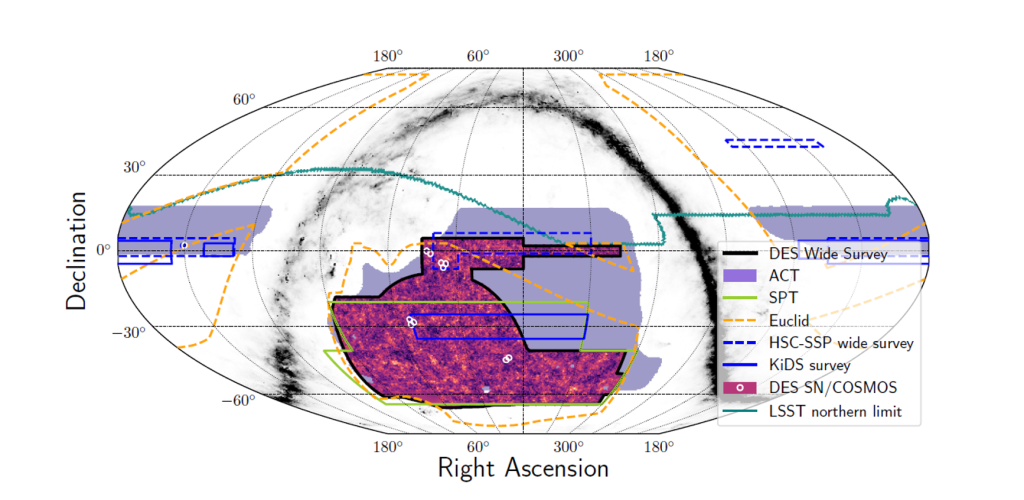
The new result is a 2026 analysis, not a set of observations first taken this year. The Dark Energy Survey used a 570-megapixel camera in Chile during 758 nights from 2013 to 2019, imaging 669 million objects across roughly one eighth of the sky. Its final program combined Type Ia supernova distances, baryon acoustic oscillations, weak gravitational lensing and galaxy clustering.
The collaboration’s dynamical-dark-energy paper, submitted in May 2026 and listed as forthcoming in Physical Review Letters, asks whether all those growth and geometry probes prefer a time-dependent equation of state. The official Year 6 results page reports the main fits and links the supporting analyses.
Each probe sees a different projection of the same history. Supernovae provide relative distances, while baryon acoustic oscillations act as a standard ruler. Galaxy clustering tracks how matter accumulated, and weak lensing measures the gravitational distortion of background galaxies. Agreement across these methods is valuable because an observational bias that affects one does not necessarily affect the others in the same way.
Scientists encode dark-energy behavior with w, the ratio of pressure to energy density. A cosmological constant has w = -1 at every epoch. The tested extension writes w(a) = w0 + wa(1-a), where a tracks the universe’s expansion. Lambda corresponds to w0 = -1 and wa = 0. Allowing both numbers to vary gives the data more freedom, but it also raises the standard for deciding whether the extra complexity is justified.
How far the result sits from a constant
Using Dark Energy Survey probes alone, the collaboration obtained w0 = -0.84 ± 0.10 and wa = -0.44, with an uncertainty of roughly 0.6. That combination sits 2.2 sigma away from a cosmological constant. Adding baryon-acoustic-oscillation distances from DESI’s second data release tightened the values to w0 = -0.84 and wa = -0.53, producing a 2.3-sigma departure.
Adding primary cosmic-microwave-background information moved the combined result to w0 = -0.82 ± 0.05 and wa = -0.63, with asymmetric uncertainty of about plus 0.21 and minus 0.18. The distance from constant dark energy became 3.0 sigma. Across combinations that omitted individual probes, the preference ranged from 2.3 to 3.2 sigma. Even without supernovae, it was 2.6 sigma, an important check against supernova calibration being the sole cause.
These numbers do not mean there is a 99.7% probability that dynamic dark energy is real. Sigma describes how surprising a result would be under assumptions about the model, data and errors. Cosmologists test many extensions and dataset combinations, so a notable local discrepancy can weaken when alternative choices and previously hidden systematics are considered.
Why the evidence is a hint, not a reversal
The result follows earlier signs. In 2025, DESI reported that its baryon acoustic oscillations alone remained consistent with ΛCDM, while combinations with microwave-background, weak-lensing and supernova measurements preferred evolving dark energy at 2.8 to 4.2 sigma depending on the supernova sample. The DESI announcement explicitly stopped short of the five-sigma discovery threshold.
The 2026 analysis matters because it adds growth information from galaxy clustering and weak lensing within a single survey, rather than simply rearranging the same distance data. Its best-fit direction agrees with the earlier pattern: w0 is greater than -1 and wa is less than zero. Yet the significance remains model-dependent, and no individual probe has overthrown lambda by itself.
That mixed verdict is familiar. A 2005 ScienceBlog report described supernova results consistent with Einstein’s constant to within about 10%. Two decades of improved measurements have made the test far sharper, but the apparent evolution still emerges mainly when complementary datasets are fitted together.
The next chapter is still being measured
If dark energy changes, lambda would cease to be the whole explanation for cosmic acceleration. Physicists might need a new field, an interaction within the dark sector, a modification of gravity or another mechanism. Different histories of w also imply different futures for the universe. The present data do not select among those possibilities.
Future evidence will come from the completed DESI survey, the Vera C. Rubin Observatory, Euclid and the Nancy Grace Roman Space Telescope. The crucial test is not merely shrinking error bars. Independent instruments must reproduce the same time-dependent pattern while controlling galaxy selection, redshift calibration, supernova brightness and the modeling of nonlinear structure.
This is one collaboration analysis, not settled consensus. The cosmological constant still anchors the standard model and fits a vast range of observations remarkably well. The 2026 result says something subtler: when the most precise maps of recent cosmic history are combined, a two-parameter evolving model fits a little better. Einstein’s once-discarded constant has not been discarded again, but its apparent simplicity is now under sustained observational pressure.