
A line of moisture on a cheek can redirect a conversation. The observer reads greater distress and may move closer, soften a response or offer help. The tear has changed the social environment around the person crying.
A new evolutionary account proposes that adult emotional tears are a paedomorphic signal: a juvenile form of communication retained and redeployed later in life. On this view, humans carried an infant distress signal into adulthood because the signal could still recruit attention, care and protection from other people.
The proposal fits a substantial body of experimental evidence, but its status matters. Researchers can measure how observers respond to tears today. They cannot watch the first emotional tears appear in human evolutionary history. The social effects are demonstrable; the route is a hypothesis.
Tears are one part of a larger crying system
Crying is not a single secretion. It can combine distress vocalisations, changes in breathing, characteristic movements around the mouth and eyes, bodily posture, subjective feeling and visible tears. Those components can separate. An adult may tear up silently, while a newborn can cry loudly with little moisture reaching the cheek.
The eye also produces tears for reasons unrelated to emotion. Basal tears maintain its surface, and reflex tears respond to irritation. Emotional tears accompany grief, pain and helplessness, but also relief, anger, joy, reunion and the feeling of being moved. They therefore cannot be translated simply as sadness.
A 2018 review of emotional tearing argued that its strongest likely function is interpersonal. Tears make a state visible to someone else and can promote prosocial responses. That differs from the popular claim that crying mainly removes stress chemicals or guarantees emotional relief. Laboratory mood findings are mixed, while the effects on observers are more consistent.
The distress call begins before the visible tear
An infant cannot fetch food, regulate temperature or move itself to safety. A high, repetitive cry reaches a caregiver beyond the infant’s limited field of view and creates pressure for somebody to investigate.
The sound is not a precise spoken code. Acoustic properties can carry information about arousal, pain, age and health, but caregivers do not decode every cause infallibly. Its most dependable message is broader: something requires attention. Responding brings an adult close enough to find out what.
Visible tears develop on a different timetable. A prospective study of 102 full-term newborns measured total, basal and emotionally stimulated tear secretion from the first six hours after birth. Total secretion reached adult-comparable values quickly, while all infants reached comparable emotional-tear values by four weeks.
Reviews commonly place conspicuous emotional tearing at roughly four to eight weeks. The developmental starting point in the headline should therefore be understood as the whole infant crying system, led initially by sound. Tears become coupled to that distress display rather than arriving as a complete visual signal at birth.
The new proposal calls adult tears paedomorphic
Benjamin Griffin, Zanna Clay, Robert Hyder-Wilson and Riadh Abed set out the new account in a 2026 Journal of Comparative Psychology paper. They call adult emotional tears paedomorphic signalling, meaning that a communicative form associated with youth persists or is reused after maturity.
The logic begins with parental investment. Humans have unusually dependent young, and the adults around them benefit from detecting need before hunger, cold, pain or separation becomes dangerous. Selection can therefore shape not only an infant’s signals but also an adult receiver’s readiness to orient, approach and protect.
The authors propose that adult tears tap into this receiver system. An adult crier temporarily presents a conspicuous cue of reduced control and need, activating responses originally organised around vulnerable young. That does not mean adults consciously imitate babies. A signal can affect an audience without being planned, and genuine emotion can coexist with a social function.
Visible tears add information that a face alone lacks
Removing tears from a photograph often leaves an expression that is harder to classify. The eyebrows and mouth may still show tension, yet the face can look concerned, puzzled or merely tired. Restoring the tear makes sadness and helplessness more legible.
A 2011 experiment compared infant, child and adult faces with tears digitally added or removed. Sixty-eight undergraduate participants rated the images. Tears increased perceived sadness and sympathy in every age group, but their added effect was largest for adult faces, intermediate for children and smallest for infants.
That pattern initially sounds awkward for an infant-origin hypothesis. It actually identifies a developmental division of labour. An infant’s open mouth, cry face and sound already provide abundant distress information, so a visible tear adds relatively little. As crying becomes less vocal with age, a silent track down the cheek can preserve the signal at close range.
ScienceBlog’s earlier account of tears as signals of vulnerability and appeasement focused on another possible advantage: tears blur vision, making attack and defence harder and thereby advertising non-threatening intent. The new paedomorphic account does not exclude that mechanism. The same tear can signal need, reduced threat and willingness to accept contact.
Across 41 countries, tears increased intentions to support
The broadest coordinated test recruited 7,007 participants across 41 countries. In the preregistered cross-cultural study, each participant rated four photographs selected from a set of 100 faces. The images appeared with or without digitally added tears.
Seeing tears produced a moderate increase in intentions to offer social support, with an effect size of d = 0.49. The statistical pathways were revealing. Observers perceived tearful people as warmer and more helpless, felt more connected to them and reported greater empathic concern. Their own personal distress did not explain the effect.
The finding was widespread, not uniform. The effect varied across countries and was moderated by the situation, whether the target was perceived as part of the observer’s group and the observer’s tendency towards empathic concern. Photographs and stated intentions also remain several steps away from deciding what to do when a real person cries nearby.
An intention to support is not guaranteed help
A rating scale can show that tears change perception without demonstrating action. A 2019 study used two economic games to move one step closer to behaviour. Two separate groups of 159 online participants watched a woman display a neutral or sad face, with or without visible tears, before deciding whether to share a small endowment.
In the trust game, where the recipient could later reciprocate, 85% of participants who saw tears shared, compared with 70% who did not. In the dictator game, where the recipient had no reciprocal choice, sharing was statistically unchanged: 67% after tears and 70% without them.
The contrast argues against an automatic compassion button. Tears affected behaviour when they could alter judgments about trustworthiness and peaceful intent, but did not create general altruism in the second task. Both experiments used one female actor, brief videos and very small financial stakes. Face-to-face care, physical protection and sustained support are larger outcomes that require direct study.
Tears may carry a chemical message as well
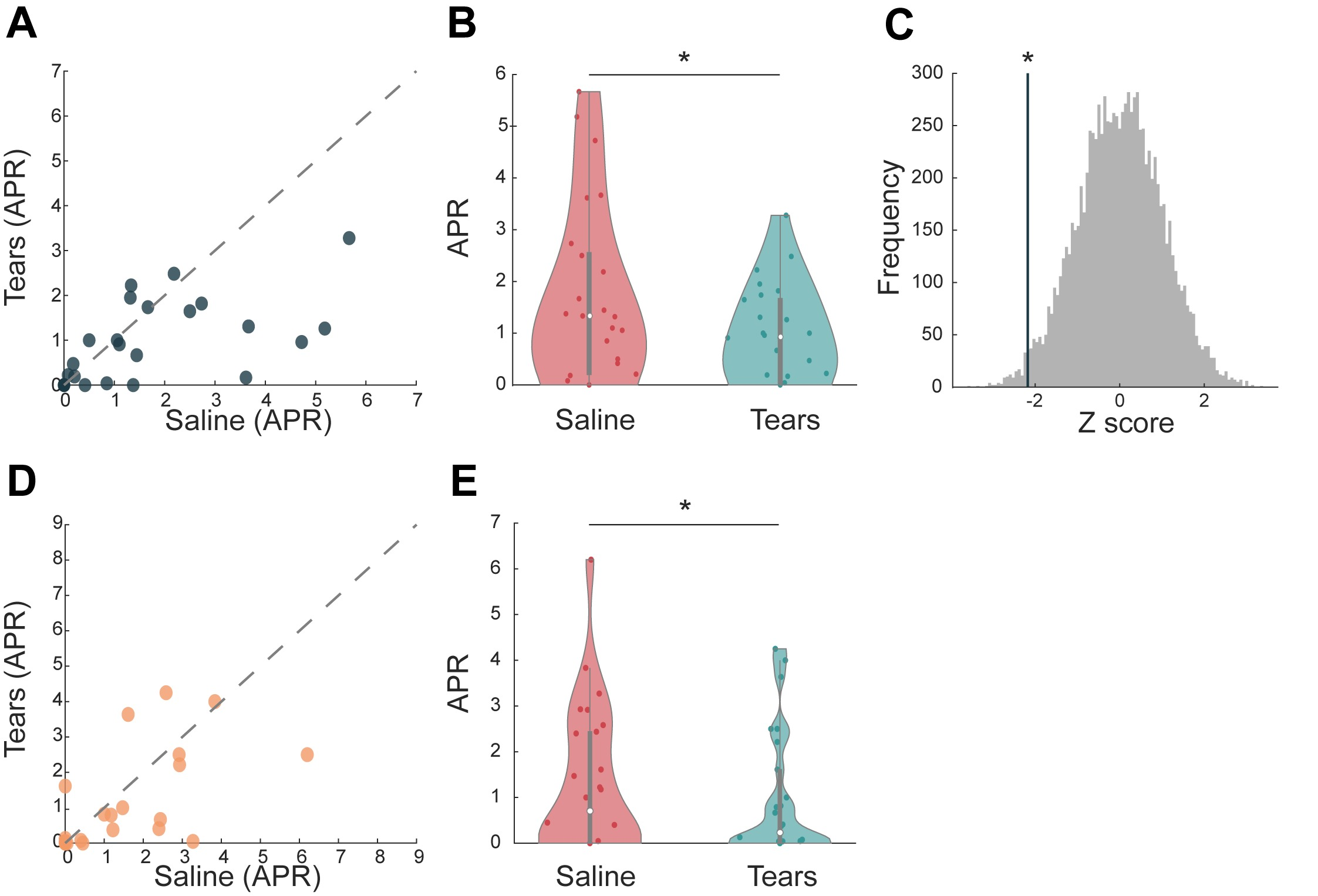
The visual channel is not the only candidate. In a 2023 PLOS Biology experiment, men sniffed emotional tears collected from six women or saline trickled down the same donors’ cheeks. Participants could not consciously distinguish the fluids by smell. While playing a game in which a fictitious opponent repeatedly took their money, however, revenge responses were 43.7% lower after exposure to tears.
The researchers applied the fluid to 62 human olfactory receptors in vitro and identified four that responded to tears in a dose-dependent manner. A brain-imaging experiment also found altered activity and connectivity in regions linking olfaction and aggression.
This is intriguing evidence for a protective chemical route, not a universal estimate of what crying does. The main behavioural test involved about 25 men, female donors and an artificial provocation task. The paper did not test tears from men or infants, responses among women, domestic conflict or ordinary consoling. Its authors explicitly described those boundaries.
Bonobos show the broader logic without shedding emotional tears
The new proposal gains comparative support from a behaviour that does not involve tears. In a study of 144 post-conflict episodes involving 27 bonobo victims, researchers recorded pouts, whimpers and tantrum-like displays that resembled signals typically used by immature animals.
Victims producing these paedomorphic signals were more likely to receive consolation from bystanders. Among adults, their use was also associated with less renewed aggression from the previous opponent. Signal production increased with audience size, and adult victims were especially likely to stop after receiving consolation.
Bonobos are not a model of a missing human ancestor, and the study was observational. It cannot show that the display caused each response or that adult bonobos calculated a strategy. It does demonstrate the wider evolutionary possibility on which the tear hypothesis rests: adult social animals can deploy juvenile-typical distress signals, and companions respond in ways that may provide care or protection.
The social effect is clearer than the evolutionary story
Several explanations can operate at once. Visible tears may magnify need, advertise reduced threat, make emotion easier to identify and alter close-range chemistry. Social learning then shapes who may cry, where crying is acceptable and whether an observer interprets tears as sincere, inappropriate or manipulative.
The evidence also does not make crying a reliable technique for obtaining care. Tears can evoke discomfort, stigma, anger or withdrawal. Responses depend on the relationship, situation, culture, age and perceived sincerity of the crier. A signal has an average effect across experiments, not control over a particular person.
The paedomorphic account turns those findings into a testable evolutionary proposal. It predicts that adult tears should activate some of the same attention and caregiving tendencies recruited by juvenile distress, while their force should change with audience, vulnerability and the availability of other signals. Direct comparisons of infant and adult responses can now probe those predictions.
Emotional tears do more than document sadness. They change what observers perceive and sometimes what observers choose to do. The evidence supports that social effect. Whether humans carried a juvenile distress signal into adult life specifically because it recruited attention, care and protection remains the compelling hypothesis still under examination.