

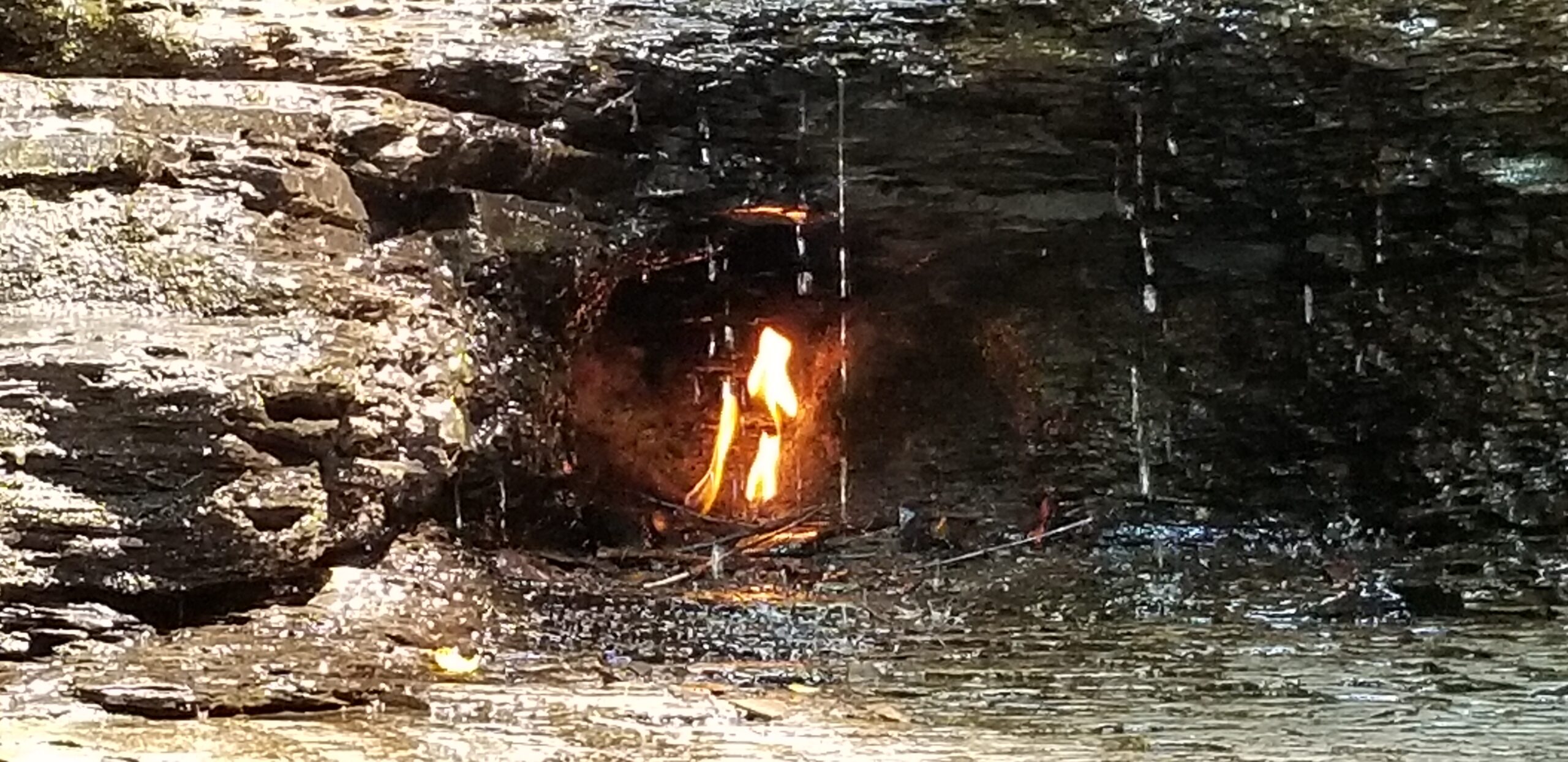
Behind a thin curtain of water in western New York, a flame flickers from a crack in dark shale. Snow can surround it in winter, spray can soak the grotto in spring, and the little waterfall above it can almost disappear during a dry summer. The gas keeps seeping.
The place is Eternal Flame Falls, in Chestnut Ridge Park south of Buffalo. Its name encourages a legend of an unbroken fire, but the literal flame is not immortal. Water and wind can extinguish it, and visitors sometimes relight it. What appears to be enduring on geological timescales is the natural supply of combustible gas rising through the rock.
When an international team sampled that gas and traced its likely origin, it found something more scientifically interesting than a fire that refuses to go out. The gas had the signature of hydrocarbons made by heat deep underground, yet the shale thought to be producing it was much less thermally mature than geologists normally expect for a productive source of natural gas.
A flame inside the waterfall
Eternal Flame Falls lies in the Shale Creek Preserve section of Chestnut Ridge Park, a landscape of wooded ravines officially described by Erie County Parks as containing one of the park’s most distinctive natural features. Water spills over a shale ledge roughly 9 metres high. Near its base, erosion has cut a small recess that shelters a gas vent and its orange flame from the strongest spray.
The fuel is not volcanic. There is no magma chamber heating the rock beneath suburban Buffalo. It is natural gas, dominated by methane but carrying unusually large amounts of the heavier hydrocarbons ethane and propane. These gases burn once ignited because their carbon and hydrogen atoms react with oxygen, releasing heat and light.
Natural oil and gas seeps occur around the world. Hydrocarbons formed or stored underground can migrate through fractures and faults until they reach the surface. Most seeps are invisible, although bubbles in water, oily films, odours or a flame can reveal them. What makes this site exceptional is the apparent combination of its direct shale source, unusual gas composition and the low thermal maturity of the source rock.
The gas carries a chemical address
Giuseppe Etiope of Italy’s National Institute of Geophysics and Volcanology worked with Agnieszka Drobniak and Arndt Schimmelmann of Indiana University to investigate the New York flame and another burning site in Pennsylvania. Their 2013 study in Marine and Petroleum Geology combined measurements of gas composition, carbon and hydrogen isotopes, regional geology and records from nearby gas wells.
The team concluded that the Chestnut Ridge seep was natural and predominantly thermogenic. That means its hydrocarbons were derived from buried organic matter altered by heat, rather than being produced recently by methane-making microorganisms near the surface. The likely source was the organic-rich Rhinestreet Shale of the Upper Devonian West Falls Group, approximately 400 metres below the park.
Faults and natural fractures appear to provide the route upward. The researchers detected many smaller, diffuse methane seeps within about 400 metres of the flame, evidence that the visible vent is one outlet in a broader leakage system. The main seep was estimated to release roughly one kilogram of methane a day.
The mixture was also remarkably “wet,” the petroleum term for natural gas rich in larger hydrocarbon molecules. Ethane and propane together made up about 35 per cent of the gas. The researchers said that may be the highest combined concentration reported from a natural gas seep at Earth’s surface. An Indiana University account of the research explains how comparison with regional well records helped connect the surface gas to the Rhinestreet formation.
Why the cool shale is a problem
Shale begins as mud containing fragments of organic material. As more sediment accumulates above it, burial raises its temperature and pressure. Over millions of years, heat breaks large organic molecules into oil and gas. Petroleum geologists refer to the range of conditions that generate oil and then gas as thermal maturity windows.
The suspected source beneath Eternal Flame Falls did not look mature enough to fit that standard story comfortably. In the researchers’ archived study record, the likely source is reported with a vitrinite reflectance value of about 0.5 per cent. Vitrinite reflectance measures how strongly particles of altered plant material reflect light and is widely used as a geological thermometer recording the maximum heating a rock has experienced. A value around 0.5 indicates relatively low maturity, near the beginning of the conventional oil-generating range and below what would normally be expected for abundant thermogenic gas.
This does not mean the researchers had no idea where the gas came from. Its molecular and isotopic fingerprints pointed to ancient organic-rich shale, and its regional match pointed specifically towards the Rhinestreet layer. The puzzle is how that comparatively cool, shallow and immature shale generated or retained a gas mixture that looks so clearly thermogenic.
One possibility is that the local burial and heating history is more complicated than a single maturity measurement captures. Another is that minerals in the shale helped catalyse reactions at lower temperatures than usual. Gas could also have migrated within connected layers before entering the fractures that carry it upward. The 2013 paper established an unusual natural system, not a final explanation of every reaction that created it.
Nature’s own fractured shale system
The site has sometimes been folded into arguments about hydraulic fracturing, but the cracks feeding the flame were not created by modern drilling. They are natural structures associated with the region’s tectonic history. The researchers described the shale as displaying “naturally fracked” characteristics because geological fractures had opened pathways for gas to escape.
A later regional study of natural gas leakage across the Appalachian Basin found that the Eternal Flame gas is isotopically related to Upper Devonian shale gases, supporting the link to organic-rich strata in the region. It also showed why each burning seep must be investigated separately. The Pennsylvania flame sampled in the original work, for example, was traced not to an untouched natural seep but probably to gas escaping from an abandoned and poorly sealed well.
That distinction matters for methane accounting. Methane is a powerful greenhouse gas, and its sources include wetlands, agriculture, fossil-fuel operations and natural geological emissions. The US Environmental Protection Agency notes that methane remains in the atmosphere for much less time than carbon dioxide but traps far more heat per unit mass over a 20-year period. One kilogram a day from a single picturesque flame is small, yet thousands of unseen microseeps can add up and complicate efforts to separate natural emissions from industrial leakage.
The enduring part is the seep
Available historical accounts suggest that people have known about burning gas in this landscape for a long time, and the study’s authors wrote that the seep may have supported a flame for hundreds or even thousands of years. That is an inference from a persistent geological system, not a continuous eyewitness record. The fire can go out when the grotto is flooded or the gas flow is disrupted.
The more accurate wonder is therefore not that one tongue of fire has survived every storm. It is that a fracture in Devonian shale keeps delivering fuel to the same sheltered opening, and that the fuel records an unexpectedly complicated history of heat, organic matter and rock.
Eternal Flame Falls looks like a contradiction between water and fire. Its deeper contradiction is geological. The researchers could identify the likely source hundreds of metres below, measure the methane, ethane and propane, and map the fractures that let the gas escape. Yet the shale’s low thermal maturity showed that the familiar recipe for making natural gas was not enough on its own to explain what they found.