

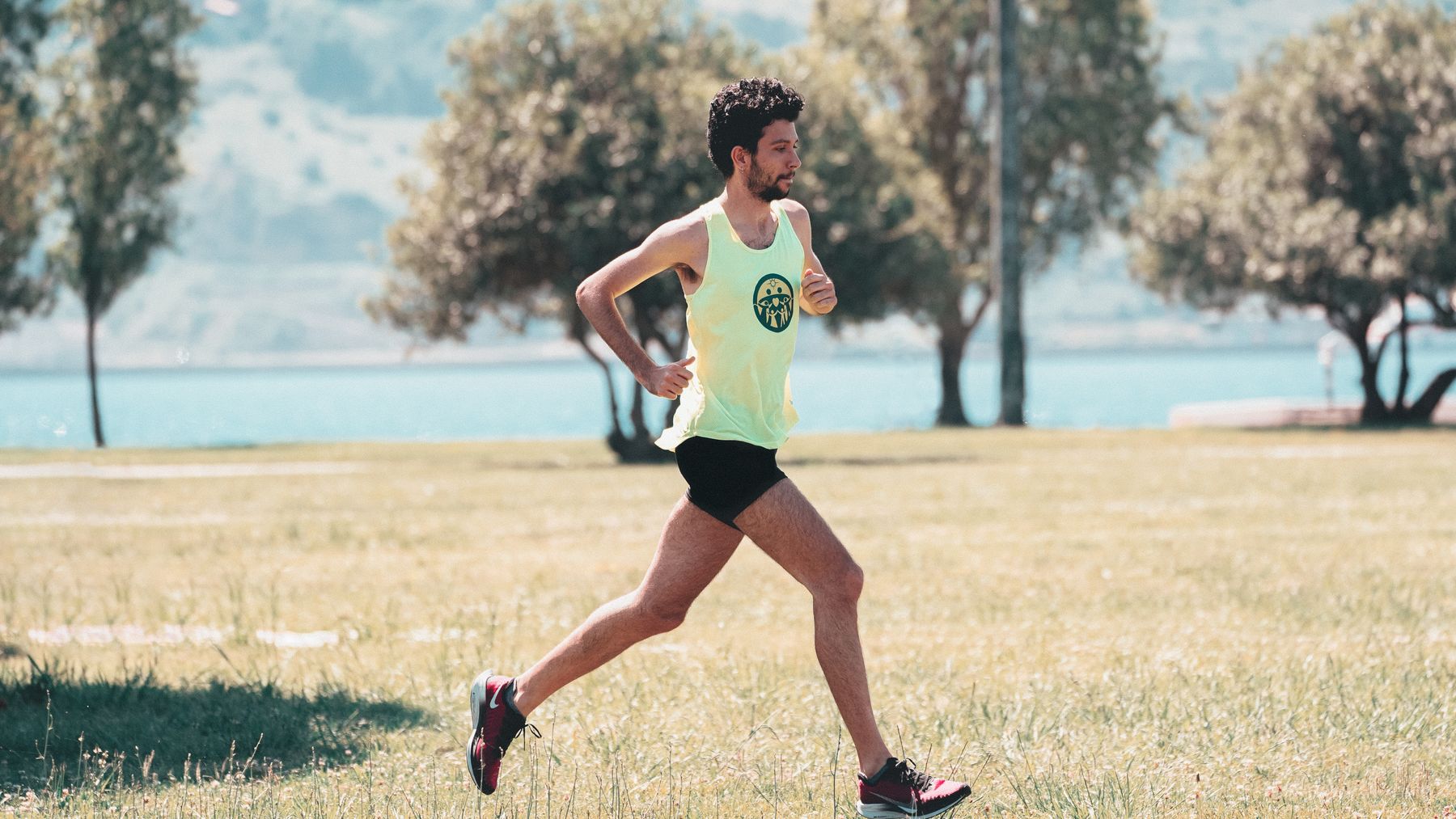
“Burning more fat” sounds as if it must mean “losing more body fat.” In exercise physiology, those statements describe different scales of time.
A small experiment published in 2025 found that young men running before breakfast derived more of their energy from fat than they did when running after breakfast. Their total energy expenditure was similar. Even in the fasted condition, carbohydrates still supplied part of the fuel.
The result is a useful measurement of what happened during and shortly after a controlled run. It is not evidence that a month of pre-breakfast running would remove more body fat than the same training performed after eating.
That distinction sounds fussy until “fat burning” becomes weight-loss advice. The body changes its fuel mixture from minute to minute. Body composition reflects what is stored and spent across days, months and all the meals and movements between workouts.
The same 18 men completed five test conditions
Hao Lan, Kaibin Wu, Chunyun Deng and Songtao Wang conducted the study at South China Normal University. Their open-access paper appeared in Frontiers in Physiology on 23 April 2025.
The participants were 18 healthy male college students. The paper’s abstract and demographic table give their average age as 23.47 years. An inconsistency worth noting is that the main methods text instead says 21.3 years. Either figure describes a very young, narrow sample.
The experiment used a randomized crossover design. Rather than assigning separate groups to different routines, every participant completed all five conditions: a sedentary control day, exercise before breakfast, exercise after breakfast, exercise before dinner and exercise after dinner. At least three days separated the trials.
That arrangement is valuable in a small study. Each man serves as his own comparison, reducing the chance that an inherently efficient fat oxidiser happens to populate one group while a strong carbohydrate user ends up in another.
The run was moderate, standardised and precisely timed
Before the main experiment, the researchers measured each participant’s maximum oxygen uptake using an incremental treadmill test. The later running speed could then be set relative to the individual’s capacity rather than using one pace for everyone.
Each exercise session lasted 50 minutes: a five-minute warm-up at 40 percent of maximal oxygen uptake, 40 minutes at 65 percent and a five-minute cool-down back at 40 percent. Running distance was standardised and energy values were adjusted for body weight.
The pre-breakfast session ran from 6:50 to 7:40 am. Breakfast was scheduled for 8:10 am. The post-breakfast session began at 9 am, making it both a fed run and a run performed more than two hours later.
The afternoon condition began at 3:40 pm, before the 5 pm dinner. The final running condition began at 6 pm, after dinner. The design therefore examined feeding state and time of day together, not breakfast alone.
The researchers also tried to reduce avoidable noise. Participants kept a two-day dietary record to guide standardised meals, avoided caffeine and alcohol, followed scheduled hydration and remained sedentary outside the exercise periods during testing.
The fuel estimate came from oxygen and carbon dioxide
A portable COSMED K5 metabolic system measured oxygen consumption and carbon dioxide production. Standard stoichiometric equations convert those respiratory gases into estimates of carbohydrate oxidation, fat oxidation and total energy expenditure.
The logic rests on chemistry. Oxidising fat and oxidising carbohydrate consume oxygen and produce carbon dioxide in different proportions. A respiratory quotient closer to 0.7 indicates a greater contribution from fat; a value closer to 1.0 indicates a greater contribution from carbohydrate.
This is an established form of indirect calorimetry, but the word “indirect” matters. The device did not watch stored fat disappear from a participant’s waist or determine which fat deposit supplied a molecule. It estimated whole-body substrate use from breath.
Measurements covered the run, short samples during each hour of a four-hour recovery period and a ten-minute measurement the following morning. A technical limitation prevented the researchers from analysing energy expenditure during sleep.
Before breakfast, the same calorie cost used a different fuel mix
During exercise, the before-breakfast condition produced significantly greater fat expenditure than the after-breakfast condition. It was also higher than both evening exercise conditions. Carbohydrate expenditure moved in the opposite direction.
The total calorie cost remained comparable across conditions. There is no contradiction. Imagine paying the same bill with a different mixture of coins and notes: the composition changes while the total does not.
Nor did the participants switch to an all-fat engine. The published figures show contributions from both fat and carbohydrate in every running condition. “More fat” describes a relative change in the mixture, not the disappearance of glucose or glycogen from exercise metabolism.
The pattern continued into recovery, although not identically across every comparison. The pre-breakfast condition retained higher fat use over the next four hours than the before- and after-dinner conditions. The next morning, exercise performed after dinner was associated with higher fat oxidation than the after-breakfast condition, suggesting timing effects were not limited to the fasted run.
An earlier meta-analysis of 27 studies and 273 participants also found greater fat oxidation during fasted aerobic exercise. The 2025 trial therefore adds a carefully timed crossover example to a pattern already seen in acute experiments.
Lower insulin probably helped, but the study did not measure it
After an overnight fast, insulin is generally lower than it is after breakfast. Lower insulin permits more fatty acids to be released from fat tissue, while eating raises insulin and provides fresh carbohydrate. Overnight fasting can also reduce available liver glycogen, encouraging the body to lean further toward fat.
That is a plausible explanation for the observed fuel shift. It was not demonstrated inside this experiment. The researchers did not take blood samples for insulin, glucose, free fatty acids or other metabolic signals.
The breakfast and clock-time effects are also entangled. One run occurred at 6:50 am without food; the other at 9 am after food. A design that gave participants breakfast or a placebo at the same clock time would isolate feeding state more cleanly, although blinding a meal is not simple.
Circadian biology could contribute independently. Metabolism, body temperature, hormones and exercise performance vary across the day. The paper was designed to explore that wider timing question, which is why it included four exercise windows rather than only a fasted-fed morning comparison.
Using body fat now does not guarantee losing more of it later
Fat oxidation is a flow. Body-fat loss is a change in the size of a store. A person can draw more from that store during a run and replenish it later through food. They can also burn a carbohydrate-heavy mixture during exercise and draw more heavily on fat at another point in the day.
ScienceBlog previously explained that when stored fat is oxidised, most of its mass eventually leaves as carbon dioxide, with the remainder becoming water. But that chemistry does not mean breathing harder causes fat loss. In the same way, measuring more fat in the fuel mixture during one workout does not settle the body’s longer balance.
A systematic review focused on the longer question found minimal changes in body mass and composition in both fasted and fed aerobic-training groups, with no clear advantage for overnight-fasted exercise. Its evidence base was limited, so this is not the final word either. It does show why acute oxidation and long-term composition need separate studies.
Over weeks, food intake, exercise adherence, workout quality and compensatory movement all matter. If skipping breakfast makes one runner cut a session short, the laboratory fuel advantage may disappear. If another person finds early fasted running comfortable and therefore trains consistently, timing may matter indirectly through adherence.
The study is narrow even before the weight-loss question
Eighteen men can reveal a physiological signal in a crossover experiment, but they cannot represent the whole population. The paper’s participants were young, healthy male students with regular sleep schedules and no metabolic disorders. The result cannot simply be assumed for women, older adults, highly trained endurance athletes or people with diabetes.
The researchers tested one moderate treadmill protocol. High-intensity intervals, very long endurance sessions, walking and resistance exercise place different demands on glycogen and may respond differently to pre-exercise food.
The observation window was also brief. There was no training programme, no assignment to weeks of fasted or fed running, and no measurement of changing body composition. The authors explicitly describe their observations as preliminary and call for longer follow-up.
Performance was not the central outcome. Food before prolonged or demanding exercise can support intensity and endurance in ways that an acute fat-oxidation calculation does not capture. The “best” timing therefore depends on the question being asked.
A clean acute result with a deliberately modest conclusion
For the experiment’s precise question, the answer is fairly clear. When these 18 young men ran before breakfast, their bodies used significantly more fat and less carbohydrate than when they ran after breakfast, while spending a similar total amount of energy.
The mechanism is plausible but unconfirmed. Overnight fasting and lower insulin probably helped shift the mixture, while clock time may also have played a part. Both fat and carbohydrate remained active fuels.
What the experiment cannot answer is the question most likely to attract attention: whether routinely running before breakfast produces greater fat loss. Showing that would require repeated training, controlled or carefully tracked diets and direct body-composition measurements over weeks or months.
The body’s fuel gauge moved during one morning run. The size of its long-term fuel store was never tested.