

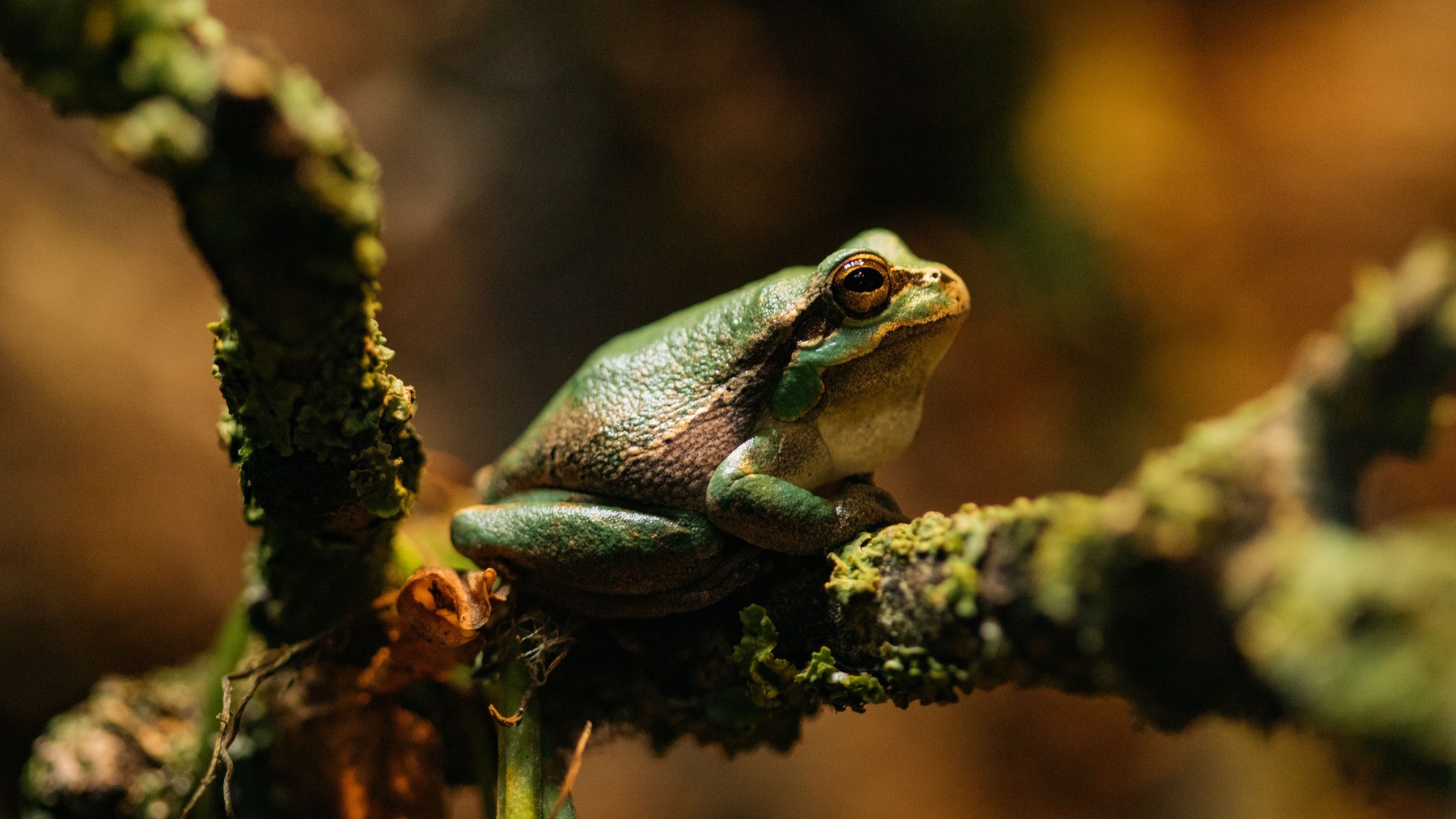
On a warm breeding night, a pond full of calling male treefrogs sounds like abundance. Each voice advertises a possible mate. Yet for a female listening from the edge, adding voices may not improve the odds of finding the one she prefers.
In a study published in iScience on August 12, 2026, female Cope’s gray treefrogs became slower, less accurate and somewhat more likely to make no choice as the number of recorded male calls increased. The researchers interpret the combined pattern as choice overload.
The phrase invites an easy comparison with a screen full of dating profiles. That analogy is useful only up to a point. The experiment involved 60 frogs, loudspeakers and one acoustic trait under controlled conditions. It did not test people, apps or whether more options are generally harmful.
A two-meter dating arena for frogs
Researchers led by Claire Hemingway of the University of Tennessee and the Smithsonian Tropical Research Institute collected female Cope’s gray treefrogs around ponds near Knoxville. The species, Dryophytes chrysoscelis, breeds in choruses in which males advertise with repeated trilling calls and females approach a chosen caller.
Inside a soundproof, temperature-controlled room, the team placed each female at the center of a circular arena about two meters across. Speakers around its edge represented prospective mates. This movement toward a sound source is called phonotaxis, and it gives researchers a visible measure of which call a female follows.
Every trial included one relatively long target call. Cope’s gray treefrog females have a well-established preference for longer calls, which require males to invest more effort. The other calls were much shorter distractors. Females encountered sets of two, four or eight calls: one target accompanied by one, three or seven distractors.
The calls were arranged so the alternatives could be heard without simply piling all their acoustic energy on top of one another. That design mattered because the study was asking whether the number of choices itself could impair a decision.
Accuracy fell while decisions took longer
With two calls available, females pursued a mate in 97 percent of trials. With eight calls, they did so in 82 percent. Put another way, failure to commit rose from about 3 percent to about 18 percent as the choice set grew.
Among the trials in which a frog moved toward a speaker, the expression of the familiar long-call preference also weakened. Females selected the target in 76 percent of the two-call trials but only 25 percent of the eight-call trials.
They took longer as well. Average time to reach a chosen speaker increased from 114 seconds with two options to 183 seconds with eight. The larger set therefore affected three related outcomes: whether a choice happened, which option was selected and how long commitment required.
One arithmetic caution belongs beside those percentages. The single target represented half the available calls in a two-option trial but only one-eighth in an eight-option trial. The raw decline to 25 percent is not meaningful by itself. Its value comes from the experimental models and from its alignment with longer decision times and more deferred choices.
The chorus was more than a wall of noise
Frog communication researchers already knew that crowded choruses cause an acoustic problem called energetic masking. When calls overlap in time and frequency, the sound energy from one caller can obscure another, much as conversation becomes harder to hear in a crowded room.
Choice overload is a different proposed bottleneck. The alternatives remain available, but comparing, remembering and selecting among them taxes the receiver’s information processing. One problem concerns whether a signal reaches the animal clearly; the other concerns what the animal can do with multiple signals.
To separate them, the researchers repeated the choice experiment with overlapping chorus sound delivered from an overhead speaker. Performance still worsened as the number of options increased, with or without that background. The added noise did not explain away the set-size effect.
That does not mean noise is irrelevant in a real pond. Natural callers vary in position, timing and loudness, and their calls often overlap. Masking and choice overload can operate together outside the laboratory. The experiment’s narrower conclusion is that acoustic masking was not necessary to produce the observed decline.
A preference can survive while selectivity weakens
Saying that the females became less selective does not mean their underlying attraction to long calls disappeared. Preference and expressed choice are not the same thing. An animal may value one signal more highly yet fail to locate it, compare it effectively or commit before the trial ends.
The distinction matters because biologists often measure preferences in clean two-option tests, then use those results to reason about sexual selection. A real chorus may confront a female with dozens of unevenly spaced callers. If her decision system cannot express the laboratory preference under those conditions, the evolutionary pressure on male signals will be weaker or less predictable than the simple test implies.
Earlier work showed how the calls of closely related gray treefrog species help females choose males with matching chromosome numbers. That result illustrates how much biological information a frog must extract from a trill. The new study adds a constraint: recognition and preference have to operate inside a crowded acoustic scene, not one isolated comparison at a time.
Why shorter-calling males may remain
Longer calling is costly for a male, but females generally find it attractive. In a simplified account of sexual selection, persistent female preference should favor longer callers and gradually make short calls rarer.
Short-calling males have not disappeared. Choice overload offers one possible reason. When many males call, a female may follow a less-preferred signal or make no choice before conditions change. Enough such decisions could allow a wider range of call traits to contribute to the next generation.
The experiment did not follow offspring, measure male reproductive success in natural ponds or document call evolution across generations. It identified a behavioral mechanism that could help maintain variation. Calling it an evolutionary explanation remains a hypothesis until field and population data connect the steps.
Delay could carry costs for females too. More time moving around a breeding pond may mean greater exposure to predators or a lost mating opportunity. Those risks are biologically plausible, but this study did not measure predation or lifetime reproductive success.
The human comparison is tempting but unsettled
Dating apps make the metaphor almost unavoidable. Both a phone screen and a frog chorus can present more alternatives than a chooser can examine deeply. Neither setting guarantees that a larger pool produces a better final decision.
But the treefrog experiment is not evidence that apps cause indecision in people. Human mate choice includes language, identity, memory, culture, algorithms and relationships extending far beyond an acoustic approach task. Frogs selecting among call durations do not model all of that.
Even the broader human choice-overload literature resists a universal rule. A meta-analysis of 50 published and unpublished experiments found an average adverse effect close to zero, alongside considerable variation between studies. Whether overload appears may depend on factors such as time pressure, task difficulty, similarity among options and the chooser’s existing preferences.
The dating-app line should therefore be read as a bridge, not a finding. The frogs show that an animal with a small brain can face a genuine tradeoff between more opportunity and more information to process. They do not prove that every large menu of human choices is paralyzing.
What one controlled study can establish
This was a controlled experiment in one species using recorded calls as stand-ins for males. That control helped distinguish the number of alternatives from acoustic masking, but it also removed the irregularity of a living chorus. Males move, call at different rates, fall silent and interact. Females may enter the pond with experience or use cues that loudspeakers cannot provide.
The sample of 60 females and repeated trials provides evidence for this species under these conditions, not a general law of animal decision-making. Similar tests in other frogs, insects, birds and mammals will be needed to learn when choice overload emerges and which nervous systems or environments resist it.
There are useful leads beyond frogs. A 2022 experiment with female Pacific field crickets found that their response and preference weakened as the number of calling males grew, although that design could not fully separate choice overload from acoustic interference. A 2025 review of choice overload in non-human animals argued that such cases deserve study as cognitive limits in their own right. The treefrog experiment advances that program by manipulating chorus noise separately from the number of alternatives.
The study nevertheless exposes a useful gap between having a preference and being able to use it. With two calls, Cope’s gray treefrogs usually found the long target quickly. With eight, more females hesitated, declined to choose or followed a shorter call.
More potential mates expanded the opportunity set while making the decision harder. Long before anyone could swipe through a screen, a crowded pond had already created that paradox.